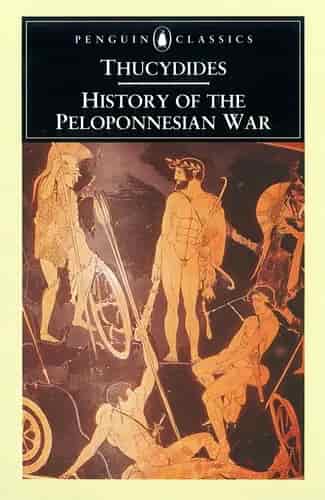
Thucydides
Quotes
Let him remember that many before now have tried to chastise a wrongdoer, and failing to punish their enemy have not even saved themselves; while many who have trusted in force to gain an advantage, instead of gaining anything more, have been doomed to lose what they had. Vengeance is not necessarily successful because wrong has been done, or strength sure because it is confident; but the incalculable element in the future exercises the widest influence, and is the most treacherous, and yet in fact the most useful of all things, as it frightens us all equally, and thus makes us consider before attacking each other.
 History of the Peloponnesian War
The country on the sea coast, now called Macedonia, was first acquired by Alexander, the father of Perdiccas, and his ancestors, originally Temenids from Argos...The whole is now called Macedonia, and at the time of the invasion of Sitalces, Perdiccas, Alexander's son, was the reigning king.
History of the Peloponnesian WarThe secret of happiness is freedom and the secret of freedom is courage.
History of the Peloponnesian WarIn practice we always base our preparations against an enemy on the assumption that his plans are good; indeed, it is right to rest our hopes not on a belief in his blunders, but on the soundness of our provisions. Nor ought we to believe that there is much difference between man and man, but to think that the superiority lies with him who is reared in the severest school.
History of the Peloponnesian WarWords had to change their ordinary meaning and to take that which was now given them. Reckless audacity came to be considered the courage of a loyal ally; prudent hesitation, specious cowardice; moderation was held to be a cloak for unmanliness; ability to see all sides of a question, inaptness to act on any. Frantic violence became the attribute of manliness; cautious plotting, a justifiable means of self-defence. The advocate of extreme measures was always trustworthy; his opponent a man to be suspected. To succeed in a plot was to have a shrewd head, to divine a plot a still shrewder; but to try to provide against having to do either was to break up your party and to be afraid of your adversaries.
History of the Peloponnesian WarI am more afraid of our own blunders than of the enemy's devices.
History of the Peloponnesian WarI have often before now been convinced that a democracy is incapable of empire...
History of the Peloponnesian WarOn the whole, however, the conclusions I have drawn from the proofs quoted may, I believe, safely be relied on. Assuredly they will not be disturbed either by the lays of a poet displaying the exaggeration of his craft, or by the compositions of the chroniclers that are attractive at truth's expense; the subjects they treat of being out of the reach of evidence, and time having robbed most of them of historical value by enthroning them in the region of legend.
History of the Peloponnesian War" war is a matter not so much of arms as of money,"
History of the Peloponnesian WarAbstinence from all injustice to other first-rate powers is a greater tower of strength than anything that can be gained by the sacrifice of permanent tranquillity for an apparent temporary advantage.
History of the Peloponnesian WarIt is a common mistake in going to war to begin at the wrong end, to act first, and wait for disaster to discuss the matter.
History of the Peloponnesian WarFor the true author of the subjugation of a people is not so much the immediate agent, as the power which permits it having the means to prevent it.
History of the Peloponnesian War