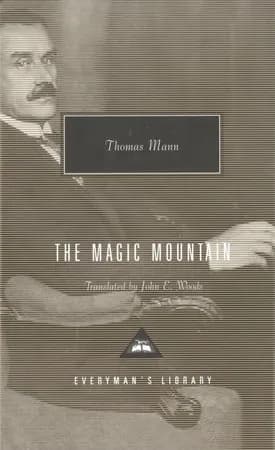
Thomas Mann
Quotes
I love and reverence the Word, the bearer of the spirit, the tool and gleaming ploughshare of progress.
Frau Stöhr ... began to talk about how fascinating it was to cough.... Sneezing was much the same thing. You kept on wanting to sneeze until you simply couldn't stand it any longer; you looked as if you were tipsy; you drew a couple of breaths, then out it came, and you forgot everything else in the bliss of the sensation. Sometimes the explosion repeated itself two or three times. That was the sort of pleasure life gave you free of charge.
Time has no divisions to mark its passage, there is never a thunderstorm or blare of trumpets to announce the beginning of a new month or year. Even when a new century begins it is only we mortals who ring bells and fire off pistols.
A black pall, you know, with a silver cross on it, or R.I.P. — requiescat in pace — you know. That seems to me the most beautiful expression — I like it much better than ‘He is a jolly good fellow,’ which is simply rowdy.
What was life? It was warmth, the warmth generated by a form-preserving instability, a fever of matter, which accompanied the process of ceaseless decay and repair of protein molecules that were too impossibly ingenious in structure.
One always has the idea of a stupid man as perfectly healthy and ordinary, and of illness as making one refined and clever and unusual.
Irony, forsooth! Guard yourself, Engineer, from the sort of irony that thrives up here; guard yourself altogether from taking on their mental attitude! Where irony is not a direct and classic device of oratory, not for a moment equivocal to a healthy mind, it makes for depravity, it becomes a drawback to civilization, an unclean traffic with the forces of reaction, vice and materialism.
It seemed that at the end of the lecture Dr. Krokowski was making propaganda for psycho-analysis; with open arms he summoned all and sundry to come unto him. "Come unto me," he was saying, though not in those words, " come unto me, all ye who are weary and heavy-laden." And he left no doubt of his conviction that all those present were weary and heavy-laden. He spoke of secret suffering, of shame and sorrow, of the redeeming power of the analytic. He advocated the bringing of light into the unconscious mind and explained how the abnormality was metamorphosed into the conscious emotion; he urged them to have confidence; he promised relief.
Hans Castorp loved music from his heart; it worked upon him much the same way as did his breakfast porter, with deeply soothing, narcotic effect, tempting him to doze.
There is both rhyme and reason in what I say, I have made a dream poem of humanity. I will cling to it. I will be good. I will let death have no mastery over my thoughts. For therein lies goodness and love of humankind, and in nothing else.
I, for one, have never in my life come across a perfectly healthy human being.
I never can understand how anyone can not smoke — it deprives a man of the best part of life … with a good cigar in his mouth a man is perfectly safe, nothing can touch him — literally.