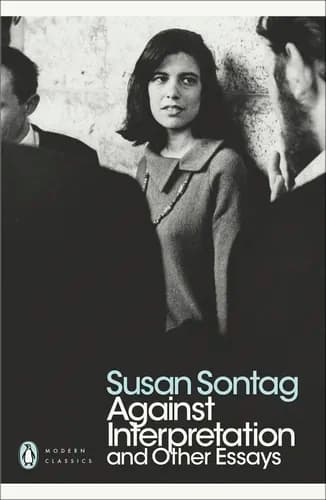
Susan Sontag
Quotes
Tennessee Williams’ forceful psychological melodrama now became intelligible: it was about something, about the decline of Western civilization. Apparently, were it to go on being a play about a handsome brute named Stanley Kowalski and a faded mangy belle named Blanche Du Bois, it would not be manageable.
To interpret is to impoverish, to deplete the world—in order to set up a shadow world of "meanings."
p. 7
Science fiction films are not about science. They are about disaster, which is one of the oldest subjects of art.
p. 212
In place of a hermeneutics we need an erotics of art.
p. 14
Interpretation is the revenge of the intellect upon art.
p. 7
None of us can ever retrieve that innocence before all theory when art knew no need to justify itself, when one did not ask of a work of art what it said because one knew (or thought one knew) what it did. From now to the end of consciousness, we are stuck with the task of defending art. We can only quarrel with one or another means of defense. Indeed, we have an obligation to overthrow any means of defending and justifying art which becomes particularly obtuse or onerous or insensitive to contemporary needs and practices.
This is the case, today, with the very idea of content itself. Whatever it may have been in the past, the idea of content is today mainly a hindrance, a nuisance, a subtle or not so subtle philistinism.
p. 5
The work of Kafka … has been subjected to a mass ravishment by no less than three armies of interpreters. Those who read Kafka as a social allegory see case studies of the frustrations and insanity of modern bureaucracy and its ultimate issuance in the totalitarian state. Those who read Kafka as a psychoanalytic allegory see desperate revelations of Kafka’s fear of his father, his castration anxieties, his sense of his own impotence, his thralldom to his dreams. Those who read Kafka as a religious allegory explain that K. in The Castle is trying to gain access to heaven, that Joseph K. in The Trial is being judged by the inexorable and mysterious justice of God.
Transparence is the highest, most liberating value in art—and in criticism—today. Transparence means experiencing the luminousness of the thing in itself, of things being what they are.
What the overemphasis on the idea of content entails is the perennial, never consummated project of interpretation. And, conversely, it is the habit of approaching works of art in order to interpret them that sustains the fancy that there really is such a thing as the content of a work of art.
p. 5
The old style of interpretation was insistent, but respectful; it erected another meaning on top of the literal one. The modern style of interpretation excavates, and as it excavates, destroys; it digs ‘behind’ the text, to find a sub-text which is the true one. The most celebrated and influential modern doctrines, those of Marx and Freud, actually amount to elaborate systems of hermeneutics, aggressive and impious theories of interpretation.
p. 6
Real art has the capacity to make us nervous. By reducing the work of art to its content and then interpreting that, one tames the work of art. Interpretation makes art manageable, comformable.
p. 8
Interpretation is not (as most people assume) an absolute value, a gesture of mind situated in some timeless realm of capabilities. Interpretation must itself be evaluated, within a historical view of human consciousness.''' In some cultural contexts, interpretation is a liberating act. It is a means of revising, of transvaluing, of escaping the dead past. In other cultural contexts, it is reactionary, impertinent, cowardly, stifling.
p. 6