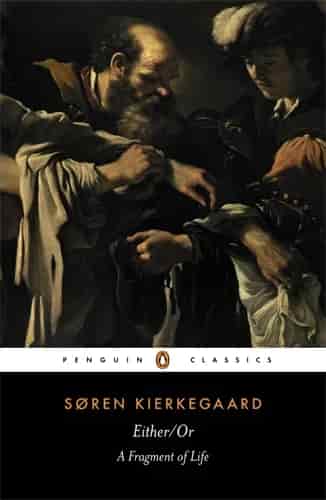
Søren Kierkegaard
Quotes
What intoxication is as beautiful as despair … It gives a slight flourish to the hat and to the whole body; it gives a proud, defiant look. The lips smile haughtily. It provides an indescribable lightness to life, a regal outlook on everything.
p. 195
 Either/Or
A religiously developed person makes a practice of referring everything to God, of permeating and saturating every finite relation with the thought of God, and thereby consecrating and ennobling it.
p. 43
Either/Orpp.28, Princeton University Press
Either/OrTo be a perfect man is after all the highest human ideal. Now I have got corns, which ought to help some.
p. 27
Either/OrIf you marry, you will regret it; if you do not marry, you will also regret it; if you marry or do not marry, you will regret both; Laugh at the world’s follies, you will regret it, weep over them, you will also regret that; laugh at the world’s follies or weep over them, you will regret both; whether you laugh at the world’s follies or weep over them, you will regret both. Believe a woman, you will regret it, believe her not, you will also regret that; believe a woman or believe her not, you will regret both; whether you believe a woman or believe her not, you will regret both. Hang yourself, you will regret it; do not hang yourself, and you will also regret that; hang yourself or do not hang yourself, you will regret both; whether you hang yourself or do not hang yourself, you will regret both. This, gentlemen, is the sum and substance of all philosophy.
p. 37
Either/OrIn my insisting that adversity is part of marriage, I by no means permit you to identify marriage with a retinue of adversities. It is already implicit in the resignation contained in the resolution that there will be accompanying adversities, except that these have not as yet assumed a definite shape and are not alarming, since on the contrary they are already seen as overcome in the resolution. Furthermore, adversity is not seen externally but internally in its reflection in the individual, but this belongs to the shared history of marital love. Secretiveness becomes a contradiction when it has nothing to keep secret, a childishness when it is only amorous bric-a-brac that constitutes its deposit. Not until the individual’s love has truly opened his heart, made him eloquent in a much profounder sense than that in which one usually says that love makes one eloquent (for even the seducer may have that kind of eloquence), not until the individual has deposited everything in the shared consciousness, not until then does secretiveness gain its strength, life and meaning. But a decisive step is required for this, and consequently courage is also required; yet marital love collapses into nothing if this does not take place, for only thereby does one show that one loves not oneself but another.
p. 109
Either/OrSo the richest personality is nothing before he has chosen himself; and … the poorest personality is everything when he has chosen himself, for the greatness is not to be this or that but to be oneself, and every human being can be this if he so wills it.
p. 177
Either/OrHow often do we have an urge to go beyond the historical consciousness, a longing, a homesickness for the primeval forest that lies behind us, and does not this longing acquire a double significance when it joins to itself the conception of another being whose home is also in that region? Therefore, every marriage, even one that is entered into after sober consideration, has an urge, at least in particular moments, to imagine such a foreground. And how beautiful it is that the God who is spirit also loves the earthly love. That there is much lying among married people on this score, I readily admit to you, and that your observations along this line have frequently amused me, but the truth in it ought not to be forgotten. Perhaps someone thinks it is better to have complete authority in the choice of “one’s life-partner,” but such an expression as that betrays an extreme narrowness of mind and foolish self-importance of understanding and has no intimation that in its genius romantic love is free and that precisely this genius constitutes its greatness.
p. 20
Either/OrNever take any official post. If one does that, one becomes just a plain John Anyman, a tiny little cog in the machine of the body politic. The individual ceases to be himself the manager of the operation, and then theories can be of little help. One acquires a title, and implicit in that are all the consequences of sin and evil. The law under which one slaves is equally boring no matter whether advancement is swift or slow. A title can never be disposed of, it would take a criminal act for that, which would incur a public whipping, and even then one cannot be sure of not being pardoned by royal decree and acquiring the title again.
p. 298
Either/OrIn addition to my numerous other acquaintances I have still one more intimate friend — my melancholy. In the midst of pleasure, in the midst of work, he beckons to me, calls me aside, even though I remain present bodily. My melancholy is the most faithful sweetheart I have had — no wonder that I return the love!
p. 43
Either/Or... take care that the great things to which you are really sacrificing your life do not deceive you.
p. 170
Either/OrThis is what is sad when one contemplates human life, that so many live out their lives in quiet lostness; they outlive themselves, not in the sense that life's content successively unfolds and is now possessed in the unfolding, but they live, as it were, away from themselves and vanish like shadows. Their immortal souls are blown away, and they are not disquieted by the question of its immortality, because they are already disintegrated before they die.
p. 168
Either/Or