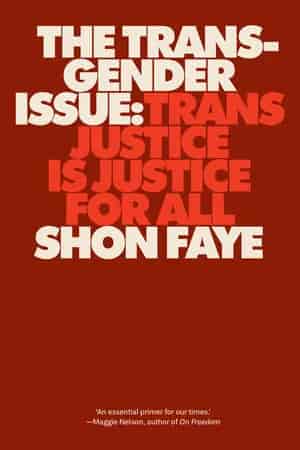
The demand for true trans liberation echoes and overlaps with the demands of workers, socialists, feminists… — Shon Faye
The demand for true trans liberation echoes and overlaps with the demands of workers, socialists, feminists, anti-racists and queer people. They are radical demands, in that they go to the root of what our society is and what it could be. For this reason, the existence of trans people is a source of constant anxiety for many who are either invested in the status quo or fearful about what would replace it. In order to neutralize the potential threat to social norms posed by trans people's existence, the establishment has always sought to confine and curtail their freedom. In twenty-first-century Britain, this has been achieved in large part by belittling our political needs and turning them into a 'issue'. Typically, trans people are lumped together as 'the transgender issue', dismissing and erasing the complexity of trans lives, reducing them to a set of stereotypes on which various social anxieties can be brought to bear. By and large, the transgender issue is seen as a 'toxic debate', a 'difficult topic' chewed over (usually by people who are not trans themselves) on television shows, in newspaper opinion pieces and in university philosophy departments. Actual trans people are rarely to be seen.
Source: Wikiquote · CC BY-SA 4.0
More from this book
Moral panics rely on an inherent paradox: that the rights of a small minority of the population wielding little institutional power are in fact a risk to the majority. This is achieved by inciting in the population a mixture of moral disgust and anxiety about contagion. The problem group may be small now, but they will grow. They will grow by encouraging confused young people to join. For sexual minorities, this narrative of recruitment lends itself to the language of seduction and abuse, which helps direct the moral disgust society feels at paedophilia on to an innocent group. It is a shameful but highly effective propaganda tool. Despite the obvious parallels and analogous struggles that trans people have had with the wider queer movement’s struggle for sexual liberation, the claim that trans people are not only actively different but substantially harmful to the LGB movement has been readily embraced and promoted by extreme political conservatives. This includes even politicians who would themselves traditionally oppose lesbian, gay and bisexual rights.
It may seem paradoxical that in a period where civil rights for LGBT people seem to be at unique risk – a time in which Boris Johnson, a man who once called gay men ‘tank-topped bum boys’ and equated gay marriage with bestiality, can be prime minister – there has never been more media representation for LGBT people or more companies happy to insist they support us. This is not out of the sheer kindness of corporate hearts. Brands have recognized that the rainbow flag lends them the goodwill of people who care about social justice. Corporations can purport to be part of a movement with countercultural and liberationist roots, package that movement as ‘aspirational’ for marketing purposes, and in doing so denude it of all the politics that threaten the capitalist status quo and sell it back to those who can afford it. The idea that conspicuous consumption is a route to sexual and gender freedom has been effective in allowing the LGBT movement’s muscles to atrophy. In a godless age, there are new ways to give the masses their opium.
When non-binary people ask for legal recognition or a rethinking of gendered language (for instance through neutral pronouns, or new words for new genders), they are asking for more freedom for us all. In one sense, the claim that everyone is non-binary isn’t wrong: the binary is a powerful and pervasive myth, and everyone is somewhere on a spectrum. ‘Non-binary’ is only useful insofar as it is a term which can be used to make such ideas legible to policymakers, families, schools and societies. It is a term designed to make conversation easier; it is not the end point.