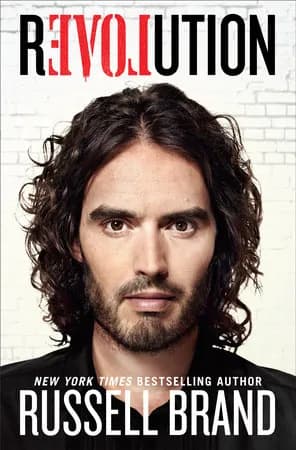
Russell Brand
Quotes
The first thing is serenity. The agitation has to end. The itchy irritability, the restlessness, the wanting. So do the lows, the self-loathing, wretched, heavy-hearted, lead-gutted, teary-eyed, dry-mouthed misery. The pain. So do the highs. The wide-eyed, bilious highs, the cheek-chewing, trouble-brewing highs, the never-stopping-till-I-touch-the-sky highs, the up-at-dawn hitting-the-pipe highs, chasing, defacing, heart-racing highs, gagging, shagging, blagging highs. All the things we do to change the way we feel, the way the world looks and tastes: It’s all got to go. So courage is necessary. Courage to change yourself, the one thing you can change. Your attitude and actions. Neither the serenity nor the courage are available to you on your own; if they were, you would’ve found them by now—you’ve been pretty fastidious in your research. God, however you conceptualize him, will have to grant them to you. And whatever you conceptualize God as, with your human mind, your individual brain, made up of instinctive responses, training, and memories, however you conceptualize a power that’s beyond you and the decisions you’ve made so far, your conception will be extremely limited. Likely as limited as my cat’s conception of the Internet. The invisible network of interconnected portals that communicate data are beyond my cat’s comprehension. My cat’s inability to comprehend does not impede the Internet. The World Wide Web (which is incidentally quicker to say than "double-you, double-you, double-you-dot") will continue to exist, regardless of my cat’s awareness. Pray, then, for wisdom, wisdom to know the difference between things we can change and things we can’t. Likely this will be a lifetime’s work, undertaken one day at a time. Which, for humans, is the way time happens. I don’t have to live the 25th of May 2022 yet. I might never have to. I only have to live in this moment. That’s why meditation comes in handy, and practicing it as a community has benefits too. How are we to achieve real change, conditions in which practices that lead to a different type of consciousness can plausibly be pursued?
I really hate it when I think I’m on the precipice of saying something deep and empowering when it’s actually more or less a quote from Rocky IV ("If I can change and you can change, everybody can change") or a lyric from an M People song ("search for the hero inside yourself") but I’ve really got very little to add to these scattered and perennial pop cultural artifacts.
The world is changing and we are awakening. These statistics give us a numerical glimpse at the visceral dissatisfaction that most of us feel. Now is the time to express it. These corrupt structures cannot be maintained without our compliance. You could vote against them, if there was anything to vote for, but there isn’t, or you could stop paying your mortgage, stop paying your taxes, stop buying stuff you don’t need. When we, the majority, unite and demonstrate our new intention, we will be invincible. If we, who are complicit by our silence, become active and disobedient. This is a pivotal time in the history of our species. We are transitioning from an ideology that places power and responsibility in the hands of the few to one where we all collectively have power. It is important that we clarify, in a manner accessible to all, which institutions and systems are beneficial and which ones have to go. It is important that we propose ideas and systems that will be advantageous, like the handful in this book, and ensure that they are presented properly. When they are inevitably disparaged by the fearful enemies of change, we must remain unified and insistent. At this climactic time, we have no choice but change. This book, written by a twerp, with minimal interaction with brilliant thinkers and uncorrupted minds, demonstrates that. Now, what are you going to do about it?
I should also point out that empathy, sympathy, and love are limitless resources, energies that never deplete, and at this time of dwindling fuels we should cherish and explore these inexhaustible inner resources more than ever
Since industrialization, we have moved rapidly out of synchronicity with nature and our own nature.
Folk codes of pride and togetherness, pride in both senses, honor, and togetherness. Ring-fenced emotion permitted only at three o’clock for ninety minutes in the sanctuary of the stadium. Can we march that pride out of the gates and into the streets? Can we harness it? Direct it? Use it for something less stymied by white lines and whistles, that could pour from the terraces and into the oak-and-leather chambers, the steel-and-glass towers?
My dad, Ron Brand, was an entrepreneurial Essex man, Del Boy’d up to the hilt on Thatcher’s creed. He was a self-made and self-destructive man and intermittently tumbled either side of the line. The prevailing mentality of the time, the eighties, was "every man for himself." Unions were crushed, state interests were carved up and flogged, and council houses were sold back to the people whose efforts had built them. One of the great venture-capitalist heroes of this time, who epitomized this buccaneering spirit, was Sir James Goldsmith, Tory hero, Thatcher crush, scourge of Private Eye, and demon of the left. My dad and a lot of people from modest backgrounds admired him; there was something appealingly antiestablishment and daring in the aggressive and ingenious ways that James Goldsmith exploited the system.
All the good things about America either came from the counterculture or were there already when the white people arrived.
Diablo and I fashioned my beard together in my trailer, together, as cautiously as you’d sculpt a peace treaty between two nations that prefer war to peace. The reality was that my identity outside of filmmaking had become more important to me. I was doing hours of yoga and meditation each day, I was going through a divorce, and the result was a kind of hirsute intransigence. I looked like the cliché of a terrorist and I behaved like one. Except the beard wasn’t the symbol, it was the cause. I feel some guilt about my lack of enthusiasm for acting, like it’s a bit ungrateful. Like I’ve let my teenage self down. Mind you, he let himself down a fair bit, the dirty little pervert. The dreams of my adolescent self were entangled with silvery screens and limousines, and I still feel that I need to offer up superficial sacrifices to his misguided altar. The fact is, though, I find filmmaking a boring process and its ends dubious. This could, of course, be due to the quality of the stuff I’ve done so far, as opposed to an essential rejection of an art form. Maybe if I’d been "R. P. McMurphy" or "The Elephant Man" or "Brian," I’d feel different. It just wasn’t what I thought it would be. It’s not just the entertainment industry that has seemed like a mirage on arrival. What about clubs and parties? When I’m there I think, "Is this it? Is this all there is? Is this what all the fuss is about?" This feeling of disillusionment perhaps climaxed around the time of my divorce and the making of this subsequent film.
"I believe in God," says my nan, in a way that makes the idea of an omnipotent, unifying frequency of energy manifesting matter from pure consciousness sound like a chore. An unnecessary chore at that, like cleaning under the fridge. I tell her, plucky little seven-year-old that I was, that I don’t. This pisses her off. Her faith in God is not robust enough to withstand the casual blasphemy of an agnostic tot. "Who do you think made the world, then?" I remember her demanding as fiercely as Jeremy Paxman would later insist I provide an instant global infrastructure for a post-revolutionary utopia. "Builders," I said, thinking on my feet. This flummoxed her and put her in a bad mood for the rest of the walk. If she’d hit back with "What about construction at a planetary or galactic level?" she’d’ve had me on the ropes. At that age I wouldn’t’ve been able to riposte with "an advanced species of extraterrestrials who we have been mistakenly ascribing divine attributes to due to our own technological limitations" or "a spontaneous cosmic combustion that contained at its genesis the code for all subsequent astronomical, chemical, and biological evolution." I probably would’ve just cried. Anyway, I’m supposed to be explaining the power of forgiveness, not gloating about a conflict in the early eighties in which I fared well against an old lady. Since getting clean from drugs and alcohol I have been taught that I played a part in the manufacture of all the negative beliefs and experiences from my past and I certainly play a part in their maintenance. I now look at my nan in another way. As a human being just like me, trying to cope with her own flaws and challenges. Fearful of what would become of her sick daughter, confused by the grandchild born of a match that she was averse to. Alone and approaching the end of her life, with regret and lacking a functioning system of guidance and comfort. Trying her best. Taking on the responsibility of an unusual little boy with glib, atheistic tendencies, she still behaved dutifully. Perhaps this very conversation sparked in me the spirit of metaphysical inquiry that has led to the faith in God I now have.
Serenity is the first thing people with addiction issues are instructed to request: God, grant me the serenity To accept the things I cannot change, Courage to change the things I can, And the wisdom to know the difference.
Jesus as protagonist in the Gospels is good because, like Superman, he’s been sent from another dimension; like Superman, he’s decided to dedicate himself to saving humanity; and, like Superman, he’s got special powers: heal the sick, walk on water, food multiplication. His vulnerability is that he is part man and as such can be speared, mocked, nailed up, and, at least carnally, sacrificed.