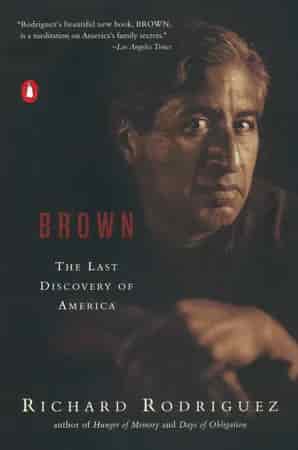
My reading was scheduled for the six-thirty slot by the University of Arizona. A few hundred people showed up… — Richard Rodriguez
My reading was scheduled for the six-thirty slot by the University of Arizona. A few hundred people showed up – old more than young; mostly brown. I liked my "them," in any case, for coming to listen, postponing their dinners. In the middle of one of my paragraphs, a young man stood to gather his papers, then retreated up the aisle, pushed open the door at the back of the auditorium. In the trapezoid of lobby-light thus revealed, I could see a crowd was forming for the eight o'clock reading — a lesbian poet. Then the door closed, resealed the present; I continued to read, but wondered to myself: Why couldn't I get the lesbians for an hour? And the lesbian poet serenade my Mexican audience?
Source: Wikiquote · CC BY-SA 4.0
More from this book
The other night at a neighborhood restaurant the waiter, after mentioning he had read my books, said about himself, “I’m white, I’m nothing.” But that was what I wanted, you see, growing up in America—the freedom of being nothing, the confidence of it, the arrogance. And I achieved it.
It is one thing to know your author-man or woman or gay or black or paraplegic or president. It is another thing to choose only man or woman or et cetera, as the only quality of voice empowered to address you, as the only class of sensibility or experience able to understand you, or that you are able to understand.
How a society orders its bookshelves is as telling as the books a society writes and reads. American bookshelves of the twenty-first century describe fractiousness, reduction, hurt. Books are isolated from one another, like gardenias or peaches, lest they bruise or become bruised, or, worse, consort, confuse. If a man in a wheelchair writes his life, his book will be parked in a blue-crossed zone: "Self-Help" or "Health." There is no shelf for bitterness. No shelf for redemption. The professor of Romance languages at Dresden, a convert to Protestantism, was tortured by the Nazis as a Jew — only that — a Jew. His book, published sixty years after the events it recounts, is shelved in my neighborhood bookstore as "Judaica." There is no shelf for irony.
Certainly in Mexico, the Latin American country I know best, white ascends. Certainly, the whitest dinner party I ever attended was a Mexico City dinner party where a Mexican squire of exquisite manner, mustache, and flán-like jowl, expressed himself surprised, so surprised, to learn that I am a writer. One thought he would never get over it. Un escritor . . . ¿Un escritor . . . ? Turning the word on a lathe of tooth and tongue, until: “You know, in Mexico, I think we do not have writers who look like you,” he said. He meant dark skin, thick lips, Indian nose.