Leafy Quotes
Recently added
The newest book quotes in the Leafy Quotes collection — passages readers have just added, each with its author, book and the page it came from.
“Very evocative. He seems to be confirming what I said last year—that the universe really has no underpinnings, that when a good hypothesis comes along, one that explains the prior events, the underpinnings shape themselves to accommodate and a powerful theory is born.”
“Then there is no ultimate reality?”
“Apparently not. Bad hypotheses, those that don’t fit what happen on our level, are rejected by the universe. Good ones, powerful ones, are incorporated.”
p. 239
Information can be stored even more compactly than in molecular memory. It can be stored in the structure of space-time. What is matter, after all, but a standing-wave of information in the vacuum?
p. 237
Nothing is lost. Nothing is forgotten.
It was in the blood, the flesh,
And now it is forever.
p. 247
There are two Americas. One is the America of Lincoln and Adlai Stevenson; the other is the America of Teddy Roosevelt and the modern superpatriots. One is generous and humane, the other narrowly egotistical; one is self-critical, the other self-righteous; one is sensible, the other romantic; one is good-humored, the other solemn; one is inquiring, the other pontificating; one is moderate, the other filled with passionate intensity; one is judicious and the other arrogant in the use of great power.
p. 245
The true mark of greatness is not stridency but magnanimity.
p. 199
He may not have had time, but even allowing him the time, Vergil simply did not think such things through. Brilliant in the creation, slovenly in the consideration of consequences.
But wasn’t that true of every creator?
Didn’t anyone who changed things ultimately lead some people—perhaps many people—to death, grief, torment?
p. 219
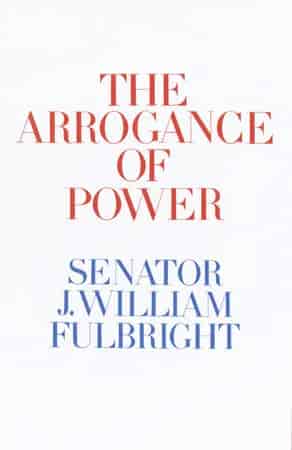
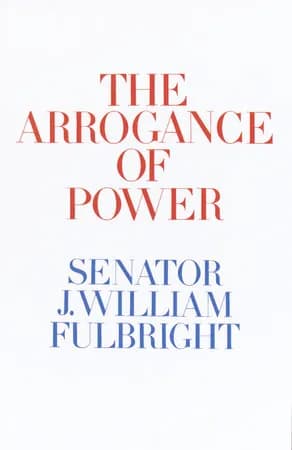
Power tends to confuse itself with virtue and a great nation is particularly susceptible to the idea that its power is a sign of God's favor, conferring upon it a special responsibility for other nations — to make them richer and happier and wiser, to remake them, that is, in its own shining image. Power confuses itself with virtue and tends also to take itself for omnipotence. Once imbued with the idea of a mission, a great nation easily assumes that it has the means as well as the duty to do God's work.
p. 4
Can’t own a woman, Mike. Wonderful companions, can’t own them.
p. 207
A pre-emptive war in 'defense' of freedom would surely destroy freedom, because one simply cannot engage in barbarous action without becoming a barbarian, because one cannot defend human values by calculated and unprovoked violence without doing mortal damage to the values one is trying to defend.
p. 154
...there is a sum of evil equal to the sum of good, the continuing equilibrium of the world requires that there be as many good people as wicked people...
Marriage is both the most public and the most secret of institutions, its miseries as irritatingly insistent as a hacking cough, its private malaise less easily diagnosed. And nothing is so destructive as unhappiness to social life. No one wants to sit in embarrassed silence while his host and hostess demonstrate their mutual incompatibility and dislike.
p. 133
Nothing we can do outrages Nature directly. Our acts of destruction give her new vigour and feed her energy, but none of our wreckings can weaken her power.