 Leafy Quotes
Recently added
The newest book quotes in the Leafy Quotes collection — passages readers have just added, each with its author, book and the page it came from.
Anything you don't understand, Mr. Rankin, you attribute to God. God for you is where you sweep away all the mysteries of the world, all the challenges to our intelligence. You simply turn your mind off and say God did it.
p. 166
Those who are skeptical about carbon dioxide greenhouse warming might profitably note the massive greenhouse effect on Venus. No one proposes that Venus's greenhouse effect derives from imprudent Venusians who burned too much coal, drove fuel-inefficient autos, and cut down their forests. My point is different. The climatological history of our planetary neighbor, an otherwise Earthlike planet on which the surface became hot enough to melt tin or lead, is worth considering — especially by those who say that the increasing greenhouse effect on Earth will be self-correcting, that we don't really have to worry about it, or (you can see this in the publications of some groups that call themselves conservative) that the greenhouse effect is a "hoax".
p. 227
The major religions on the Earth contradict each other left and right. You can't all be correct. And what if all of you are wrong? It's a possibility, you know. You must care about the truth, right? Well, the way to winnow through all the differing contentions is to be skeptical. I'm not any more skeptical about your religious beliefs than I am about every new scientific idea I hear about. But in my line of work, they're called hypotheses, not inspiration and not revelation.
p. 162
Modern science has been a voyage into the unknown, with a lesson in humility waiting at every stop. Many passengers would rather have stayed home.
Do we, holding that the gods exist,
deceive ourselves with insubstantial dreams
and lies, while random careless chance and
change alone control the world?
p. 157
In Mozambique, the story goes, monkeys do not talk, because they know if they utter even a single word some man will come and put them to work.
p. 313
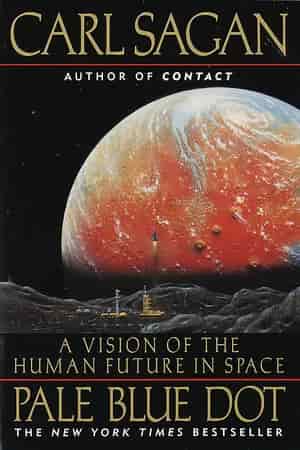
Ann Druyan suggests an experiment: Look back again at the pale blue dot of the preceding chapter. Take a good long look at it. Stare at the dot for any length of time and then try to convince yourself that God created the whole Universe for one of the 10 million or so species of life that inhabit that speck of dust. Now take it a step further: Imagine that everything was made just for a single shade of that species, or gender, or ethnic or religious subdivision. If this doesn't strike you as unlikely, pick another dot. Imagine it to be inhabited by a different form of intelligent life. They, too, cherish the notion of a God who has created everything for their benefit. How seriously do you take their claim?
p. 11
Since, in the long run, every planetary society will be endangered by impacts from space, every surviving civilization is obliged to become spacefaring — not because of exploratory or romantic zeal, but for the most practical reason imaginable: staying alive.
p. 371
You see, the religious people — most of them — really think this planet is an experiment. That's what their beliefs come down to. Some god or other is always fixing and poking, messing around with tradesmen's wives, giving tablets on mountains, commanding you to mutilate your children, telling people what words they can say and what words they can't say, making people feel guilty about enjoying themselves, and like that. Why can't the gods leave well enough alone? All this intervention speaks of incompetence. If God didn't want Lot's wife to look back, why didn't he make her obedient, so she'd do what her husband told her? Or if he hadn't made Lot such a shithead, maybe she would've listened to him more. If God is omnipotent and omniscient, why didn't he start the universe out in the first place so it would come out the way he wants? Why's he constantly repairing and complaining? No, there's one thing the Bible makes clear: The biblical God is a sloppy manufacturer. He's not good at design, he's not good at execution. He'd be out of business if there was any competition.
p. 285
A celibate clergy is an especially good idea, because it tends to suppress any hereditary propensity toward fanaticism.
p. 244
Once we overcome our fear of being tiny, we find ourselves on the threshold of a vast and awesome Universe that utterly dwarfs — in time, in space, and in potential — the tidy anthropocentric proscenium of our ancestors. We gaze across billions of light-years of space to view the Universe shortly after the Big Bang, and plumb the fine structure of matter. We peer down into the core of our planet, and the blazing interior of our star. We read the genetic language in which is written the diverse skills and propensities of every being on Earth. We uncover hidden chapters in the record of our origins, and with some anguish better understand our nature and prospects. We invent and refine agriculture, without which almost all of us would starve to death. We create medicines and vaccines that save the lives of billions. We communicate at the speed of light, and whip around the Earth in an hour and a half. We have sent dozens of ships to more than seventy worlds, and four spacecraft to the stars. We are right to rejoice in our accomplishments, to be proud that our species has been able to see so far, and to judge our merit in part by the very science that has so deflated our pretensions.
p. 53
She too had found the experience transforming. How could she not? A demon had been exorcised. Several. And just when she felt more capable of love than she had ever been, she found herself alone.
p. 407