

Quotes
A society’s stock of knowledge is structured in terms of what is generally relevant and what is relevant only to specific roles… the social distribution of knowledge entails a dichotomization in terms of general and role-specific relevance… because of the division of labor, role-specific knowledge will grow at a faster rate than generally relevant and accessible knowledge… The increasing number and complexity of [the resulting] sub universes [of specialized knowledge] make them increasingly inaccessible to outsiders.
p. 77
Specific procedures of universe-maintenance become necessary when the symbolic universe has become a problem. As long as this is not the case, the symbolic universe is self-maintaining, that is, self-legitimating by the sheer facticity of its objective existence in the society in question.
Modern science is an extreme step in this development, and in the secularization and sophistication of universe-maintenance.
Habitualization carries with it the important psychological gain that choices are narrowed… the background of habitualized activity opens up a foreground for deliberation and innovation [which demand a higher level of attention].
p. 53
On this level of legitimation, the reflective integration of discrete institutional processes reaches its ultimate fulfilment. A whole world is created. All the lesser legitimating theories are viewed as special perspectives on phenomena that are aspects of this world. Institutional roles become modes of participation in a universe that transcends and includes the institutional order. In our previous example, the 'science of cousinhood' is only a part of a much wider body of theory, which, almost certainly, will contain a general theory of the cosmos and a general theory of man.
The individual... is not born a member of society. He is born with a predisposition towards sociality, and he becomes a member of society. In the life of every individual, therefore, there is a temporal sequence, in the course of which he is inducted into participation in the societal dialectic. The beginning point of this process is internalization : the immediate apprehension or interpretation of an objective event as expressing meaning, that is, as a manifestation of another's subjective processes which thereby becomes subjectively meaningful to myself.
p. 129
Without proposing an evolutionary scheme for such types, it is safe to say that mythology represents the most archaic form of universe-maintenance, as indeed it represents the most archaic form of legitimation generally.
Society... directly penetrates the organism in its functioning, most importantly in respect to sexuality and nutrition. While both sexuality and nutrition are grounded in biological drives, these drives are extremely plastic in the human animal. Man is driven by his biological constitution to seek sexual release and nourishment. But his biological constitution does not tell him where he should seek sexual release and what he should eat.
The child does not internalize the world of his significant others as one of many possible worlds… It is for this reason that the world internalized in primary socialization is so much more firmly entrenched in consciousness than worlds internalized in secondary socialization…. Secondary socialization is the internalization of institutional or institution-based ‘sub worlds’… The roles of secondary socialization carry a high degree of anonymity… The same knowledge taught by one teacher could also be taught by another… The institutional distribution of tasks between primary and secondary socialization varies with the complexity of the social distribution of knowledge
p. 129
Legitimation as a process is best described as a 'second-order' objectivation of meaning. Legitimation produces new meanings that serve to integrate the meanings already attached to disparate institutional processes. The function of legitimation is to make objectively available and subjectively plausible the 'first-order' objectivations that have been institutionalized.
p. 92
The most important gain is that each [member of society] will be able to predict the other’s actions. Concomitantly, the interaction of both becomes predictable… Many actions are possible on a low level of attention. Each action of one is no longer a source of astonishment and potential danger to the other.
p. 57
Theoretical knowledge is only a small and by no means the most important part of what passed for knowledge in a society… the primary knowledge about the institutional order is knowledge... is the sum total of ‘what everybody knows’ about a social world, an assemblage of maxims, morals, proverbial nuggets of wisdom, values and beliefs, myths, and so forth.
p. 65
One may view the individual’s everyday life in terms of the working away of a conversational apparatus that ongoingly maintains, modifies and reconstructs his subjective reality… [for example] ‘Well, it’s time for me to get to the station,’ and ‘Fine, darling, have a good day at the office’ implies an entire world within which these apparently simple propositions make sense… the exchange confirms the subjective reality of this world… the great part, if not all, of everyday conversation maintains subjective reality… imagine the effect…of an exchange like this: ‘Well, it’s time for me to get to the station,’ ‘Fine, darling, don’t forget to take along your gun.’
p. 147
Social order is a human product, or more precisely, an ongoing human production.
p. 52
The symbolic universe also orders history. It locates all collective events in a cohesive unity that includes past, present and future. With regard to the past, it establishes a 'memory' that is shared by all the individuals socialized within the collectivity. With regard to the future, it establishes a common frame of reference for the projection of individual actions.
p. 104
An intrinsic problem, similar to the one we discussed in connexion with tradition in general, presents itself with the process of transmission of the symbolic universe from one generation to another. Socialization is never completely successful. Some individuals 'inhabit' the transmitted universe more definitely than others.
Two societies confronting each other with conflicting universes will both develop conceptual machineries designed to maintain their respective universes. From the point of view of intrinsic plausibility the two forms of conceptualization may seem to the outside observer to offer little choice.
By ‘successful socialization’ we mean the establishment of a high degree of symmetry between objective and subjective reality.
p. 163
A social world [is] a comprehensive and given reality confronting the individual in a manner analogous to the reality of the natural world... In early phases of socialization the child is quite incapable of distinguishing between the objectivity of natural phenomena and the objectivity of the social formations… The objective reality of institutions is not diminished if the individual does not understand their purpose or their mode of operation...He must ‘go out’ and learn about them, just as he must learn about nature.
p. 59
The second level of legitimation contains theoretical propositions in a rudimentary form. Here may be found various explanatory schemes relating sets of objective meanings. These schemes are highly pragmatic, directly related to concrete actions. Proverbs, moral maxims and wise sayings are common on this level. Here, too, belong legends and folk tales, frequently transmitted in poetic forms.
Man is biologically predestined to construct and to inhabit a world with others. This world becomes for him the dominant and definite reality. Its limits are set by nature, but, once constructed, this world acts back upon nature. In the dialectic between nature and the socially constructed world the human organism itself is transformed. In this same dialectic man produces reality and thereby produces himself.
p. 183
Society determines how long and in what manner the individual organism shall live. This determination may be institutionally programmed in the operation of social controls, as in the institution of law. Society can maim and kill. Indeed, it is in its power over life and death that it manifests its ultimate control over the individual.
p. 202
Life-expectancies of lower-class and upper-class [vary] …society determines how long and in what manner the individual organism shall live…
p. 202
It will be enough, for our purposes, to define 'reality' as a quality appertaining to phenomena that we recognize as having a being independent of our own volition (we cannot 'wish them away'), and to define 'knowledge' as the certainty that phenomena are real and that they possess specific characteristics.
p. 1
Compared to the reality of everyday life, other realities appear as finite provinces of meaning, enclaves within the paramount reality marked by circumscribed meanings and modes of experience.
p. 25
The present volume is intended as a systematic, theoretical treatise in the sociology of knowledge. It is not intended, therefore, to give a historical survey of the development of this discipline, or to engage in exegesis of various figures in this or other developments in sociological theory, or even to show how a synthesis may be achieved between several of these figures and developments. Nor is there any polemic intent here. Critical comments on other theoretical positions have been introduced (not in the text, but in the Notes) only where they may serve to clarify the present argument.
p. 7
The social distribution of knowledge thus begins with the simple fact that I do not know everything known to my fellowmen, and vice versa, and culminates in exceedingly complex and esoteric systems of expertise. Knowledge of how the socially available stock of knowledge is distributed, at least in outline, is an important element of that same stock of knowledge.
p. 46
A sign [has the] explicit intention to serve as an index of subjective meanings... Language is capable of becoming the objective repository of vast accumulations of meaning and experience, which it can then preserve in time and transmit to following generations... Language also typifies experiences, allowing me to subsume them under broad categories in terms of which they have meaning not only to myself but also to my fellowmen.
p. 35
The social stock of knowledge differentiates reality by degrees of familiarity... my knowledge of my own occupation and its world is very rich and specific, while I have only very sketchy knowledge of the occupational worlds of others.
p. 43
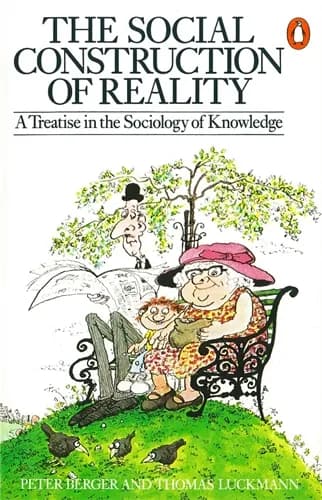
The basic contentions of the argument of this book are implicit in its title and sub-title, namely, that reality is socially constructed and that the sociology of knowledge must analyse the process in which this occurs.
p. 1

That’s all the quotes.
30 quotes in the collection · come back when we add more