

Quotes
So let's start telling the truth: competitiveness is a meaningless word when applied to national economies. And the obsession with competitiveness is both wrong and dangerous.
If growth in East Asia is indeed running into diminishing returns, however, the conventional wisdom about an Asian-centered world economy needs some rethinking.
This article makes three points. First, it argues that concerns about competitiveness are, as an empirical matter, almost completely unfounded. Second, it tries to explain why defining the economic problem as one of international competition is nonetheless so attractive to so many people. Finally, it argues that the obsession with competitiveness is not only wrong but dangerous, skewing domestic policies and threatening the international economic system.
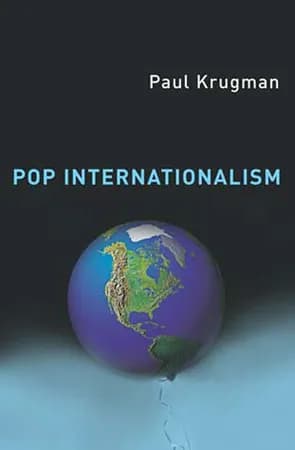
Whose fault is the replacement of serious discussion of world trade by what I have come to think of as "pop internationalism"? To some extent, of course, it is the result of basic human instincts: intellectual laziness, even among those who would be seen as wise and deep, will always be a powerful force. To some extent it also reflects the decline in the influence of economists in general: the high prestige of the profession a generation ago had much to do with the presumed effectiveness of Keynesian macroeconomic policies, and has suffered greatly as macroeconomics has dissolved into squabbling factions. And one should not ignore the role of editors, who often prefer what pop internationalists have to say to the disturbingly difficult ideas of people who know how to read national accounts or understand that the trade balance is also the difference between savings and investment. Indeed, some important editors, like James Fallows at The Atlantic or Robert Kuttner at The American Prospect are pop internationalists themselves; they deliberately use their magazines as platforms for what amounts to an anti-intellectual crusade.
First, most of the speculation about the superiority of the communist system - including the popular view that Western economies could painlessly accelerate their own growth by borrowing some aspects of that system - was off base. Rapid growth was based entirely on one attribute: the willingness to save, to sacrifice current consumption for the sake of future production. The communist example offered no hint of a free lunch.
Second, the economic analysis of communist countries' growth implied some future limits to their industrial expansion - in other words, implied that a naive projection of their past growth rates into the future was likely to greatly overstate their real prospects. Economic growth that is based on expansion of inputs, rather than on growth in output per unit of input, is inevitably subject to diminishing returns. It was simply not possible for the Soviet economies to sustain the rates of growth of labor force participation, average education levels, and above all the physical capital stock that had prevailed in previous years. Communist growth would predictably slow down, perhaps drastically.
The idea that a country's economic fortunes are largely determined by its success on world markets is a hypothesis, not a necessary truth; and as a practical, empirical matter, that hypothesis is flatly wrong. That is, it is simply not the case that the world's leading nations are to any important degree in economic competition with each other, or that any of their major economic problems can be attributed to failures to compete on world markets.
That's a hard answer to accept, especially for those American policy intellectuals who recoil from the dreary task of reducing deficits and raising the national savings rate. But economics is not a dismal science because the economists like it that way; it is because in the end we must submit to the tyranny not just of the numbers, but of the logic they express.
To make a harsh but not entirely unjustified analogy, a government wedded to the ideology of competitiveness is as unlikely to make good economic policy as a government committed to creationism is to make good science policy, even in areas that have no direct relationship to the theory of evolution.

That’s all the quotes.
8 quotes in the collection · come back when we add more