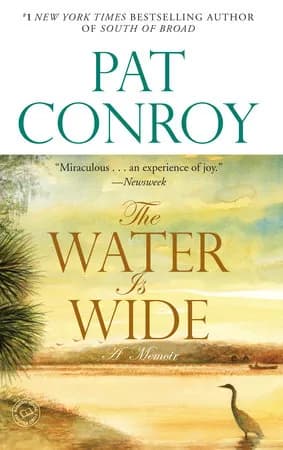
Pat Conroy
Quotes
The Southern school superintendent is a kind of remote deity who breathes the purer air of Mount Parnassus. The teachers see him only on those august occasions when they need to be reminded of the nobility of their calling. The powers of a superintendent are considerable. He hires and fires, manipulates the board of education, handles a staggering amount of money, and maintains the precarious existence of the status quo.
p. 11
Teaching is a record of failures. But the glory of teaching is in the attempt.
p. 285
I developed The Great Teacher theory late in my freshman year. It was a cornerstone of the theory that great teachers had great personalities and that the greatest teachers had outrageous personalities. I did not like decorum or rectitude in a classroom; I preferred a highly oxygenated atmosphere, a climate of intemperance, rhetoric, and feverish melodrama. And I wanted my teachers to make me smart. A great teacher is my adversary, my conqueror, commissioned to chastise me. He leaves me tame and grateful for the new language he has purloined from other kings whose granaries are filled and whose libraries are famous. He tells me that teaching is the art of theft; knowing what to steal and from whom.
p. 271
[...] I learned from those evening recitals that music could ache and hurt, that beautiful music was a place a suffering man could hide.
p. 548
One can do anything, anything at all, I thought, if provided with a passionate and gifted teacher.
p. 536
I have never had to look up a definition of honor. I knew instinctively what it was. It is something I had the day I was born, and I never had to question where it came from or by what right it was mine. If I was stripped of my honor, I would choose death as certainly and unemotionally as I clean my shoes in the morning. Honor is the presence of God in man.
p. 46
Sports show you your limits. Sports teach humility. Sooner or later the athlete becomes humble no matter how good he is. But he plays until he has reached as high as he can.
p. 468
And in that instant was born the terrible awareness that life eventually broke every man, but in different ways and at different times.
p. 196
I learned that politicians are not supposed to help people. They simply listen to people, nod their heads painfully, commiserate at proper intervals, promise to do all they can, and then do nothing. It was very instructive. I could probably have enlisted more action from a bleached jellyfish washed ashore in a seasonal storm.
p. 278
There were these deep, serious thoughts I sometimes had to drive from my head like flocks of pesky starlings. I was too pragmatic and impatient to let such thoughts flog me into impotence, yet I sincerely needed a working philosophy on which to hang my hat. After the Halloween trip, one began to form and crystallize without my knowledge, and when I finally acknowledged its presence, it was already a part of me: simply, that life was good, but it was hard; we would prepare to meet it head on, but we would enjoy the preparation.
p. 158
I loved these salt rivers more than I loved the sea; I loved the movement of tides more than I loved the fury of surf. Something in me was congruent with this land, something affirmed when I witnessed the startled, piping rush of shrimp or the flash of starlight on the scales of mullet. I could feel myself relax and change whenever I returned to the lowcountry and saw the vast green expanses of marsh, feminine as lace, delicate as calligraphy. The lowcountry had its own special ache and sting.
p. 60
The South of humanity and goodness is slowly rising out of the fallen temple of hatred and white man's nationalism. The town retains her die-hards and nigger-haters and always will. Yet they grow older and crankier with each passing day. When Beaufort digs another four hundred holes in her plentiful grave-yards, deposits there the rouged and elderly corpses, and covers them with the sandy, lowcountry soil, then another whole army of the Old South will be silenced and not heard from again. The religion of the Confederacy and apartheid will one day be subdued by the passage of years. The land will be the final arbiter of human conflict; no matter how intense the conflict, the victory of earth and grave will be complete.
p. 313