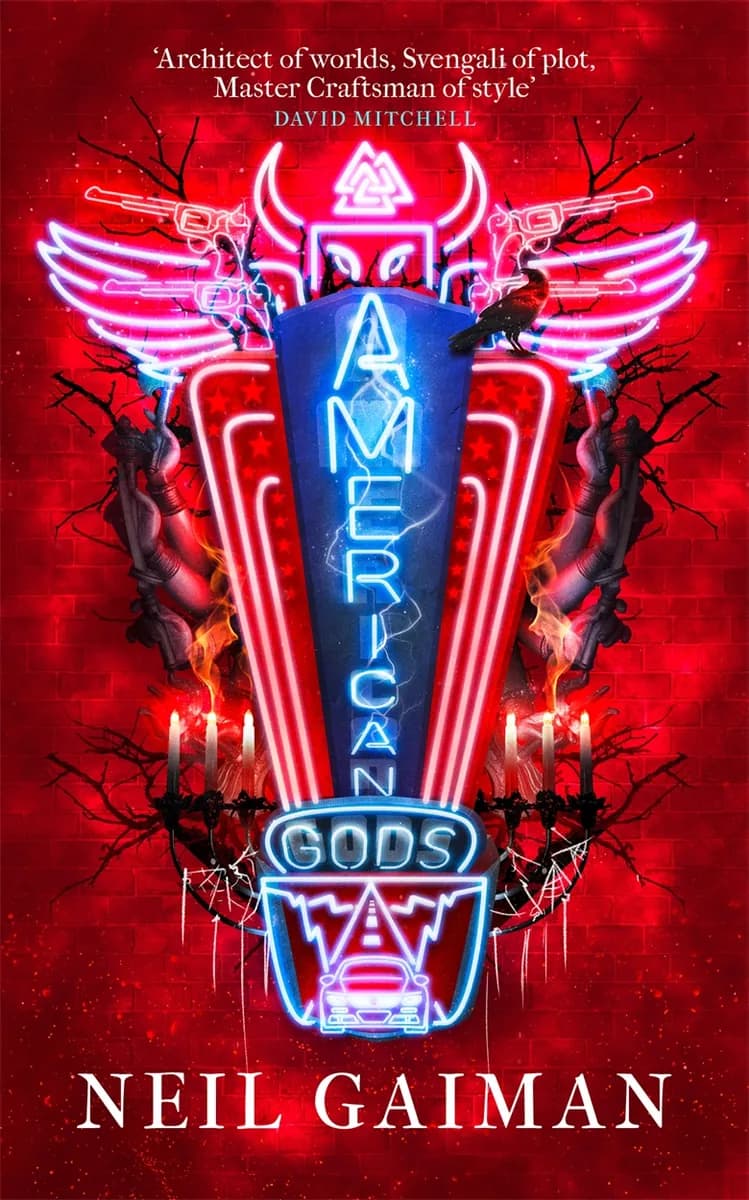
Neil Gaiman
Quotes
"I want to rest now," said Shadow. "That’s what I want. I want nothing. No heaven, no hell, no anything. Just let it end."
"You're certain?" asked Thoth.
"Yes," said Shadow.
Mr. Jacquel opened the last door for Shadow, and behind that door there was nothing. Not darkness. Not even oblivion. Only nothing.
Shadow accepted it, completely and without reservation, and he walked through the door into nothing with a strange fierce joy.
"San Francisco isn’t in the same country as Lakeside anymore than New Orleans is in the same country as New York or Miami is in the same country as Minneapolis."
"Is that so?" said Shadow, mildly.
"Indeed it is. They may share certain cultural signifiers—money, a federal government, entertainment—it’s the same land, obviously—but the only things that give it the illusion of being one country are the greenback, The Tonight Show, and McDonald’s."
Shadow shook his head. "You know," he said, "I think I would rather be a man than a god. We don’t need anyone to believe in us. We just keep going anyhow. It’s what we do."
It was in North Carolina, when she had seen the food for the slave children and the dogs poured into the same trough, and she had seen her little children scrabbling with the dogs for the scraps. She saw that happen one day—and she had seen it before, every day on that plantation, and she would see it again many times before she left—she saw it that one day and it broke her heart.
We do not always remember the things that do no credit to us. We justify them, cover them in bright lies or with the thick dust of forgetfulness. All of the things that Shadow had done in his life of which he was not proud, all the things he wished he had done otherwise or left undone, came at him then in a swirling storm of guilt and regret and shame, and he had nowhere to hide from them. He was as naked and as open as a corpse on a table, and dark Anubis the jackal god was his prosecutor and his persecutor.
And I know an eighteenth charm, and that charm is the greatest of all, and that charm I can tell no man, for a secret that no one knows but you is the most powerful secret there can ever be.
"Gods are great," said Atsula, slowly, as if she were imparting a great secret. "But the heart is greater. For it is from our hearts they come, and to our hearts they shall return..."
Without individuals we see only numbers: a thousand dead, a hundred thousand dead, "casualties may rise to a million." With individual stories, the statistics become people — but even that is a lie, for the people continue to suffer in numbers that themselves are numbing and meaningless. Look, see the child’s swollen, swollen belly, and the flies that crawl at the corners of his eyes, his skeletal limbs: will it make it easier for you to know his name, his age, his dreams, his fears? To see him from the inside? And if it does, are we not doing a disservice to his sister, who lies in the searing dust beside him, a distorted, distended caricature of a human child? And there, if we feel for them, are they now more important to us than a thousand other children touched by the same famine, a thousand other young lives who will soon be food for the flies’ own myriad squirming children?
We draw our lines around these moments of pain, and remain upon our islands, and they cannot hurt us. They are covered with a smooth, safe, nacreous layer to let them slip, pearllike, from our souls without real pain.
Fiction allows us to slide into these other heads, these other places, and look out through other eyes. And then in the tale we stop before we die, or we die vicariously and unharmed, and in the world beyond the tale we turn the page or close the book, and we resume our lives.
A life that is, like any other, unlike any other.
"You people talk about the living and the dead as if they were two mutually exclusive categories. As if you cannot have a river that is also a road, or a song that is also a color."
"You can't," said Shadow. "Can you?" The echoes whispered his words back at him from across the pool.
"What you have to remember," said Mr. Ibis, testily, "is that life and death are different sides of the same coin. Like the heads and tails of a quarter."
"And if I had a double-headed quarter?"
"You don't. They only belong to fools, and gods."
There was a girl, and her uncle sold her, wrote Mr. Ibis in his perfect copperplate handwriting.
That is the tale; the rest is detail.
He sat down on a grassy bank and looked at the city that surrounded him, and thought, one day he would have to go home. And one day he would have to make a home to go back to. He wondered whether home was a thing that happened to a place after a while, or if it was something that you found in the end, if you simply walked and waited and willed it long enough.
"All revelations are personal." she said. "That’s why all revelations are suspect."