
Quotes
It was this wave of reforms that turned China into the sweatshop of the world, the preferred location for contract factories for virtually every multinational on the planet. No country offered more lucrative conditions than China: low taxes and tariffs, corruptible officials and, most of all, a plentiful low-wage workforce that, for many years, would be unwilling to risk demanding decent salaries or the most basic workplace protections for fear of the most violent reprisals. (p190)
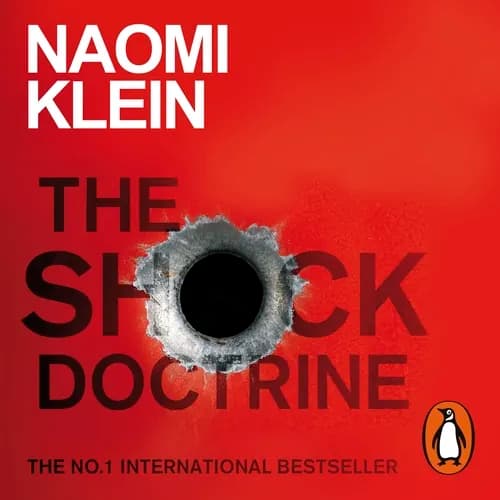
 The Shock Doctrine
When it comes to paying contractors, the sky is the limit; when it comes to financing the basic functions of the state, the coffers are empty. (p409)
The Shock Doctrine...extreme violence has a way of preventing us from seeing the interests it serves. In a way, it had happened already to the antiwar movement.
p. 327
The Shock Doctrine...This is what Keynes had meant when he warned of the dangers of economic chaos—you never know what combination of rage, racism and revolution will be unleashed. (p264)
The Shock DoctrineThe dirty secret of the neoliberal era is that these ideas were never defeated in a great battle of ideas, nor were they voted down in elections. They were shocked out of the way at key political junctures. (p450)
The Shock DoctrineBy the time the think-tank lifers arrived in Baghdad, the crucial roles in the reconstruction had already been outsourced to Halliburton and KPMG. Their job as the public servants was simply to administer the petty cash, which in Iraq took the form of handling shrink-wrapped bricks of hundred-dollar bills to contractors. It was a graphic glimpse into the acceptable role of government in a corporatist state - to act as a conveyor belt for getting public money into private hands, a job for which ideological commitment is far more relevant than elaborate field experience. (p355)
The Shock DoctrineLike Russia's gangsterism and Bush's cronyism, contemporary Iraq is a creation of the fifty-year crusade to privatize the world. Rather than being disowned by its creators, it deserves to be seen as the purest incarnation yet of the ideology that gave it birth. (p359)
The Shock DoctrineDuring the Cold War, widespread alcoholism was always seen in the West as evidence that life under Communism was so dismal that Russians needed large quantities of vodka to get through the day. Under capitalism, however, Russians drinks more than twice as much alcohol as they used to - and they are reaching for harder painkillers as well. (p238)
The Shock DoctrineRegardless of the overall state of the economy, there is now a large enough elite made up of new multi-millionaires and billionaires for Wall Street to see the group as "superconsumers," able to carry consumer demand all on their own. (p392)
The Shock DoctrineThe American Society of Civil Engineers said in 2007 that the U.S. had fallen so far behind in maintaining its public infrastructure -- roads, bridges, schools, dams -- that it would take more than a trillion and half dollars over five years to bring it back up to standard. Instead, these types of expenditures are being cut back. At the same time, public infrastructure around the world is facing unprecedented stress, with hurricanes, cyclones, floods and forest fires all increasing in frequency and intensity. It's easy to imagine a future in which growing numbers of cities have their frail and long-neglected infrastructures knocked out by disasters and then are left to rot, their core services never repaired or rehabilitated. The well-off, meanwhile, will withdraw into gated communities, their needs met by privatized providers. (p415)
The Shock DoctrineAs for journalists and activists, we seemed to be exhausting our attention on the spectacular physical attacks, forgetting that the parties with the most to gain never show up on the battlefield. (p326)
The Shock DoctrineThe widespread abuse of prisoners is a virtually foolproof indication that politicians are trying to impose a system--whether political, religious or economic--that is rejected by large numbers of the people they are ruling. Just as ecologists define ecosystems by the presence of certain "indicator species" of plants and birds, torture is an indicator species of a regime that is engaged in a deeply anti-democratic project, even if that regime happens to have come to power through elections. (p125)
The Shock DoctrineThe recent spate of disasters has translated into such spectacular profits that many people around the world have come to the same conclusion: the rich and powerful must be deliberately causing the catastrophes so that they can exploit them. (p426)
The Shock DoctrineAs a means of extracting information during interrogations, torture is notoriously unreliable, but as a means of terrorizing and controlling populations, nothing is quite as effective. (p126)
The Shock DoctrineThe theory of economic shock therapy relies in part on the role of expectations on feeding an inflationary process. Reining in inflation requires not only changing monetary policy but also changing the behavior of consumers, employers and workers. The role of a sudden, jarring policy shift is that it quickly alters expectations, signaling to the public that the rules of the game have changed dramatically— prices will not keep rising, nor will wages. (p82)
The Shock DoctrineThe coups, wars and slaughters to instill and maintain pro-corporate regimes have never been treated as capitalist crimes but have instead been written off as the excess of overzealous dictators, as hot fronts in the Cold War, and now of the War on Terror. If the most committed opponents of the corporatist economic model are systematically eliminated, whether in Argentina in the seventies or in Iraq today, that suppression is explained- almost never as the fight for the advancement of pure capitalism. (p20)
The Shock Doctrine

That’s all the quotes.
16 quotes in the collection · come back when we add more