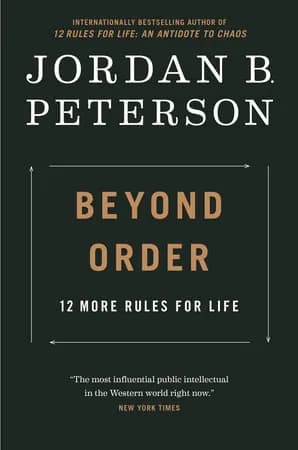
Jordan B. Peterson
Quotes
We could use a poetic metaphor to represent the elements of experience that we have so far discussed (this is in fact how the world I am describing is usually considered). Imagine the realm of the Dragon of Chaos as the night sky, stretching infinitely above you on a clear night, representing what will remain forever outside your domain of understanding. Maybe you are standing on a beach, looking up, lost in contemplation and imagination. Then you turn your attention to the ocean—as grand in its way as the starry cosmos, but tangible and manifest and knowable, comparatively speaking. That is nature. It is not mere potential. It is there, in its unknowability, instead of removed from comprehension entirely. It is not yet tamed, however; not brought into the domain of order. And it is beautiful in its mystery. The moon reflects on its surface; the waves crash eternally and lull you to sleep; you can swim in its welcoming waters. But that beauty has a price. You better keep an eye out for sharks. And poisonous jellyfish. And the riptide that can pull you or your children under. And the storms that could destroy your warm and welcoming beach house.
p. 329
Of course, my socialist colleagues and I weren’t out to hurt anyone. Quite the reverse. We were out to improve things—but we were going to start with other people. I came to see the temptation in this logic, the obvious flaw, the danger—but could also see that it did not exclusively characterize socialism. Anyone who was out to change the world by changing others was to be regarded with suspicion. The temptations of such a position were too great to be resisted.
So, attend carefully to your posture. Quit drooping and hunching around. Speak your mind. Put your desires forward, as if you had a right to them—at least the same right as others. Walk tall and gaze forthrightly ahead. Dare to be dangerous. Encourage the serotonin to flow plentifully through the neural pathways desperate for its calming influence.
p. 27
When the aristocracy catches a cold, as it is said, the working class dies of pneumonia.
p. 4
The Bible is, for better or worse, the foundational document of Western civilization (of Western values, Western morality, and Western conceptions of good and evil). It's the product of processes that remain fundamentally beyond our comprehension. The Bible is a library composed of many books, each written and edited by many people. It's a truly emergent document—a selected, sequenced and finally coherent story written by no one and everyone over many thousands of years. The Bible has been thrown up, out of the deep, by the collective human imagination, which is itself a product of unimaginable forces operating over unfathomable spans of time. Its careful, respectful study can reveal things to us about what we believe and how we do and should act that can be discovered in almost no other manner.
p. 104
To stand up straight with your shoulders back is to accept the terrible responsibility of life, with eyes wide open. It means deciding to voluntarily transform the chaos of potential into the realities of habitable order. It means adopting the burden of self-conscious vulnerability, and accepting the end of the unconscious paradise of childhood, where finitude and mortality are only dimly comprehended. It means willingly undertaking the sacrifices necessary to generate a productive and meaningful reality (it means acting to please God, in the ancient language).
p. 27
Behavior is imitated, then abstracted into play, formalized into drama and story, crystallized into myth and codified into religion—and only then criticized in philosophy, and provided, post-hoc, with rational underpinnings.
p. 78
The first step, perhaps, is to take stock. Who are you? When you buy a house and prepare to live in it, you hire an inspector to list all its faults—as it is, in reality, now, not as you wish it could be. You’ll even pay him for the bad news. You need to know. You need to discover the home’s hidden flaws. You need to know whether they are cosmetic imperfections or structural inadequacies. You need to know because you can’t fix something if you don’t know it’s broken—and you’re broken. You need an inspector. The internal critic—it could play that role, if you could get it on track; if you and it could cooperate.
p. 93
We require routine and tradition. That’s order. Order can become excessive, and that’s not good, but chaos can swamp us, so we drown—and that is also not good. We need to stay on the straight and narrow path.
Standards of better or worse are not illusory or unnecessary. If you hadn’t decided that what you are doing right now was better than the alternatives, you wouldn’t be doing it. The idea of a value-free choice is a contradiction in terms. Value judgments are a precondition for action. Furthermore, every activity, once chosen, comes with its own internal standards of accomplishment. If something can be done at all, it can be done better or worse.
p. 87
If you can bite, you generally don't have to.
p. 23
Every explorer is therefore, by necessity, a revolutionary, and every successful revolutionary is a peacemaker.
p. 179