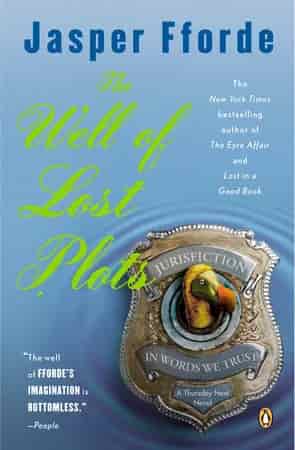
Jasper Fforde
Quotes
“Do you know what the worst bit about dying is?”
“Tell me, Gran.”
“You never get to see how it all turns out.”
p. 136
“Well,” he said thoughtfully, “it is my considered opinion that most coincidences are simply quirks of chance—if you extrapolate the bell curve of probability you will find statistical abnormalities that seem unusual but are, in actual fact, quite likely, given the amount of people on the planet and the amount of different things we do in our lives.”
p. 87
Like any other big government department, it looks good on paper but is an utter shambles. Petty infighting and political agendas, arrogance and sheer bloody-mindedness almost guarantees that the left hand doesn’t know what the right is doing.
p. 18
“We’re fine, Joff. You?”
“Not that good, Thurs. The Church of the Global Standard Deity has undergone a split.”
“No!” I said with his much surprise and concern in my voice as I could muster.
“I’m afraid so. The new Global Standard Clockwise Deity have broken away due to unresolvable differences over the direction in which the collection plate is passed round.”
“Another split? That’s the third this week!”
“Fourth,” replied Joffy dourly, “and it’s only Tuesday. The Standardized pro-Baptist conjoined Methodarian-Lutherian sisters of something-or-other split into two subgroups yesterday. Soon,” he added grimly, “there won’t be enough ministers to man the splits.”
p. 81
You’ve got a face longer than a Dickens novel.
p. 371
“James Crometty!” demanded Bowden. “Did you kill him?”
“I kill a lot of people,” whispered Felix7. “I don’t remember names.”
“You shot him six times in the face.”
The dying killer smiled.
“That I remember.”
“Six times! Why?”
Felix7 frowned and started to shiver.
“Six was all I had,” he answered simply.
p. 166
The industrial age had only just begun; the planet had reached its Best Before date.
p. 318
“Haven’t I seen your face somewhere else?”
“No, it’s always been right here on the front of my head.”
p. 248
“And nothing can stop it?”
“Nothing I know of,” he replied sadly. “The best way to stop this is to not allow it to start—sort of a minimum entry requirement for man-made disasters, really.”
p. 377
The atmosphere in the room was so thick with dramatic clichés you could have cut it with a knife.
p. 55
“Write is only the word we use to describe the recording process,” replied Snell as we walked along. “The Well of Lost Plots is where we interface the writer’s imagination with the characters and plots so that it will make sense in the reader’s mind. After all, reading is arguably a far more creative and imaginative process than writing; when the reader creates emotion in their head, or the colors of the sky during the setting sun, or the smell of a warm summer’s breeze on their face, they should reserve as much praise for themselves as they do for the writer—perhaps more.”
p. 48
“Books”—Snell smiled—“are a kind of magic.”
p. 49