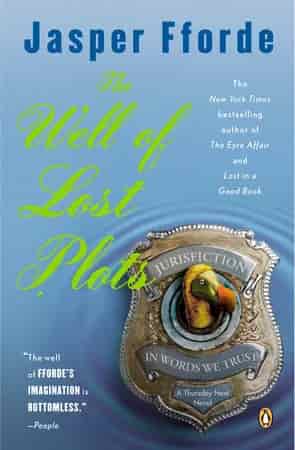
Jasper Fforde
Quotes
“Incredibly enough, reality TV has just gotten worse.”
“Is that possible? I asked. “Wasn’t Celebrity Trainee Pathologist the pits?” I thought for a moment. “Actually, Whose Life Support Do We Switch Off? was worse. Or maybe Sell Your Granny. Wow, the choice these days makes it also tricky to decide.
Bowden laughed.
“I’ll agree that Granny lowered the bar for distasteful program makers everywhere, but RTA-TV, never one to shrink from a challenge, has devised Samaritan Kidney Swap. Ten renal-failure patients take turns trying to convince a tissue-typed donor—and the voting viewers—which one should have his spare kidney.”
I groaned. Reality TV was to me the worst form of entertainment—the modern equivalent of paying sixpence to watch lunatics howling at the wall down at the local madhouse.
p. 26
Noting with dismay that most cross-religion bickering occurred only because all the major religions were convinced that they were the right one and every other religion was the wrong one, the founders of the Global Standard Deity based their fledgling “portmanteau” faith on the premise that most religions want the same thing once all the shameless, manipulative power play had been subtracted: peace, stability, equality and justice—the same as the nonfaiths. As soon as they found that centralizing thread that unites all people and makes a dialogue of sorts with a Being of Supreme Moral Authority mostly optional, the GSD flourished.
p. 125
“Tell them ballocks.”
“They’ll pay me five hundred guineas.”
“Cancel the ballocks thing—tell them you’ll be honored and overjoyed.”
“It’s a sellout. I don’t do sellouts. Not for that price anyway.”
p. 6
Hamlet would worry about having nothing to worry about if he had nothing to worry about.
p. 21
For centuries I’ve been worrying about audiences seeing me as a mouthy spoiled brat who can’t make up his mind about anything, but, having seen the real world, I can understand the appeal. My play is popular because my failings are your failings, my indecision the indecision of you all. We all know what has to be done; it’s just that sometimes we don’t know how to get there. Acting without thought doesn’t really help in the long run. I might dither for a while, but at least I make the right decision in the end: I bear my troubles and take arms against them. And thereby lies a message for all mankind, although I’m not exactly sure what it is. Perhaps there’s no message. I don’t really know. Besides, if I don’t dither, there’s no play.
p. 371
But his hits were greater than the sum of his misses, and such is the way with greatness.
p. 97
Money had never been a problem in the Book World. All the details of life were taken care of by something called Narrative Assumption. A reader would assume you had gone shopping, or gone to the toilet, or brushed your hair, so a writer never needed to outline it.
p. 72
Preservation without expenditure is worthless.
p. 157
“Listen to what it says in the horoscopes: ‘If it is your birthday, there may be an increased amount of mail. Expect gifts, friendly salutations from people and the occasional surprise. Possibility of cake.’ That’s so weird—I wonder if any of it will come true?”
p. 48
Tyrants are all the same—shocking temper when they don’t get their own way!
p. 306
Good evening and welcome to Evade the Question Time, the nation’s premier topical talk show. Tonight, as every night, a panel of distinguished public figures generally evade answering the audience’s questions and instead toe the party line.
p. 47
“’Tis very strange!” he murmured, staring at the sun, trees, houses and traffic in turn. “It would take a rhapsody of wild and whirling words to do justice of all that I witness!”
“You’re going to have to speak English out here.”
“All this,” explained Hamlet, waving his hands at the fairly innocuous Swindon street, “would take millions of words to describe correctly!”
“You’re right. It would. That’s the magic of the book imagino-transference technology,” I told him. “A few dozen words conjure up an entire picture. But in all honesty the reader does most of the work.”
“The reader? What’s it got to do with him?”
“Well, each interpretation of an event, setting or character is unique to each of those who read it because they clothe the author’s description with the memory of their own experiences. Every character they read is actually a complex amalgam of people that they’ve met, read or seen before—far more real than it can ever be just from the text on the page. Because every reader’s experiences are different, each book is unique for each reader.”
p. 21