
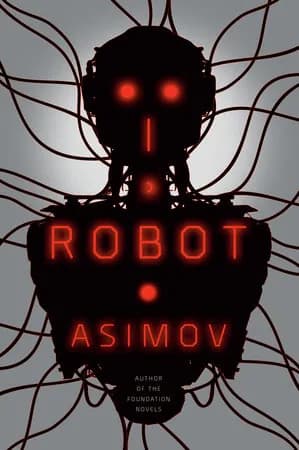
Quotes
“Fifty years,” I hackneyed, “is a long time.”
“Not when you’re looking back at them,” she said. “You wonder how they vanished so quickly.”
p. 8
I accept nothing on authority. A hypothesis must be backed by reason, or else it is worthless.
p. 52
Milton Ashe is not the type to marry a head of hair and a pair of eyes.
p. 89
“Nonsense,” Weston denied, with an involuntary nervous shiver. “That’s completely ridiculous. We had a long discussion at the time we bought Robbie about the First Law of Robotics. You know that it is impossible for a robot to harm a human being; that long before enough can go wrong to alter that First Law, a robot would be completely inoperable. It’s a mathematical impossibility. Besides I have an engineer from U.S. Robots here twice a year to give the poor gadget a complete overhaul. Why, there’s no more chance of anything at all going wrong with Robbie than there is of you or I suddenly going looney—considerably less, in fact.”
p. 17
There's nothing like deduction. We've determined everything about our problem but the solution.
p. 41
There is nothing so eternally adhesive as the memory of power.
p. 189
The machine is only a tool after all, which can help humanity progress faster by taking some of the burdens of calculations and interpretations off its back. The task of the human brain remains what it has always been; that of discovering new data to be analyzed, and of devising new concepts to be tested.
p. 187
The unwritten motto of United States Robot and Mechanical Men Corp. was well-known: “No employee makes the same mistake twice. He is fired the first time.”
p. 65
Just you think first, and don't bother to speak afterward, either.
p. 71
“You can prove anything you want by coldly logical reason—if you pick the proper postulates. We have ours and Cutie [robot QT-1] has his.”
“Then let’s get at those postulates in a hurry. The storm’s due tomorrow.”
Powell sighed wearily. “That’s where everything falls down. Postulates are based on assumptions and adhered to by faith. Nothing in the Universe can shake them. ...”
p. 63
Francis Quinn was a politician of the new school. That, of course, is a meaningless expression, as are all expressions of the sort. Most of the “new schools” we have were duplicated in the social life of ancient Greece, and perhaps, if we knew more about it, in the social life of ancient Sumeria and in the lake dwellings of prehistoric Switzerland as well.
p. 148
“You’re the U. S. Robot’s psychologist, aren’t you?”
“Robopsychologist, please.”
“Oh, are robots so different from men, mentally?”
“Worlds different.” She allowed herself a frosty smile, “Robots are essentially decent.”
p. 151
“There’s danger of violence?”
“The Fundamentalists threaten it, so I suppose there is, in a theoretical sense. But I don’t really expect it. The Fundies have no real power. They’re just the continuous irritant factor that might stir up a riot after a while.”
p. 165
"Why, Stephen, if I am right, it means that the Machine is conducting our future for us not only simply in direct answer to our direct questions, but in general answer to the world situation and to human psychology as a whole. And to know that may make us unhappy and may hurt our pride. The Machine cannot, must not, make us unhappy.
"Stephen, how do we know what the ultimate good of Humanity will entail? We haven't at our disposal the infinite factors that the Machine has at its! Perhaps, to give you a not unfamiliar example, our entire technical civilization has created more unhappiness and misery than it has removed. Perhaps an agrarian or pastoral civilization, with less culture and less people would be better. If so, the Machines must move in that direction, preferably without telling us, since in our ignorant prejudices we only know that what we are used to, is good—and we would then fight change. Or perhaps a complete urbanization, or a completely caste-ridden society, or complete anarchy, is the answer. We don't know. Only the Machines know, and they are going there and taking us with them."
"But you are telling me, Susan, that the 'Society for Humanity' is right; and that Mankind has lost its own say in its future."
"It never had any, really. It was always at the mercy of economic and sociological forces it did not understand—at the whims of climate, and the fortunes of war. Now the Machines understand them; and no one can stop them, since the Machines will deal with them as they are dealing with the Society,—having, as they do, the greatest of weapons at their disposal, the absolute control of our economy."
"How horrible!"
"Perhaps how wonderful! Think, that for all time, all conflicts are finally evitable. Only the Machines, from now on, are inevitable!"
p. 192
That’s all the quotes.
14 quotes in the collection · come back when we add more