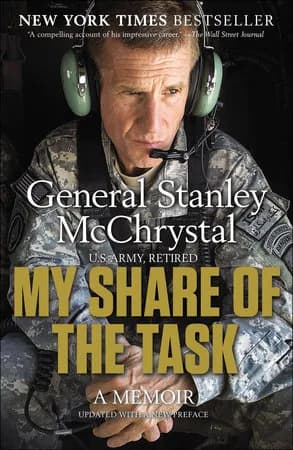
General Stanley McChrystal
Quotes
As visible symbols, soldiers often receive praise or condemnation, and both reactions feel curiously undeserved.
p. 13
In the end, leadership is a choice. Rank, authority, and even responsibility can be inherited or assigned, whether or not an individual desires or deserves them. Even the mantle of leadership occasionally falls to people who haven't sought it. But actually leading is different. A leader decides to accept responsibility for others in a way that assumes stewardship of their hopes, their dreams, and sometimes their very lives. It can be a crushing burden, but I found it an indescribable honor.
p. 394
When the ceremony ended Anne and I stayed on the field to greet friends, many of whom had traveled to share the ceremony with us. In one respect it was a difficult day at the end of a difficult month. But in the broader view of life, it was a magical evening at the end of an incredible journey we shared. We walked back over to the quarters we would move out of a few days later, and found friends in the yard and almost every room. At one point I saw Mike Hall, Charlie Flynn, Shawn Lowery, and Casey Welch standing in the fading summer light. I thought of my father, of my first day at West Point, and of our cold Christmas Eve flight over Afghanistan seven months before. The final words of my last speech in uniform, spoken just an hour before were repeated in my mind: "If I had it to do over again, I'd do some things in my career differently, but not many. I believed in people, and I still believe in them. I trusted and I still trust. I cared and I still care. I wouldn't have it any other way... To the young leaders of today and tomorrow, it's a great life. Thank you."
p. 394
While I had enjoyed other jobs, I loved command. I had been in a command position for ten of the previous twenty-six years. But each new position was initially daunting. As I suspect many leaders feel, I was never sure if I could command at the next level until I actually assumed the job. I remembered how Douglas Southall Freeman, in Lee's Lieutenants, had described Lee's challenges in determining which brigade commanders could actually handle the responsibilities of a division or corps. The most aggressive brigade commanders often lacked the intangible qualities required for more senior leadership. Of course I often wondered about myself. As the demands of the positions differed, I found that I had changed as a leader. I learned to ask myself two questions: First, what must the organization I command do and be? And second, how can I best command to achieve that? Experience taught me that many factors would shape my "command style," and it would be some time before I had settled into it.
p. 95
At the heart of the story is Afghanistan itself, a complex swirl of ethnic and political rivalries, cultural intransigence, strains of religious fervor, and bitter memories overlaid on a beautiful, but harshly poor, landscape. Without internal struggles or outside influence, Afghanistan would be a difficult place to govern, and a challenge to develop. And there have always been struggles and interference. But it's not just that. In her beauty and coarseness, in her complexity and tragedy Afghanistan possesses a mystical quality, a magnetism. Few places have such accumulated layers of culture, religion, history, and lore that instill both fear and awe. Yet those who seek to budge her trajectory are reminded that dreams often end up buried in the barren slopes of the Hindu Kush or in muddy fields alongside the Helmand River.
For a boy who'd grown up on stories of legionnaires, it was easy to feel the thick spirit that filled this small outpost, home to the parachute battalion that had this corner of the fight. I had come to thank them for their service and their courage. Talking to young soldiers, some already seasoned warriors, who had purposely selected a life of expeditionary service, I thought of their predecessors in Indochina and Algeria. I looked over at two of my aides, one a German officer, another an Afghan. How different wars could be, I thought, but the soldiers seemed the same.
p. 385
As the story unfolds many things appear: extraordinary sacrifice and teamwork, often alongside an atmosphere of mistrust, uncertainty, media scrutiny, and politics. There is a temptation to seek a single hero or culprit- a person, group, or policy- that emerges as the decisive factor. This makes for better intrigue, but it's a false drama. To do so is to oversimplify the war, the players, and Afghanistan itself. Because despite their relevance as contributing factors, I found no single personality, decision, relationship, or event that determined the outcome or even dominated the direction of events. Afghanistan did that. Only Afghanistan, with her deep scars and opaque complexity, emerged as the essential reality and dominant character. On her brutal terrain, and in the minds of her people, the struggle was to be waged and decided. No outcome was preordained, but nothing would come easily. Few things of value do.
p. 278
People are born; leaders are made. I was born the son of a leader with a clear path to a profession of leadership. But whatever leadership I later possessed, I learned from others. I grew up in a household of overt values, many of which hardened in me only as I matured. Although history fascinated me, and mentors surrounded me, the overall direction and key decisions of my life and career were rarely impacted by specific advice, or even a particularly relevant example I'd read or seen. I rarely wondered What would Nelson, Buford, Grant, or my father have done? But as I grew, I was increasingly aware of the guideposts and guardrails that leaders had set for me, often through their examples. The question became What kind of leader have I decided to be? Over time, decisions came easily against that standard, even when the consequences were grave.
p. 393
When I entered West Point, some Americans still believed the Vietnam War might end honorably. By the time I graduated, South Vietnam did not exist. As cadets, we watched the war teeter and implode, and the historical sweep was not lost on us.
p. 17
It was a lot to ask of Annie, but I never had to. There was no cautious conversation in which I broke the news to her, or asked her permission- I didn't need to. I knew that for as long as I wore the uniform, whatever I had to do, Annie would support me.
p. 288
All leaders are human. They get tired, angry, and jealous and carry the same range of emotions and frailties common to mankind. Most leaders periodically display them. The leaders I most admired were totally human but constantly strove to be the best humans they could be. Leaders make mistakes, and they are often costly. The first reflex is normally to deny the failure to themselves; the second is to hide it from others, because most leaders covet a reputation for infallibility. But it's a fool's dream and inherently dishonest. There are few secrets to leadership. It is mostly just hard work. More than anything else it requires self-discipline. Colorful, charismatic characters often fascinate people, even soldiers. But over time, effectiveness is what counts. Those who lead most successfully do so while looking out for their followers' welfare.
p. 393
Leaders are not necessarily popular. For soldiers, the choice between popularity and effectiveness is ultimately no choice at all. Soldiers want to win; their survival depends on it. They will accept, and even take pride in, the quirks and shortcomings of a leader if they believe he can produce success.
p. 392