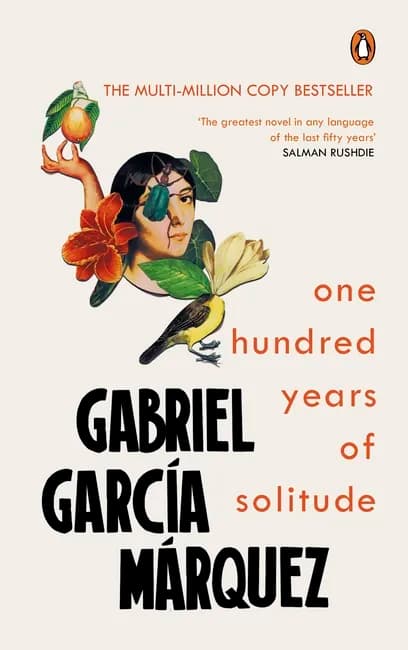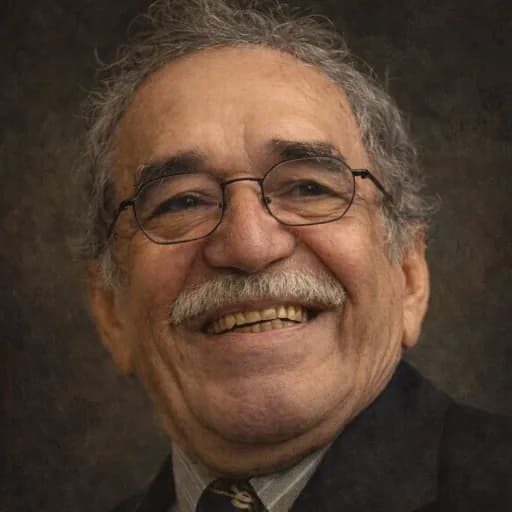
Gabriel Garcia Marquez
Quotes
In the shattered schoolhouse where for the first time he had felt the security of power, a few feet from the room where he had come to know the uncertainty of love, Arcadio found the formality of death ridiculous. Death really did not matter to him but life did and therefore the sensation he felt when they gave their decision was not a feeling of fear but of nostalgia. He did not speak until they asked him for his last request.
p. 148
While [Aureliano Segundo] was shut up in Melquíades room he was drawn into himself, like how Coronel Aurelian Buendía had been in his youth. But just before the treaty of Neerlandia a piece of chance took him out of his withdrawn self and made him face the reality of the world. A young woman who was selling numbers for the raffle of an accordion greeted him with a great deal of familiarity. Aureliano Segundo was not surprised, for he was frequently confused with his brother. But he did not clear up the mistake, not even when the girl tried to soften his heart with sobs, and she ended taking him to her room. […] Aureliano Segundo realized that the woman had been going to bed alternately with him and his brother, thinking that they were the same man, and instead of making things clear, he arranged to prolong the situation. He did not return to Melquíades' room. […]
For almost two months he shared the woman with his brother.[…] One morning he discovered that he was sick. Two days later he found his brother clinging to a beam in the bathroom. […] José Arcadio Segundo did not see the woman again. Aureliano Segundo obtained her pardon and stayed with her until his death.
p. 228
The lesson was not interrupted, but the girl raised her eyes to see who was passing by the window, and that casual glance was the beginning of a cataclysm of love that still had not ended half a century later.
p. 80
He had made notes of these premature observations, intending to write a practical supplement to the Lovers’ Companion, but the project met the same fate as the previous one after Ausencia Santander sent him tumbling with her old dog’s wisdom, stood him on his head, tossed him up and threw him down, made him as good as new, shattered all his virtuous theories, and taught him the only thing he had to learn about love: that nobody teaches life anything.
p. 235
Florentina Ariza had kept his answer ready for fifty-three years, seven months, and eleven days and nights.
'Forever,' he said.
p. 461
“Save that powder for when the Liberals come,” he said with good humor. “We are no longer in the Middle Ages.”
p. 157
"I adore you because you made me a whore"
p. 205
He allowed himself to be swayed by his conviction that human beings are not born once and for all on the day their mothers give birth to them, but that life obliges them over and over again to give birth to themselves.
p. 221
A man knows when he is growing old because he begins to look like his father.
p. 227
It had to teach her to think of love as a state of grace: not the means to anything but the alpha and omega, an end in itself.
p. 390
To him she seemed so beautiful, so seductive, so different from ordinary people, that he could not understand why no one was as disturbed as he by the clicking of her heels on the paving stones, why no one else's heart was wild with the breeze stirred by the sighs of her veils, why everyone did not go mad with the movements of her braid, the flight of her hands, the gold of her laughter. He had not missed a single one of her gestures, not one of the indications of her character, but he did not dare approach her for fear of destroying the spell.
p. 140
"We men are the miserable slaves of prejudice."
p. 437