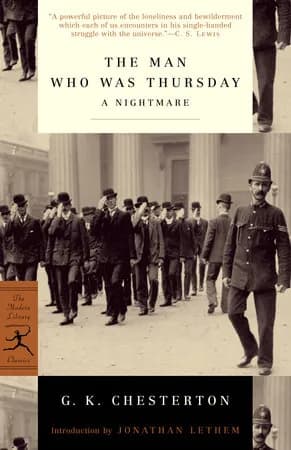
G. Chesterton
Quotes
"I see everything," he cried, "everything that there is. Why does each thing on the earth war against each other thing? Why does each small thing in the world have to fight against the world itself? Why does a fly have to fight the whole universe? Why does a dandelion have to fight the whole universe? For the same reason that I had to be alone in the dreadful Council of the Days. So that each thing that obeys law may have the glory and isolation of the anarchist. So that each man fighting for order may be as brave and good a man as the dynamiter. So that the real lie of Satan may be flung back in the face of this blasphemer, so that by tears and torture we may earn the right to say to this man, 'You lie!' No agonies can be too great to buy the right to say to this accuser, "We also have suffered."
"It is not true that we have never been broken. We have been broken upon the wheel. It is not true that we have never descended from these thrones. We have descended into hell. We were complaining of unforgettable miseries even at the very moment when this man entered insolently to accuse us of happiness. I repel the slander; we have not been happy. I can answer for every one of the great guards of Law whom he has accused. At least —"
He had turned his eyes so as to see suddenly the great face of Sunday, which wore a strange smile.
"Have you," he cried in a dreadful voice, "have you ever suffered?"
As he gazed, the great face grew to an awful size, grew larger than the colossal mask of Memnon, which had made him scream as a child. It grew larger and larger, filling the whole sky; then everything went black. Only in the blackness before it entirely destroyed his brain he seemed to hear a distant voice saying a commonplace text that he had heard somewhere, "Can ye drink of the cup that I drink of?"
This particular evening, if it is remembered for nothing else, will be remembered in that place for its strange sunset. It looked like the end of the world. All the heaven seemed covered with a quite vivid and palpable plumage; you could only say that the sky was full of feathers, and of feathers that almost brushed the face. Across the great part of the dome they were grey, with the strangest tints of violet and mauve and an unnatural pink or pale green; but towards the west the whole grew past description, transparent and passionate, and the last red-hot plumes of it covered up the sun like something too good to be seen. The whole was so close about the earth, as to express nothing but a violent secrecy. The very empyrean seemed to be a secret. It expressed that splendid smallness which is the soul of local patriotism. The very sky seemed small.
I say that there are some inhabitants who may remember the evening if only by that oppressive sky.
Was anyone wearing a mask? Was anyone anything? This wood of witchery, in which men's faces turned black and white by turns, in which their figures first swelled into sunlight and then faded into formless night, this mere chaos of chiaroscuro (after the clear daylight outside), seemed to Syme a perfect symbol of the world in which he had been moving for three days, this world where men took off their beards and their spectacles and their noses, and turned into other people. That tragic self-confidence which he had felt when he believed that the Marquis was a devil had strangely disappeared now that he knew that the Marquis was a friend. He felt almost inclined to ask after all these bewilderments what was a friend and what an enemy. Was there anything that was apart from what it seemed? The Marquis had taken off his nose and turned out to be a detective. Might he not just as well take off his head and turn out to be a hobgoblin? Was not everything, after all, like this bewildering woodland, this dance of dark and light? Everything only a glimpse, the glimpse always unforeseen, and always forgotten. For Gabriel Syme had found in the heart of that sun-splashed wood what many modern painters had found there. He had found the thing which the modern people call Impressionism, which is another name for that final scepticism which can find no floor to the universe.
It never occurred to him to be spiritually won over to the enemy. Many moderns, inured to a weak worship of intellect and force, might have wavered in their allegiance under this oppression of a great personality. They might have called Sunday the super-man. If any such creature be conceivable, he looked, indeed, somewhat like it, with his earth-shaking abstraction, as of a stone statue walking. He might have been called something above man, with his large plans, which were too obvious to be detected, with his large face, which was too frank to be understood. But this was a kind of modern meanness to which Syme could not sink even in his extreme morbidity. Like any man, he was coward enough to fear great force; but he was not quite coward enough to admire it.
That has been for me the mystery of Sunday, and it is also the mystery of the world. When I see the horrible back, I am sure the noble face is but a mask. When I see the face but for an instant, I know the back is only a jest.
If you'd take your head home and boil it for a turnip it might be useful. I can't say. But it might.
Then he tried to blast my claims intellectually. I countered that by a very simple dodge. Whenever he said something that nobody but he could understand, I replied with something which I could not even understand myself.
Life was a fly that faded, and death a drone that stung;
The world was very old indeed when you and I were young.
They twisted even decent sin to shapes not to be named:
Men were ashamed of honour; but we were not ashamed.
''A cloud was on the mind of men, and wailing went the weather,
Yea, a sick cloud upon the soul when we were boys together.
Science announced nonentity and art admired decay;
The world was old and ended: but you and I were gay;
Round us in antic order their crippled vices came —
Lust that had lost its laughter, fear that had lost its shame.
"I swear to you, then," said MacIan, after a pause. "I swear to you that nothing shall come between us. I swear to you that nothing shall be in my heart or in my head till our swords clash together. I swear it by the God you have denied, by the Blessed Lady you have blasphemed; I swear it by the seven swords in her heart. I swear it by the Holy Island where my fathers are, by the honour of my mother, by the secret of my people, and by the chalice of the Blood of God."
The atheist drew up his head. "And I," he said, "give my word."
It is the one great weakness of journalism as a picture of our modern existence, that it must be a picture made up entirely of exceptions. We announce on flaring posters that a man has fallen off a scaffolding. We do not announce on flaring posters that a man has not fallen off a scaffolding. Yet this latter fact is fundamentally more exciting, as indicating that that moving tower of terror and mystery, a man, is still abroad upon the earth. That the man has not fallen off a scaffolding is really more sensational; and it is also some thousand times more common. But journalism cannot reasonably be expected thus to insist upon the permanent miracles. Busy editors cannot be expected to put on their posters, "Mr. Wilkinson Still Safe," or "Mr. Jones, of Worthing, Not Dead Yet." They cannot announce the happiness of mankind at all. They cannot describe all the forks that are not stolen, or all the marriages that are not judiciously dissolved. Hence the complex picture they give of life is of necessity fallacious; they can only represent what is unusual. However democratic they may be, they are only concerned with the minority.
And it is not very difficult to see where we have really to look for it. The people (as I tactfully pointed out to them) who really take the name of the Lord in vain are the clergymen themselves. The thing which is fundamentally and really frivolous is not a careless joke. The thing which is fundamentally and really frivolous is a careless solemnity. If Mr. McCabe really wishes to know what sort of guarantee of reality and solidity is afforded by the mere act of what is called talking seriously, let him spend a happy Sunday in going the round of the pulpits. Or, better still, let him drop in at the House of Commons or the House of Lords. Even Mr. McCabe would admit that these men are solemn—more solemn than I am. And even Mr. McCabe, I think, would admit that these men are frivolous—more frivolous than I am. Why should Mr. McCabe be so eloquent about the danger arising from fantastic and paradoxical writers? Why should he be so ardent in desiring grave and verbose writers? There are not so very many fantastic and paradoxical writers. But there are a gigantic number of grave and verbose writers; and it is by the efforts of the grave and verbose writers that everything that Mr. McCabe detests (and everything that I detest, for that matter) is kept in existence and energy. How can it have come about that a man as intelligent as Mr. McCabe can think that paradox and jesting stop the way? It is solemnity that is stopping the way in every department of modern effort.