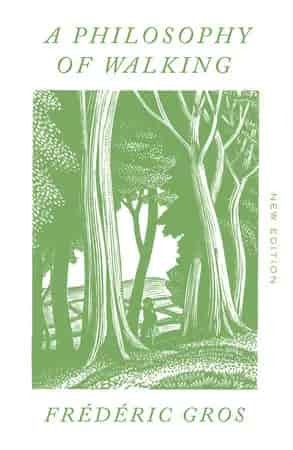
You are nobody to the hills or the thick boughs heavy with greenery. You are no longer a role, or a status… — Frederic Gros
You are nobody to the hills or the thick boughs heavy with greenery. You are no longer a role, or a status, not even an individual, but a body, a body that feels sharp stones on the paths, the caress of long grass and the freshness of the wind. When you walk, the world has neither present nor future: nothing but the cycle of mornings and evenings. Always the same thing to do all day: walk.
On n’est jamais personne pour les collines et les grandes frondaisons. On n’est plus ni un rôle, ni un statut, pas même un personnage, mais un corps, un corps qui ressent la pointe des cailloux sur les chemins, la caresse des hautes herbes et la fraîcheur du vent. Quand on marche, le monde n’a plus ni présent, ni futur. Il n’y a plus que le cycle des matins et des soirs. Toujours à faire la même chose tout le jour : marcher.
Source: Wikiquote · CC BY-SA 4.0
More from this book
But walking causes absorption. Walking interminably, taking in through your pores the height of the mountains when you are confronting them at length, breathing in the shape of the hills for hours at a time during a slow descent. The body becomes steeped in the earth it treads. And thus, gradually, it stops being in the landscape: it becomes the landscape. That doesn’t have to mean dissolution, as if the walker were fading away to become a mere inflection, a footnote. It’s more a flashing moment: sudden flame, time catching fire. And here, the feeling of eternity is all at once that vibration between presences. Eternity, here, in a spark.
Perhaps the itinerant monks called ‘Gyrovagues’ were especially responsible for promoting this view of our condition as eternal strangers. They journeyed ceaselessly from monastery to monastery, without fixed abode, and they haven’t quite disappeared, even today: it seems there are still a handful tramping Mount Athos. They walk for their entire lives on narrow mountain paths, back and forth on a long repeated round, sleeping at nightfall wherever their feet have taken them; they spend their lives murmuring prayers on foot, walk all day without destination or goal, this way or that, taking branching paths at random, turning, returning, without going anywhere, illustrating through endless wandering their condition as permanent strangers in this profane world.
First of all, there is the suspensive freedom that comes by walking, even a simple short stroll: throwing of the burden of cares, forgetting business for a time. You choose to leave the once behind, go out, stroll around, think about other things. With a longer excursion of several days, the process of self-liberation is accentuated: you escape the constraints of work, throw of the yoke of routine.