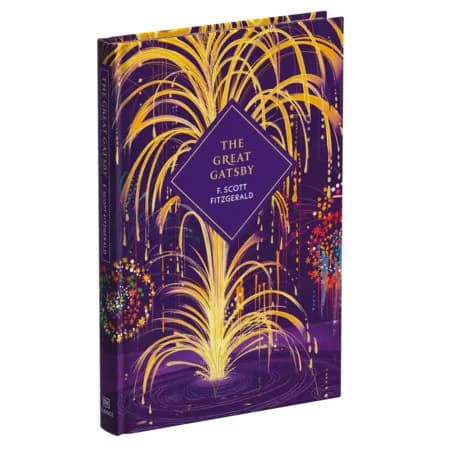
F S Fitzgerald
Quotes
I was rather literary in college […] and now I was going to bring back all such things into my life and become again that most limited of all specialists, the "well-rounded man." This isn’t just an epigram — life is much more successfully looked at from a single window, after all.
p. 4
They were careless people, Tom and Daisy—they smashed up things and creatures and then retreated back into their money or their vast carelessness or whatever it was that kept them together, and let other people clean up the mess they had made....
p. 179
But his heart was in a constant, turbulent riot. The most grotesque and fantastic conceits haunted him in his bed at night. A universe of ineffable gaudiness spun itself out in his brain while the clock ticked on the washstand and the moon soaked with wet light his tangled clothes upon the floor. Each night he added to the pattern of his fancies until drowsiness closed down upon some vivid scene with an oblivious embrace. For a while these reveries provided an outlet for his imagination; they were a satisfactory hint of the unreality of reality, a promise that the rock of the world was founded securely on a fairy’s wing.
p. 99
Most of the big shore places were closed now and there were hardly any lights except the shadowy, moving glow of a ferryboat across the Sound. And as the moon rose higher the inessential houses began to melt away until gradually I became aware of the old island here that flowered once for Dutch sailors’ eyes — a fresh, green breast of the new world. Its vanished trees, the trees that had made way for Gatsby’s house, had once pandered in whispers to the last and greatest of all human dreams; for a transitory enchanted moment man must have held his breath in the presence of this continent, compelled into an aesthetic contemplation he neither understood nor desired, face to face for the last time in history with something commensurate to his capacity for wonder.
And as I sat there, brooding on the old unknown world, I thought of Gatsby's wonder when he first picked out the green light at the end of Daisy’s dock. He had come a long way to this blue lawn and his dream must have seemed so close that he could hardly fail to grasp it. He did not know that it was already behind him, somewhere back in that vast obscurity beyond the city, where the dark fields of the republic rolled on under the night.
Gatsby believed in the green light, the orgastic future that year by year recedes before us. It eluded us then, but that’s no matter — tomorrow we will run faster, stretch out our arms farther.... And one fine morning —
So we beat on, boats against the current, borne back ceaselessly into the past.
p. 180
I wanted to get out and walk eastward toward the park through the soft twilight, but each time I tried to go I became entangled in some wild, strident argument which pulled me back, as if with ropes, into my chair. Yet high over the city our line of yellow windows must have contributed their share of human secrecy to the casual watcher in the darkening streets, and I was him too, looking up and wondering. I was within and without, simultaneously enchanted and repelled by the inexhaustible variety of life.
p. 35
In his blue gardens men and girls came and went like moths among the whisperings and the champagne and the stars.
p. 39
He put his hands in his coat pockets and turned back eagerly to his scrutiny of the house, as though my presence marred the sacredness of the vigil. So I walked away and left him standing there in the moonlight — watching over nothing.
p. 145
[Gatsby] was balancing himself on the dashboard of his car with that resourcefulness of movement that is so peculiarly American — that comes, I suppose, with the absence of lifting work or rigid sitting in youth and, even more, with the formless grace of our nervous, sporadic games. This quality was continually breaking through his punctilious manner in the shape of restlessness. He was never quite still; there was always a tapping foot somewhere or the impatient opening and closing of a hand.
p. 64
Standing behind him, Michaelis saw with a shock that he was looking at the eyes of Doctor T. J. Eckleburg, which had just emerged, pale and enormous, from the dissolving night. “God sees everything,” repeated Wilson.
p. 159
"They're a rotten crowd," I shouted across the lawn. "You're worth the whole damn bunch put together."
I’ve always been glad I said that. It was the only compliment I ever gave him, because I disapproved of him from beginning to end. First he nodded politely, and then his face broke into that radiant and understanding smile, as if we’d been in ecstatic cahoots on that fact all the time.
p. 154
So we drove on toward death in the cooling twilight.
p. 136
That any one should care in this heat whose flushed lips he kissed, whose head made damp the pajama pocket over his heart!
p. 115