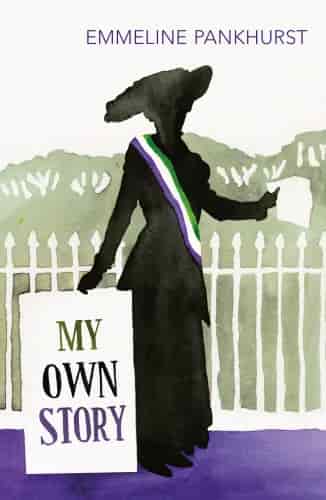
Emmeline Pankhurst
Quotes
One of my earliest recollections is of a great bazaar which was held in my native city of Manchester, the object of the bazaar being to raise money to relieve the poverty of the newly emancipated negro slaves in the United States.... Young as I was—I could not have been older than five years—I knew perfectly well the meaning of the words slavery and emancipation. From infancy I had been accustomed to hear pro and con discussions of slavery and the American Civil War. Although the British government finally decided not to recognise the Confederacy, public opinion in England was sharply divided on the questions both of slavery and of secession. Broadly speaking, the propertied classes were pro-slavery, but there were many exceptions to the rule. Most of those who formed the circle of our family friends were opposed to slavery, and my father... was always a most ardent abolitionist. (Ch. 1)
 My Own Story
[O]ne night when I lay in my little bed waiting for sleep to overtake me. It was a custom of my father and mother to make the round of our bedrooms every night before going themselves to bed. When they entered my room that night I was still awake, but for some reason I chose to feign slumber. My father bent over me, shielding the candle flame with his big hand. I cannot know exactly what thought was in his mind as he gazed down at me, but I heard him say, somewhat sadly, "What a pity she wasn't born a lad."
My first hot impulse was to sit up in bed and protest that I didn't want to be a boy, but I lay still and heard my parents' footsteps pass on toward the next child's bed. I thought about my father's remark for many days afterward, but I think I never decided that I regretted my sex. However, it was made quite clear that men considered themselves superior to women, and that women apparently acquiesced in that belief. (Ch. 1)
My Own StoryIt was two weeks before I saw any of my friends again, and meantime the health of Mrs. Drummond had been so seriously impaired that she was released for hospital treatment. My daughter also, I learned, was ill, and in desperation I made application to the Board of Visiting Magistrates to be allowed to see her. After a long conference, during which I was made to wait outside in the corridor, the magistrates returned a refusal, saying that I might renew my application in a month... My anxiety sent me to bed ill again, but, although I did not know it, relief was already on its way. I had told the visiting magistrates that I would wait until public opinion got within those walls, and this happened sooner than I had dared to hope. Mrs. Drummond, as soon as she was able to appear in public, and the other suffrage prisoners, as they were released, spread broadcast the story of our mutiny, and of a subsequent one led by Miss Wallace Dunlop, which sent a large number of women into solitary confinement. The Suffragettes marched by thousands to Holloway, thronging the approaches to the prison street. Round and round the prison they marched, singing the Women's Marseillaise and cheering. Faintly the sound came to our ears, infinitely lightening our burden of pain and loneliness. The following week they came again, so we afterwards learned, but this time the police turned them back long before they reached the confines of the prison. (Book II, Ch. 4)
My Own StoryI ask my readers, some of whom no doubt will be shocked and displeased at these words of mine that I have so frankly set down, to put themselves in the place of those women who for years had given their lives entirely and unstintingly to the work of securing political freedom for women; who had converted so great a proportion of the electorate that, had the House of Commons been a free body, we should have won that freedom years before; who had seen their freedom withheld from them through treachery and misuse of power. I ask you to consider that we had used, in our agitation, only peaceful means until we saw clearly that peaceful means were absolutely of no avail, and then for years we had used only the mildest militancy, until we were taunted by Cabinet Ministers, and told that we should never get the vote until we employed the same violence that men had used in their agitation for suffrage. After that we had used stronger militancy, but even that, by comparison with the militancy of men in labour disputes, could not possibly be counted as violent. (Book III, Ch. 3)
My Own StoryThe horsemen rode directly into the procession, scattering the women right and left. But still the women would not turn back. Again and again they returned, only to fly again and again from the merciless hoofs. Some of the women left the streets for the pavements, but even there the horsemen pursued them, pressing them so close to walls and railings that they were obliged to retreat temporarily to avoid being crushed. Other strategists took refuge in doorways, but they were dragged out by the foot police and were thrown directly in front of the horses. Still the women fought to reach the House of Commons with their resolution. They fought until their clothes were torn, their bodies bruised, and the last ounce of their strength exhausted. Fifteen of them did actually fight their way through those hundreds on hundreds of police, foot and mounted, as far as the Strangers' Lobby of the House. Here they attempted to hold a meeting, and were arrested. Outside, many more women were taken into custody. It was ten o'clock before the last arrest was made, and the square cleared of the crowds. After that the mounted men continued to guard the approaches to the House of Commons until the House rose at midnight. (Book II, Ch. 1)
My Own StoryMy first act on reaching Holloway was to demand that the Governor be sent for. When he came I told him that the Suffragettes had resolved that they would no longer submit to being treated as ordinary law-breakers. In the course of our trial two Cabinet Ministers had admitted that we were political offenders, and therefore we should henceforth refuse to be searched or to undress in the presence of the wardresses. For myself I claimed the right, and I hoped the others would do likewise, to speak to my friends during exercise, or whenever I came in contact with them. The Governor, after reflection, yielded to the first two demands, but said that he would have to consult the Home Office before permitting us to break the rule of silence. We were accordingly allowed to change our clothing privately, and, as a further concession, were placed in adjoining cells. This was little advantage to me, however, since within a few days I was removed to a hospital cell, suffering from the illness which prison life always inflicts on me. (Book II, Ch. 4)
My Own StoryWe women have presented larger petitions in support of our enfranchisement than were ever presented for any other reform; we have succeeded in holding greater public meetings than men have ever held for any reform, in spite of the difficulty which women have in throwing off their natural diffidence, that desire to escape publicity which we have inherited from generations of our foremothers. We have broken through that. We have faced hostile mobs at street corners, because we were told that we could not have that representation for our taxes that men have won unless we converted the whole of the country to our side. Because we have done this, we have been misrepresented, we have been ridiculed, we have had contempt poured upon us, and the ignorant mob have been incited to offer us violence, which we have faced unarmed and unprotected by the safeguards which Cabinet Ministers enjoy. We have been driven to do this; we are determined to go on with this agitation because we feel in honour bound. Just as it was the duty of your forefathers, it is our duty to make the world a better place for women than it is to-day. (Book II, Ch. 3)
My Own StoryAt the end of the second week I decided I would no longer endure it. That afternoon at exercise I suddenly called my daughter by name and bade her stand still until I came up to her. Of course she stopped, and when I reached her side we linked arms and began to talk in low tones. A wardress ran up to us, saying: "I shall listen to everything you say." I replied: "You are welcome to do that, but I shall insist on my right to speak to my daughter." Another wardress had hastily left the yard, and now she returned with a large number of wardresses. They seized me and quickly removed me to my cell, while the other suffrage prisoners cheered my action at the top of their voices. For their "mutiny" they got three days' solitary confinement, and I, for mine, a much more severe punishment. Unrepentant, I told the Governor that, in spite of any punishment he might impose on me, I would never again submit to the silence rule. To forbid a mother to speak to her daughter was infamous. For this I was characterised as a "dangerous criminal" and was sent into solitary confinement, without exercise or chapel, while a wardress was stationed constantly at my cell door to see that I communicated with no one. (Book II, Ch. 4)
My Own StoryThe campaign of 1907 began with a Women's Parliament, called together on February 13th in Caxton Hall, to consider the provisions of the King's speech, which had been read in the national Parliament on the opening day of the session, February 12th. The King's speech, as I have explained, is the official announcement of the Government's programme for the session. When our Women's Parliament met at three o'clock on the afternoon of the thirteenth we knew that the Government meant to do nothing for women during the session ahead.... I presided over the women's meeting, which was marked with a fervency and a determination of spirit at that time altogether unprecedented. A resolution expressing indignation that woman suffrage should have been omitted from the King's speech, and calling upon the House of Commons to give immediate facilities to such a measure, was moved and carried. A motion to send the resolution from the hall to the Prime Minister was also carried. The slogan, "Rise up, women," was cried from the platform, the answering shout coming back as from one woman, "Now!" With copies of the resolution in their hands, the chosen deputation hurried forth into the February dusk, ready for Parliament or prison, as the fates decreed. (Book II, Ch. 1)
My Own StoryThose men and women are fortunate who are born at a time when a great struggle for human freedom is in progress. It is an added good fortune to have parents who take a personal part in the great movements of their time. I am glad and thankful that this was my case. (Ch 1)
My Own StoryFate did not leave them very long in doubt. The Government, it appeared, had decided that not again should their sacred halls of Parliament be desecrated by women asking for the vote, and orders had been given that would henceforth prevent women from reaching even the outer precincts of the House of Commons. So when our deputation of women arrived in the neighbourhood of Westminster Abbey they found themselves opposed by a solid line of police, who, at a sharp order from their chief, began to stride through and through the ranks of the procession, trying to turn the women back. Bravely the women rallied and pressed forward a little farther. Suddenly a body of mounted police came riding up at a smart trot, and for the next five hours or more, a struggle, quite indescribable for brutality and ruthlessness, went on. (Book II, Ch. 1)
My Own StoryThe following year (1886) found us living in London, and, as usual, interesting ourselves with labour matters and other social movements. This year was memorable for a great strike of women working in the Bryant and May match factories. I threw myself into this strike with enthusiasm, working with the girls and with some women of prominence, among these the celebrated Mrs. Annie Besant. The strike was a successful one, the girls winning substantial improvements in their working conditions. (Ch. 2)
My Own Story