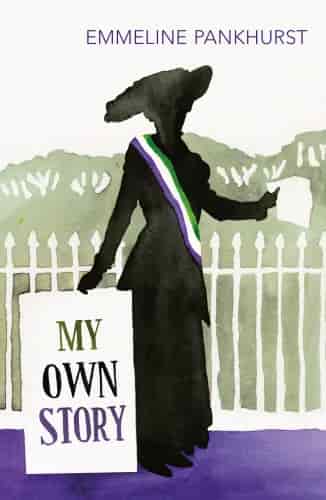
Emmeline Pankhurst
Quotes
That is all I have to say to you, sir. We are here, not because we are law-breakers; we are here in our efforts to become law-makers. (Book II, Ch. 3)
 My Own Story
Mrs. Harriet Beecher Stowe's novel, Uncle Tom's Cabin, was so great a favourite with my mother that she used it continually as a source of bedtime stories for our fascinated ears. Those stories, told almost fifty years ago, are as fresh in my mind to-day as events detailed in the morning's papers. Indeed they are more vivid, because they made a much deeper impression on my consciousness. I can still definitely recall the thrill I experienced every time my mother related the tale of Eliza's race for freedom over the broken ice of the Ohio River, the agonizing pursuit, and the final rescue at the hands of the determined old Quaker. Another thrilling tale was the story of a negro boy's flight from the plantation of his cruel master... throughout my childhood, whenever I rode in a train, I thought of that poor runaway slave escaping from the pursuing monster.
These stories, with the bazaars and the relief funds and subscriptions of which I heard so much talk, I am sure made a permanent impression on my brain and my character. They awakened in me the two sets of sensations to which all my life I have most readily responded: first, admiration for that spirit of fighting and heroic sacrifice by which alone the soul of civilisation is saved; and next after that, appreciation of the gentler spirit which is moved to mend and repair the ravages of war. (Ch. 1)
My Own StoryI soon had the joy of seeing my daughter and the other brave comrades, and walking with them in the dismal courtyard of the prison. Single file we walked, at a distance of three or four feet from one another, back and forth under the stony eyes of the wardresses. The rough flags of the pavement hurt our feet, shod in heavy, shapeless prison boots. The autumn days were cold and cheerless, and we shivered violently under our scanty cloaks. But of all our hardships the ceaseless silence of our lives was worst. (Book II, Ch. 4)
My Own StoryThe closing paragraphs of this book were written in the late summer of 1914, when the armies of every great power in Europe were being mobilised for savage, unsparing, barbarous warfare—against one another, against small and unaggressive nations, against helpless women and children, against civilisation itself. How mild, by comparison with the despatches in the daily newspapers, will seem this chronicle of women's militant struggle against political and social injustice in one small corner of Europe. Yet let it stand as it was written, with peace—so-called, and civilisation, and orderly government as the background for heroism such as the world has seldom witnessed. The militancy of men, through all the centuries, has drenched the world with blood, and for these deeds of horror and destruction men have been rewarded with monuments, with great songs and epics. The militancy of women has harmed no human life save the lives of those who fought the battle of righteousness. Time alone will reveal what reward will be allotted to the women. (Foreword)
My Own StoryThe first time I went into the place I was horrified to see little girls seven and eight years old on their knees scrubbing the cold stones of the long corridors ... bronchitis was epidemic among them most of the time ... I found that there were pregnant women in that workhouse, scrubbing floors, doing the hardest kind of work, almost until their babies came into the world ... Of course the babies are very badly protected ... These poor, unprotected mothers and their babies I am sure were potent factors in my education as a militant. (Book I, Ch. 2)
My Own StoryI want to call attention to the self-restraint which was shown by our followers on the night of the 13th, after we had been arrested. Our rule has always been to be patient, exercise self-restraint, show our so-called superiors that we are not hysterical; to use no violence, but rather to offer ourselves to the violence of others. (Book II, Ch. 3)
My Own StoryI called upon the women of the meeting to join me in this new militancy, and I reminded them anew that the women who were fighting in the Suffragette army had a great mission, the greatest mission the world has ever known—the freeing of one-half the human race, and through that freedom the saving of the other half. I said to them: "Be militant each in your own way. Those of you who can express your militancy by going to the House of Commons and refusing to leave without satisfaction, as we did in the early days—do so. Those of you who can express militancy by facing party mobs at Cabinet Ministers' meetings, when you remind them of their[ falseness to principle—do so. Those of you who can express your militancy by joining us in our anti-Government by-election policy—do so. Those of you who can break windows—break them. Those of you who can still further attack the secret idol of property, so as to make the Government realise that property is as greatly endangered by women's suffrage as it was by the Chartists of old—do so. And my last word is to the Government: I incite this meeting to rebellion. (Book III, Ch. 3)
My Own StoryOur battles are practically over, we confidently believe. For the present at least our arms are grounded, for directly the threat of foreign war descended on our nation we declared a complete truce from militancy. What will come out of this European war—so terrible in its effects on the women who had no voice in averting it—so baneful in the suffering it must necessarily bring on innocent children—no human being can calculate. But one thing is reasonably certain, and that is that the Cabinet changes which will necessarily result from warfare will make future militancy on the part of women unnecessary. No future Government will repeat the mistakes and the brutality of the Asquith Ministry. None will be willing to undertake the impossible task of crushing or even delaying the march of women towards their rightful heritage of political liberty and social and industrial freedom. (Book III, Ch. 9)
My Own StoryIt was a time of tremendous unrest, of labour agitations, of strikes and lockouts. It was a time also when a most stupid reactionary spirit seemed to take possession of the Government and the authorities. The Salvation Army, the Socialists, the trade-unionists—in fact, all bodies holding outdoor meetings—were made special objects of attack. As a protest against this policy a Law and Liberty League was formed in London, and an immense Free Speech meeting was held in Trafalgar Square... I was present at this meeting, which resulted in a bloody riot between the police and the populace. The Trafalgar Square Riot is historic, and to it Mr. John Burns owes, in large part, his subsequent rise to political eminence. Both John Burns and Cunningham Graham served prison sentences for the part they played in the riot, but they gained fame, and they did much to establish the right of free speech for English men. English women are still contending for that right.
My Own StoryThe education of the English boy, then as now, was considered a much more serious matter than the education of the English boy's sister. My parents, especially my father, discussed the question of my brothers' education as a matter of real importance. My education and that of my sister were scarcely discussed at all. Of course we went to a carefully selected girls' school, but beyond the facts that the head mistress was a gentlewoman and that all the pupils were girls of my own class, nobody seemed concerned. A girl's education at that time seemed to have for its prime object the art of "making home attractive"—presumably to migratory male relatives. It used to puzzle me to understand why I was under such a particular obligation to make home attractive to my brothers.
My Own StoryThe rest of the story reveals one of those ghastly blunders which justice not infrequently makes. Although the shooting was done without any intent to kill, the men were tried for murder and three of them were found guilty and hanged.... I was transfixed with horror, and over me there swept the sudden conviction that that hanging was a mistake—worse, a crime. It was my awakening to one of the most terrible facts of life—that justice and judgment lie often a world apart. I relate this incident of my formative years to illustrate the fact that the impressions of childhood often have more to do with character and future conduct than heredity or education. I tell it also to show that my development into an advocate of militancy was largely a sympathetic process. I have not personally suffered from the deprivations, the bitterness and sorrow which bring so many men and women to a realisation of social injustice. My childhood was protected by love and a comfortable home. Yet, while still a very young child, I began instinctively to feel that there was something lacking, even in my own home, some false conception of family relations, some incomplete ideal.
My Own StoryI say to the Government: You have not dared to take the leaders of Ulster for their incitement to rebellion. Take me if you dare, but if you dare I tell you this, that so long as those who incited to armed rebellion and the destruction of human life in Ulster are at liberty, you will not keep me in prison. So long as men rebels—and voters—are at liberty, we will not remain in prison, first division or no first division." (Book III, Ch. 3)
My Own Story