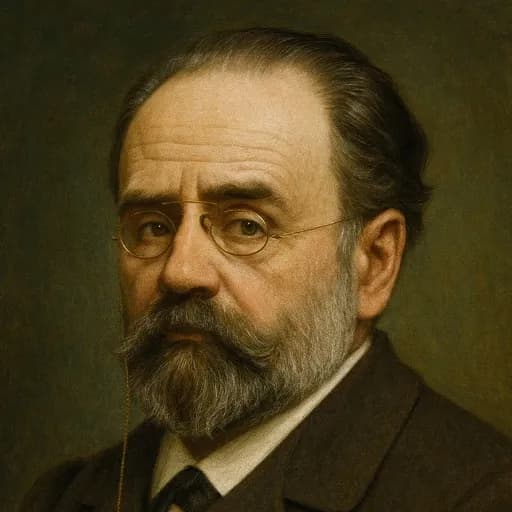
Emile Zola
Quotes
No, the only good was to be found in non-existence or, if one had to exist, in being a tree, a stone, or lower still, a grain of sand, for that cannot bleed under the heel of every passer-by.
She was haunted by the vision of Chaval, and rambled on about him, about their cat and dog life together, the one day when he had been nice to her, in Jean-Bart, and the other days or alternate caresses and blows, when he half killed her with his embraces after nearly beating her to death.
When a man was honest in his dealings, you could forgive him the rest.
But now, deep in the earth, the miner was waking from his slumber and germinating in the soil like a real seed; and one fine day people would see what was growing in the middle of these fields: yes, men, a whole army of men, would spring up from the earth, and justice would be restored.
It was at times like this that one of those waves of bestiality ran through the mine, the sudden lust of the male that came over a miner when he met one of these girls on all fours, with her rear in the air and her buttocks bursting out of her breeches.
They spoke one after the other in a despairing voice, giving expression to their complaints. The workers could not hold out; the Revolution had only aggravated their wretchedness; only the bourgeois had grown fat since '89, so greedily that they had not even left the bottom of the plates to lick. Who could say that the workers had had their reasonable share in the extraordinary increase of wealth and comfort during the last hundred years? They had made fun of them by declaring them free. Yes, free to starve, a freedom of which they fully availed themselves. It put no bread into your cupboard to go and vote for fine fellows who went away and enjoyed themselves, thinking no more of the wretched voters than of their old boots. No! one way or another it would have to come to an end, either quietly by laws, by an understanding in good fellowship, or like savages by burning everything and devouring one another. Even if they never saw it, their children would certainly see it, for the century could not come to an end without another revolution, that of the workers this time, a general hustling which would cleanse society from top to bottom, and rebuild it with more cleanliness and justice.
He would have given up everything -- education, comfort, luxurious life and his powerful position as manager -- if only just for one day he could have been the humblest of these poor devils under him and be free with his own body and be oafish enough to beat his wife and take his pleasure with the wives of his neighbors. He found himself wishing he were dying of starvation too, and that his empty belly were twisted with pains that made his brain reel, for perhaps that might deaden this relentless grief! Oh to live like a brute, possessing nothing but freedom to roam in the cornfields with the ugliest and most revolting haulage girl and possess her!
This sounded the death knell of small family businesses, soon to be followed by the disappearance of the individual entrepreneur, gobbled up one by one by the increasingly hungry ogre of capitalism, and drowned by the rising tide of large companies.
All round there was a rising tide of beer, widow Désir’s barrels had all been broached, beer had rounded all paunches and was overflowing in all directions, from noses, eyes—and elsewhere. People were so blown out and higgledy-piggledy, that everybody’s elbows or knees were sticking into his neighbour and everybody thought it great fun to feel his neighbour’s elbows. All mouths were grinning from ear to ear in continuous laughter.
Blow the candle out, I don’t need to see what my thoughts look like.
"And, then, if only there were some truth in what the priests say, if only the poor of this world were rich in the next!" These words were greeted with a burst of laughter, and even the children shrugged their shoulders, for the hard wind blowing from the outer world had taken away all their belief. They harbored a secret fear of ghosts down in the mine, but scoffed at the empty heavens.
On a pitch black, starless night, a solitary man was trudging along the main road from Marchiennes to Montsou, ten kilometres of cobblestones running straight as a die across the bare plain between fields of beet.