
Elaine Dundy
Quotes
The reviews were excellent and the book quickly went into a second printing. Then one night Ken came home and threw a copy of the book out the window. "You weren’t a writer when I married you, you were an actress," he said angrily. Obviously his colleagues had been riding him because of the attention I was receiving. I was shattered. The next day, he said, "I’ve been rereading your book. There’s love on every page." And then he gave me a beautiful red leather-bound copy of it with the inscription: "From the Critic to the Author." Looking at it I felt a pang. I wondered if it was his admission of what I’d done that he had not.
To my wonder and, it appeared, his annoyance, the book wouldn’t go away.
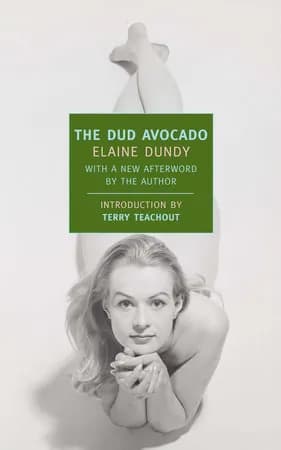
Halfway through writing the book, I still had no title. It came wonderfully into being when I complimented my host at a party on his flourishing avocado plant. I said, I’d kept trying and failing with my own avocado pits. Someone said, what you’ve got is a dud avocado, and Ken said, that’s a good title for a novel. I thought, this title is mine, and it was. Ken and I had the same agent, and for a publisher we decided on Victor Gollancz, who was so good with first novels. Wonderfully, he accepted it, but with several caveats. He didn’t like the title. It sounded like a cookbook. He also wanted me to write under my married name. I said no to both. He accepted. He decided it needed a subtitle, "La Vie Amoureuse of Sally Jay in Paris." I said, Oh no, no! He said, this was the first time in his experience that an unknown writer had complained about a book cover. However, he did put on the book’s jacket that the subtitle was the publisher’s. Ken read it in proof and said, "You’ve got a thumping great best-seller here." Curiously, the first thing I felt was relief. I believed him. No one could predict how a play or novel would be received by the public like Ken could. And only then was I set free to let excitement take hold of me.
The Big Personalities weighed in. Soon after its publication Irwin Shaw wrote to me praising it. Terry Southern, calling me "Miss Smarts," said I was "a perfect darling." Gore Vidal phoned one morning saying, "You’ve got the one thing a writer needs: You’ve got your own voice. Now go." Ernest Hemingway said to me, "I liked your book. I liked the way your characters all speak differently." And then added, "My characters all sound the same because I never listen." All this, and heaven too. Laurence Olivier told me that now that my book was making a lot of money we could elope and I could support us. The Financial Times ran an item which read, "Such and such stock: No dud avocado." Groucho Marx wrote me, "I had to tell someone how much I enjoyed The Dud Avocado.… If this was actually your life, I don’t know how the hell you got through it." When people ask me how autobiographical the book is I say, all the impulsive, outrageous things my heroine does, I did. All the sensible things she did, I made up.
My thoughts were chasing each other all over the place, but nothing seemed to sort itself out. Advice, I thought. Ask his advice. On love? Finance? Career? Better stick to love, I decided, it’s what’s on your mind anyway.
And with that my mind went blank.
He put his hand over mine, the one with the dead cigarette crumbled in it, and gave me a wonderful smile. "Easy, child, easy. I’m only teasing you. Don’t think I disapprove for Christ’s sake. Live it up, I say. Don’t say no to life, Gorce, you’re only young once.”
We were on last name terms, Keevil and I.
It was a hot, peaceful, optimistic sort of day in September. It was around eleven in the morning, I remember, and I was drifting down the boulevard St. Michel, thoughts rising in my head like little puffs of smoke, when suddenly a voice bellowed into my ear: "Sally Jay Gorce! What the hell? Well, for Christ’s sake, can this really be our own little Sally Jay Gorce?” I felt a hand ruffling my hair and I swung around, furious at being so rudely awakened.
Who should be standing there in front of me, in what I immediately spotted as the Left Bank uniform of the day, dark wool shirt and a pair of old Army suntans, but my old friend Larry Keevil. He was staring down at me with some alarm.
I said hello to him and added that he had frightened me, to cover any bad-tempered expression that might have been lingering on my face, but he just kept on staring dumbly at me.
"What have you been up to since … since … when the hell was it that I last saw you?” he asked finally.
Curiously enough I remembered exactly.
I suppose Larry’s "reality” in this case was based on the café’s internationality. But perhaps all cafés near a leading university have that authentic international atmosphere. At the table closest to us sat an ordinary-looking young girl with lank yellow hair and a gray-haired bespectacled middle-aged man. They had been conversing fiercely but quietly for some time now in a language I was not even able to identify.
All at once I knew that I liked this place, too.
Jammed in on all sides, with the goodish Tower of Babel working itself up to a frenzy around me, I felt safe and anonymous and, most of all, thankful we were going to be spared those devastating and shattering revelations one was always being treated to at the more English-speaking cafés like the Flore.
And, as I said, I was very glad to have run into Larry.
That’s all the quotes.
7 quotes in the collection · come back when we add more