Elaine Dundy
Quotes
Slowly his eyes left my hair and traveled downwards. This time he really took in my outfit and then that Look that I’m always encountering; that special one composed in equal parts of amusement, astonishment and horror came over his face.
I am not a moron and I can generally guess what causes this look. The trouble is, it’s always something different.
I squirmed uncomfortably, feeling his eyes bearing down on my bare shoulders and breasts.
"What the hell are you doing in the middle of the morning with an evening dress on?” he asked me finally.
"Sorry about that,” I said quickly, "but it’s all I’ve got to wear. My laundry hasn’t come back yet.”
Ridiculous as the idea may have been for her bluestocking mother to send brother and sister over alone like this, the fact was that Judy was protected as much by her curiosity as by her innocence. And then there was this other thing about her, too. You know all that razzle-dazzle about people being born in Original Sin and all that rot? Well, maybe it’s rot and maybe it isn’t. I mean I wouldn’t slit my throat from ear to ear, just because I’d found out for sure that most people are. But she wasn’t. That was the thing. She simply wasn’t. I’m positive of that.
The sun shone on: the shade of the awning vanished in the hot, white, shadowless midday. In that blaze of heat I was loving Paris as never before.
And there sitting opposite me, stretching himself luxuriously in the sun, his eyes lazily examining his half-empty drink, was Larry, the one I loved the best … sensationally uninterested.
I’d made a vow when I got over here never to speak to anyone I’d ever known before. Yet here we were, two Americans who hadn’t really seen each other for years; here was someone from "home” who knew me when, if you like, and, instead of shambling back into the bushes like a startled rhino, I was absolutely thrilled at the whole idea.
"I like it here, don’t you?” said Larry, indicating the café with a turn of his head.
I had to admit I’d never been there before.
He smiled quizzically. "You should come more often,” he said. "It’s practically the only nontourist trap to survive on the Left Bank. It’s real” he added.
Real, I thought … whatever that meant.
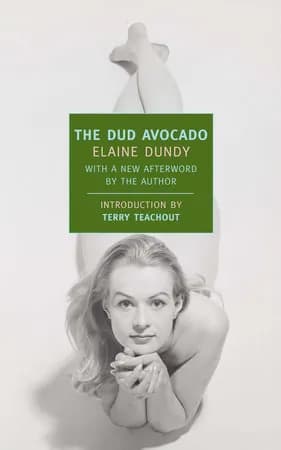
I look back in wonder at The Dud Avocado: in wonder at its initial reception and at the many times it’s been reissued — for years it was even republished alongside of every new book of mine that came out. I look back in wonder at the 1950s. The dull conformity of those years as they are generally imagined is something I don’t recognize. I look back in wonder at London in particular, where whole areas destroyed during the Second World War still lay in rubble. But London was in the midst of a renaissance for artists. In literature and playwriting the Angry Young Men were making their splash and new young actors like Richard Burton, Peter O Toole, Albert Finney, and Peter Finch were coming into their own. London was an orderly place where it was safe to take risks. Optimism was the rule of the day and I was there.
I stumbled across the Champs Élysées . I know it seems crazy to say, but before I actually stepped onto it (at what turned out to be the Étoile ) I had not even been aware of its existence. No, I swear it. I’d heard the words "Champs Élysées," of course, but I thought it was a park or something. I mean that’s what it sounds like, doesn’t it? All at once I found myself standing there gazing down that enchanted boulevard in the blue, blue evening. Everything seemed to fall into place. Here was all the gaiety and glory and sparkle I knew was going to be life if I could just grasp it.
I began floating down those Elysian Fields three inches off the ground, as easily as a Cocteau character floats through Hell. Luxury and order seemed to be shining from every street lamp along the Avenue; shining from every window of its toyshops and dress-shops and carshops; shining from its cafés and cinemas and theaters; from its bonbonneries and parfumeries and nighteries.… Talk about seeing Eternity in a Grain of Sand and Heaven in a Wild Flower; I really think I was having some sort of mystic revelation then. The whole thing seemed like a memory from the womb. It seemed to have been waiting there for me.
For some people history is a Beach or a Tower or a Graveyard. For me it was this giant primordial Toyshop with all its windows gloriously ablaze. It contained everything I’ve ever wanted that money can buy. It was an enormous Christmas present wrapped in silver and blue tissue paper tied with satin ribbons and bells. Inside would be something to adorn, to amuse, and to dazzle me forever. It was my present for being alive.
I mean, the question actors most often get asked is how they can bear saying the same things over and over again night after night, but God knows the answer to that is, don’t we all anyway; might as well get paid for it.
In London, aside from bit parts, I was unlucky in my career but I was lucky in love. There was a theatrical club much frequented by all the young lions on their way up. They all gathered to eat inexpensively and be made blissful by the lethal house cider. It was there I met Ken Tynan, recently down from Oxford, and already the enfant terrible of Britain’s drama critics. Mutually magnetized, we married three months later. I sent a wire to my parents in New York: "Have married Englishman. Letter follows." I was madly in love with him and stepped happily into the Wonderland of his fame.
Judy lived in my hotel. She was just seventeen, and what she was doing in Paris was supposedly chaperoning her younger brother, a fully fledged concert pianist of fifteen, who was studying there with one of the leading teachers. In view of their combined and startling innocence, however, this was a rather useless arrangement. Their last name was Galache, and they were the issue with which the highly unlikely union of a Quaker woman from Philadelphia and a dreadfully dashing Spaniard (now, alas, dead) had been blessed. Naturally their upbringing, up to this point, had been strict and very sheltered. … Judy was so different from me that it was really ludicrous. Whereas I was hell-bent for living, she was content, at least for the time being, to leave all that to others. Just as long as she could hear all about it. She really was funny about this. Folded every which way on the floor, looking like Bambi — all eyes and legs and no chin — she would listen for ages and ages with rapt attention to absolutely any drivel that you happened to be talking. It was unbelievable.
Maybe because I had been out very late the night before and was not able to put up my usual resistance, but it seemed to me, sitting there with the sound of his voice dying in my ears, that I could fall in love with him.
And then, as unexpected as a hidden step, I felt myself actually stumble and fall. And there it was, I was in love with him! As simple as that.
He was the first real person I’d ever been in love with. I couldn’t get over it. What I was trying to figure out was why I had never been in love with him before. I mean I’d had plenty of chance to. I’d seen him almost daily that summer in Maine two years ago when we were both in a Summer Stock company. … He was always rather nice to me in his insolent way, but there was also, I now remembered with a passing pang, an utterly ravishing girl, a model, the absolute epitome of glamour, called Lila. She used to come up at week ends to see him.
Then I heard from someone that he’d quit college the next winter and gone abroad to become a genius. I’d met him again when I first landed in Paris. He’d been very nice, bought me a drink, taken down my telephone number and never called me.
You’re a dead duck now, I told myself, as I relaxed back into my coma. You’re gone. I looked at him, smiling idly. I tried to imagine what was going on in his mind.
There are, I know (it was in our philosophy course in college), at least a hundred different reasons why some particular event takes place. So I thrashed about again trying to find some other truth and in the instant that it flashed through my head, I think I got as close to my raison d’etre as I ever have.
My success took another road. I complained to Rod Steiger, "The book’s hardly been out and everyone wants to know what I’m going to write next. I mean, don’t I get to rest on my laurels?" In fact I had no idea of writing a second novel. "No," said Rod, answering my question. "Succeeding only means you get another chance to try to do it again."
I thought about it, and then Ken said to me, "If you write another book, I’ll divorce you." I sat down and started my second novel and wondered that I knew its beginning and its end. I put it aside to write a play which went on in London.… I went back to my novel and finished it. It was published to good reviews but now there were a couple of stinkers. I tore them up and flushed them down the toilet. I’d become a writer.
In 1964 Ken and I got divorced. Well, we did bad things to each other. Now, some three decades later, I look back in gratitude at him: I look back in wonder.