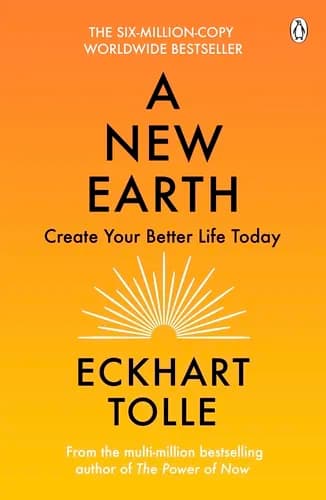
Eckhart Tolle
Quotes
As soon as you rise above mere survival, the question of meaning and purpose becomes of paramount importance in your life... There is no substitute for finding true purpose.
Try to catch the voice in your head, in the very moment it complains about something. Recognise it for what it is: the voice of the ego, no more than a thought.
According to an ancient Sufi story, there lived a king... who was continuously torn between happiness and despondency. The slightest thing would cause him great upset or provoke an intense reaction, and his happiness would quickly turn into disappointment and despair. A time came when the king finally got tired of himself and of life, and he began to seek a way out. He sent for a wise man... reputed to be enlightened. When the wise man came, the king said to him, “I want to be like you. Can you give me something that will bring balance, serenity, and wisdom into my life?... He handed the king an ornate box carved in jade. The king opened the box and found a simple gold ring inside. Some letters were inscribed on the ring. The inscription read: This, too, will pass. “What is the meaning of this?” asked the king. The wise man said, “Wear this ring always. Whatever happens, before you call it good or bad, touch this ring and read the inscription. that way, you will always be at peace.” This, too, will pass.
The primary cause of unhappiness is never the situation but your thoughts about it. Be aware of the thoughts you are thinking. Separate them from the situation, which is always neutral. There is the situation or the fact, and here are my thoughts about it. Life isn't as serious as the mind makes it out to be.
The new earth arises as more and more people discover that their main purpose in life is to bring the light of consciousness into this world and so use whatever they do as a vehicle for consciousness.
A question people frequently ask is, “How long does it take to become free of the painbody?” The answer is, of course, that it depends both on the density of an individual's painbody as well as the degree or intensity of that individual's arising Presence. But it is not the painbody, but identification with it that causes the suffering that you inflict on yourself and others. It is not the painbody but identification with the painbody that forces you to relive the past again and again and keeps you in a state of unconsciousness.
The beginning of freedom from the painbody lies first of all in the realization that you have a painbody. Then, more important, in your ability to stay present enough, alert enough, to notice the painbody in yourself as a heavy influx of negative emotion when it becomes active. When it is \recognized, it can no longer pretend to be you and live and renew itself through you.
What those words imply is this: Before you ask any other question, first ask the most fundamental question of your life: Who am I?
Know Thyself. These words were inscribed above the entrance to the temple of Apollo at Delphi, site of the sacred Oracle. In ancient Greece, people would visit the Oracle hoping to find out what destiny had in store for them or what course of action to take in a particular situation. It is likely that most visitors read those words as they entered the building without realizing that they pointed to a deeper truth than anything the Oracle could possibly tell them.
The emotion is not who you are.
Some people feel more alive when they travel and visit unfamiliar places or foreign countries because at those times sense perception – experiencing – takes up more of their consciousness than thinking. They become more present. Others remain completely possessed by the voice in the head even then. Their perceptions and experiences are distorted by instant judgments. They haven't really gone anywhere. Only their body is traveling, while they remain where they have always been: in their head.
All things are vibrating energy fields in ceaseless motion. The chair you sit on, the book you are holding in your hands appear solid and motionless only because that is how your senses perceive their vibrational frequency, that is to say, the incessant movement of the molecules, atoms, electrons and subatomic particles that together create what you perceive as a chair, a book, a tree, or a body.