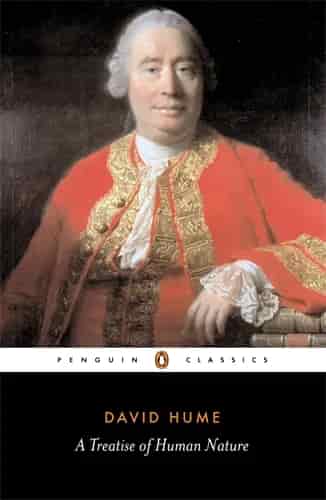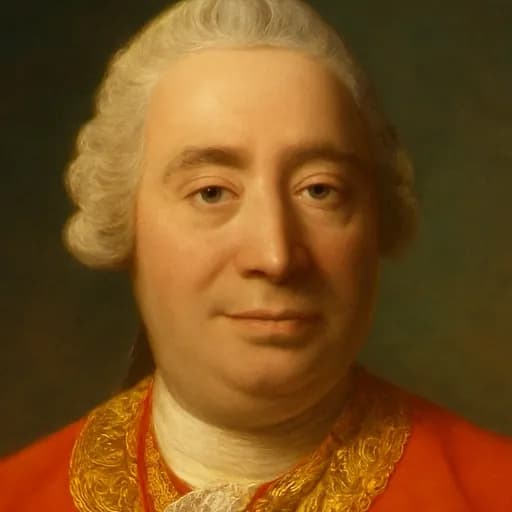
David Hume
Quotes
For do our Theologians pretend to make a monopoly of the word, action, and may not the atheists likewise take possession of it, and affirm that plants, animals, men, &c. are nothing but particular actions of one simple universal substance, which exerts itself from a blind and absolute necessity?
There is nothing in any object, consider'd in itself, which can afford us a reason for drawing a conclusion beyond it; [...] even after the observation of the frequent or constant conjunction of objects, we have no reason to draw any inference concerning any object beyond those of which we have had experience.
Next to the ridicule of denying an evident truth, is that of taking much pains to defend it; and no truth appears to me more evident, than that beasts are endow'd with thought and reason as well as men. The arguments are in this case so obvious, that they never escape the most stupid and ignorant.
'Tis certainly a kind of indignity to philosophy, whose sovereign authority ought every where to be acknowledg'd, to oblige her on every occasion to make apologies for her conclusions, and justify herself to every particular art and science, which may be offended at her.
'Tis from the resemblance of the external actions of animals to those we ourselves perform, that we judge their internal likewise to resemble ours; and the same principle of reasoning, carry'd one step farther, will make us conclude that since our internal actions resemble each other, the causes, from which they are deriv'd, must also be resembling.
Now as we call every thing , which proceeds from a past repetition, without any new reasoning or conclusion, we may establish it as a certain truth, that all the belief, which follows upon any present impression, is deriv'd solely from that origin.
Grief and disappointment give rise to anger, anger to envy, envy to malice, and malice to grief again, till the whole circle be completed.
[...] men are not astonish'd at the operations of their own reason, at the same time, that they admire the instinct of animals, and find a difficulty in explaining it, merely because it cannot be reduc'd to the very same principles. [...] reason is nothing but a wonderful and unintelligible instinct in our souls[.]
Nature may certainly produce whatever can arise from habit: Nay, habit is nothing but one of the principles of nature, and derives all its force from that origin.
By this means all knowledge degenerates into probability; and this probability is greater or less, according to our experience of the veracity or deceitfulness of our understanding, and according to the simplicity or intricacy of the question.
We must therefore glean up our experiments in this science from a cautious observation of human life, and take them as they appear in the common course of the world, by men's behaviour in company, in affairs, and in their pleasures. Where experiments of this kind are judiciously collected and compared, we may hope to establish on them a science, which will not be inferior in certainty, and will be much superior in utility to any other of human comprehension.
The very port and gait of a swan, or turkey, or peacock show the high idea he has entertain'd of himself; and his contempt of all others. This is the more remarkable, that in the two last species of animals, the pride always attends the beauty, and is discover'd in the male only. The vanity and emulation of nightingales in singing have been commonly remark'd [...] All these are evident proofs, that pride and humility are not merely human passions, but extend themselves over the whole animal creation.