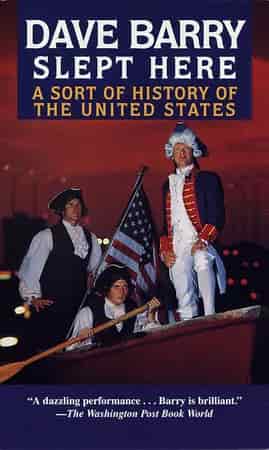
Reagan finally won the nomination by promoting "Reaganomics", an economic program based on the theory that… — Dave Barry
Reagan finally won the nomination by promoting "Reaganomics", an economic program based on the theory that the government could lower taxes while increasing spending and at the same time actually reduce the federal budget by sacrificing a live chicken by the light of a full moon. Bush charged that this amounted to "voo-doo economics," which got him into hot water until he explained that what he meant to say was "doo-doo economics." Satisfied, Reagan made Bush his vice-presidential nominee. The turning point in the election campaign came during the October 8 debate between Reagan and Carter, when Reagan's handlers came up with a shrewd strategy: No matter what Carter said, Reagan would respond by shaking his head in a sorrowful manner and saying: "There you go again." This was brilliant, because (a) it required the candidate to remember only four words, and (b) he delivered them so believably that everything Carter said seemed like a lie. If Carter had stated that the Earth was round, Reagan would have shaken his head, saying, "There you go again," and millions of voters would have said: "Yeah! What does Carter think we are? Stupid?"
p. 167Source: Wikiquote · CC BY-SA 4.0

More from this book
Stalin's strategy at the end of World War II was to acquire a small "buffer zone between Russia and Germany, consisting of Estonia, Latvia, Lithuania, Poland, Czechoslovakia, Hungary, Romania, Bulgaria, Yugoslavia, Albania, and most of Germany. In an effort to garner public support in these nations, Stalin mounted a public-relations campaign around the upbeat theme "Maybe We Won't Have Your Whole Family Shot," and in 1945 Eastern Europe decided to join the Communist bloc by a vote of 28,932,084,164,504,029-0. Heartened by this mandate, Stalin immediately ordered construction work to begin on the Iron Curtain, which was given its name by Sir Winston Churchill, who, in a historic anecdote at a dinner party, said, "Madam, I may be drunk, but an iron curtain has descended upon BLEAAARRRGGGHHH."
p. 126
So there's no question about it: by the mid-fifties, America was definitely in a Golden Era, an era of excitement and opportunity for all citizens, regardless of race or creed or color, unless the person happened to be black. Then there was a problem.
p. 137
Other nations are not allowed to mess around with the internal affairs of nations in this hemisphere.