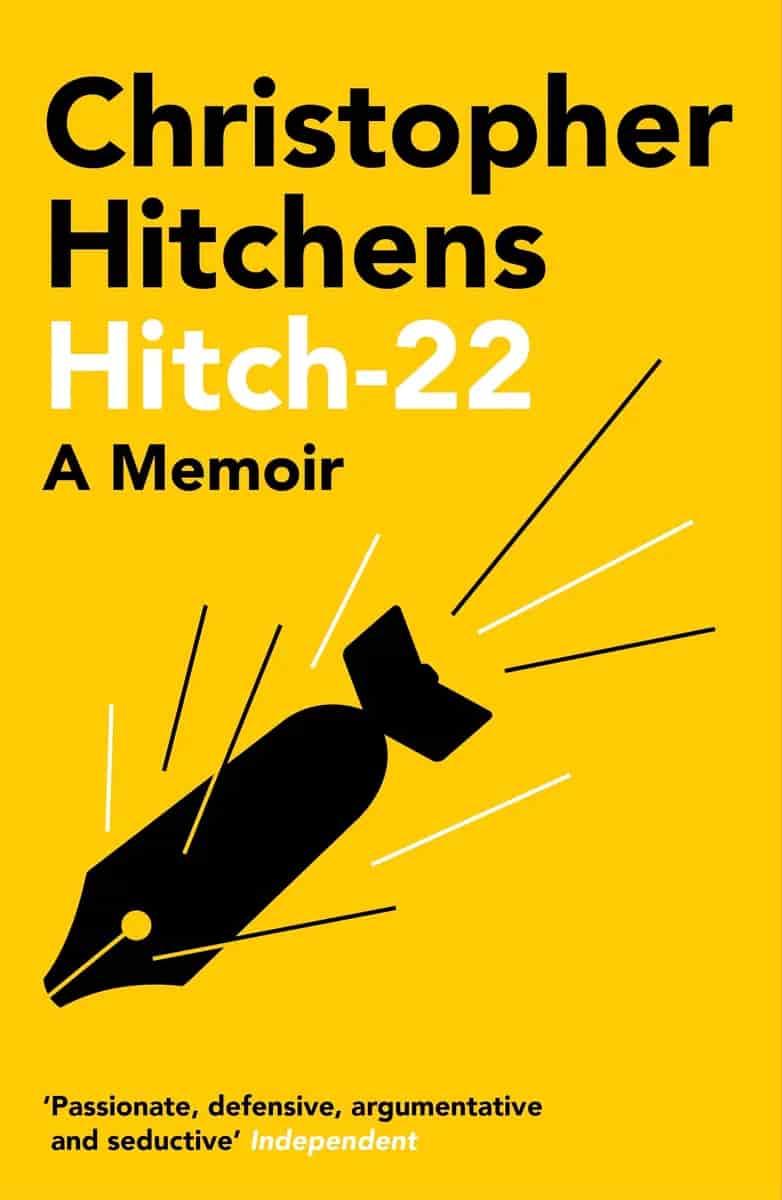
Christopher Hitchens
Quotes
One of the manifestations of his megalomania was an ever-increasing piety. He had himself photographed, and painted on huge murals, in the robes of a mullah. He ordered that the jihadi slogan Allahuh Akbar (“God Is Great”) be added to the national flag of Iraq. He began an immense mosque-building program, including the largest mosque in the Middle East, named for “the Mother of All Battles.” He had a whole Koran written in his own blood. This macabre totem was to have been the centerpiece of that mosque. His party and state rhetoric became increasingly frenzied and jihadist in tone, and he stopped supporting secular forces among the Palestinians and instead began financing theocratic ones, such as Hamas and Islamic Jihad. An Iraqi bounty was officially and openly paid to the family of any Palestinian suicide bomber. Yet none of this – none of it, including the naming of the slaughterhouse-campaign against the Kurds after a sura of the Koran – would unconvince the utterly smug western “experts” who kept on insisting that his Caligula regime was a “secular” one. To the contrary, it was precisely the genuine secular forces in the country – the Kurds, the Communist and Socialist movements, and the independent trade unions – that Ba’athism had set out deliberately to destroy. And it then filled the resulting vacuum with toxic religious propaganda of the crudest kind. Anyone who heard an Iraqi radio or television broadcast in the last decade of the regime can readily confirm that the insistent themes were those of “martyrdom” and holy war.
p. 297
 Hitch 22
The best of that scene was probably over, because by the time you have heard of such a “scene” it has almost invariably moved on or decayed.
p. 215
Hitch 22About once or twice every month I engage in public debates with those whose pressing need it is to woo and to win the approval of supernatural beings. Very often, when I give my view that there is no supernatural dimension, and certainly not one that is only or especially available to the faithful, and that the natural world is wonderful enough – and even miraculous enough if you insist – I attract pitying looks and anxious questions. How, in that case, I am asked, do I find meaning and purpose in life? How does a mere and gross materialist, with no expectation of a life to come, decide what, if anything, is worth caring about?
Depending on my mood, I sometimes but not always refrain from pointing out what a breathtakingly insulting and patronizing question this is. (It is on a par with the equally subtle inquiry: Since you don’t believe in our god, what stops you from stealing and lying and raping and killing to your heart’s content?) Just as the answer to the latter question is: self-respect and the desire for the respect of others – while in the meantime it is precisely those who think they have divine permission who are truly capable of any atrocity – so the answer to the first question falls into two parts. A life that partakes even a little of friendship, love, irony, humor, parenthood, literature, and music, and the chance to take part in battles for the liberation of others cannot be called “meaningless” except if the person living it is also an existentialist and elects to call it so. It could be that all existence is a pointless joke, but it is not in fact possible to live one’s everyday life as if this were so. Whereas if one sought to define meaninglessness and futility, the idea that a human life should be expended in the guilty, fearful, self-obsessed propitiation of supernatural nonentities…but there, there. Enough.
p. 330
Hitch 22This sort of stuff was at least partly to be expected. Rushdie was a bit of a Leftie; he had contrived to disturb the status quo: he could and should expect conservative disapproval.
More worrying to me were those on the Left who took almost exactly the same tone. Germaine Greer, always reliably terrible about such matters, again came to the fore, noisily defending the rights of book burners. “The Rushdie affair,” wrote the Marxist critic John Berger within a few days of the fatwah, has already cost several human lives and threatens to cost many, many more.” And “the Rushdie affair,” wrote Professor Michael Dummett of All Souls, has done untold damage. It has intensified the alienation of Muslims here…Racist hostility towards them has been inflamed.” Here we saw the introduction – and by a former promoter of “Michael X,” do not forget – of a willful, crass confusion between religious faith, which is voluntary, and ethnicity, which is not. All the deaths and injuries – all of them – from the mob scenes in Pakistan to the activities of the Iranian assassination squads, were directly caused by Rushdie’s enemies. None of the deaths or injuries – none of them – were caused by him, or by his friends or defenders. Yet you will notice the displacement tactic used by Berger and Dummett and the multi-culti Left, which blamed the mayhem on an abstract construct –“the Rushdie affair.” I dimly understood at the time that this kind of postmodern Left, somehow in league with political Islam, was something new, if not exactly new Left. That this trahison would take a partly “multicultural” form was also something that was slowly ceasing to surprise me.
p. 269
Hitch 22I had become too accustomed to the pseudo-Left new style, whereby if your opponent thought he had identified your lowest possible motive, he was quite certain that he had isolated the only real one. This vulgar method, which is now the norm and the standard in much non-Left journalism as well, is designed to have the effect of making any noisy moron into a master analyst.
p. 299
Hitch 22I was thunderstruck, if only by trying to picture this happening in a British cinema. (Of course it would be tough to imagine it happening in a New York or Cleveland one, either, but a crucial part of seeing America was also seeing how many Americas there were.)
p. 216
Hitch 22So far from being some jaded Casanova, Martin possesses the rare gift – enviable if potentially time consuming – of being able to find something attractive in almost any woman. If this be misogyny, then give us increase of it.
p. 159
Hitch 22I found a row house in northeast Capitol Hill, where if I wanted to cab it home late at night from Dupont Circle, African-born taxi drivers would sometimes decline to take me (on the unarguable – at least by me with them – grounds that it was “a black area”). I have never since been able to use the word “gentrification” as a sneer: the unavoidable truth is that it’s almost invariably a good symptom.
p. 236
Hitch 22So there it was: Cuban Socialism was too much like a boarding school in one way and too much like a church in another.
p. 114
Hitch 22Haight-Ashbury and the flower-power district were getting truly tawdry but this was also in obedience to the iron law which states that once you have to call something a “historic district” or a “popular quarter” then, just like the Wild West, it loses whatever character gave it the definition in the first place.
p. 216
Hitch 22If you have never yourself had the experience of feeling that you are yoked to the great steam engine of history, then allow me to inform you that the conviction is a very intoxicating one.
p. 98
Hitch 22In the squalid and cramped back streets around the Belfast shipyards, it seemed to us, no better illustration could be found of the need for working people to forget their confessional and national differences and unite in a brotherly fashion. But to say that such appeals failed to achieve locomotive force among the masses would be to understate the case to an almost heroic degree.
p. 145
Hitch 22