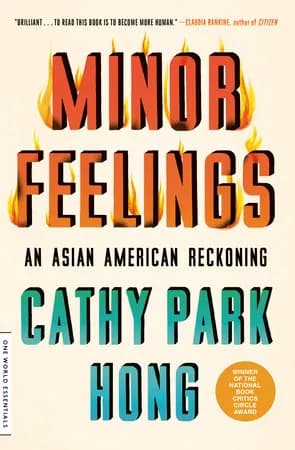
Cathy Park Hong
Quotes
As a poet, I have always treated English as a weapon in a power struggle, wielding it against those who are more powerful than me. But I falter when using English as an expression of love.
In many Asian American novels, writers set trauma in a distant mother country or within an insular Asian family to ensure that their pain is not a reproof against American imperial geopolitics or domestic racism; the outlying forces that cause their pain—Asian Patriarchal Fathers, White People Back Then—are remote enough to allow everyone, including the reader, off the hook.
Most white Americans can only understand racial trauma as a spectacle.
Innocence is both a privilege and a cognitive handicap, a sheltered unknowingness that, once protracted into adulthood, hardens into entitlement.
Asian Americans inhabit a purgatorial status: neither white enough nor black enough, unmentioned in most conversations about racial identity. In the popular imagination, Asian Americans are all high-achieving professionals. But in reality, this is the most economically divided group in the country, a tenuous alliance of people with roots from South Asia to East Asia to the Pacific Islands, from tech millionaires to service industry laborers. How do we speak honestly about the Asian American condition—if such a thing exists?
minor feelings: the racialized range of emotions that are negative, dysphoric, and therefore untelegenic, built from the sediments of everyday racial experience and the irritant of having one’s perception of reality constantly questioned or dismissed.
Patiently educating a clueless white person about race is draining. It takes all your powers of persuasion. Because it’s more than a chat about race. It’s ontological. It’s like explaining to a person why you exist, or why you feel pain, or why your reality is distinct from their reality. Except it’s even trickier than that. Because the person has all of Western history, politics, literature, and mass culture on their side, proving that you don’t exist.
Ever since I started writing poetry seriously, I have used English inappropriately.
I have to address whiteness because Asian Americans have yet to truly reckon with where we stand in the capitalist white supremacist hierarchy of this country.
Childhood is a state of mind, whether it's a nostalgic return to innocence or a sudden flashback to unease and dread. If the innocence of childhood is being protected and comforted, the precarity of childhood is when one feels the least protected and comfortable.
To other English is to make audible the imperial power sewn into the language, to slit English open so its dark histories slide out.
The problem with silence is that it can’t speak up and say why it’s silent. And so silence collects, becomes amplified, takes on a life outside our intentions, in that silence can get misread as indifference, or avoidance, or even shame, and eventually this silence passes over into forgetting.