
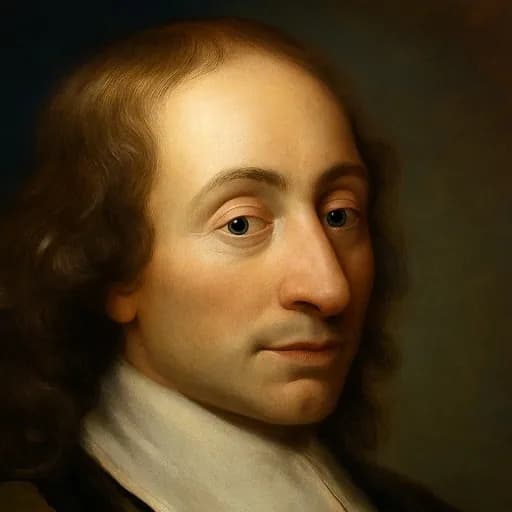
Blaise Pascal
Quotes
All is one, all is different. How many natures exist in man? How many vocations? And by what chance does each man ordinarily choose what he has heard praised?
...a king attended with every pleasure he can feel, if he be without diversion, and be left to consider and reflect on what he is, this feeble happiness will not sustain him; he will necessarily fall into forebodings of dangers, of revolutions which may happen, and, finally, of death and inevitable disease; so that if he be without what is called diversion, he is unhappy, and more unhappy than the least of his subjects who plays and diverts himself.
Imagination.—It is that deceitful part in man, that mistress of error and falsity, the more deceptive, that she is not always so; for she would be an infallible rule of truth, if she were an infallible rule of falsehood. But being most generally false, she gives no sign of her nature, impressing the same character on the true and the false. I do not speak of fools, I speak of the wisest men; and it is among them that the imagination has the great gift of persuasion. Reason protests in vain; it cannot set a true value on things.
Our magistrates have known well this mystery. Their red robes, the ermine in which they wrap themselves like furry cats, the courts in which they administer justice, the fleurs-de-lis, and all such august apparel were necessary; if the physicians had not their cassocks and their mules, if the doctors had not their square caps and their robes four times too wide, they would never have duped the world, which cannot resist so original an appearance. If magistrates had true justice, and if physicians had the true art of healing, they would have no occasion for square caps; the majesty of these sciences would of itself be venerable enough. But having only imaginary knowledge, they must employ those silly tools that strike the imagination with which they have to deal; and thereby in fact they inspire respect.
I have my foggy and my fine days within me; my prosperity or misfortune has little to do with the matter. I sometimes struggle against luck, the glory of mastering it makes me master it gaily; whereas I am sometimes surfeited in the midst of good fortune.
Imagination cannot make fools wise, but it makes them happy, as against reason, which only makes its friends wretched: one covers them with glory, the other with shame.
He who would follow reason only would be deemed foolish by the generality of men. We must judge by the opinion of the majority of mankind. Because it has pleased them, we must work all day for pleasures seen to be imaginary; and after sleep has refreshed our tired reason, we must forthwith start up and rush after phantoms, and suffer the impressions of this mistress of the world.
Variety is as abundant as all tones of the voice, all ways of walking, coughing, blowing the nose, sneezing. We distinguish vines by their fruit, and call them the Condrien, the Desargues, and such and such a stock. Is this all? Has a vine ever produced two bunches exactly the same, and has a bunch two grapes alike? etc. I can never judge of the same thing exactly in the same way. I cannot judge of my work, while doing it. I must do as the artists, stand at a distance, but not too far. How far, then? Guess.
Those who have a lively imagination are a great deal more pleased with themselves than the wise can reasonably be. They look down upon men with haughtiness; they argue with boldness and confidence, others with fear and diffidence; and this gaiety of countenance often gives them the advantage in the opinion of the hearers, such favor have the imaginary wise in the eyes of judges of like nature. Imagination cannot make fools wise; but she can make them happy, to the envy of reason which can only make its friends miserable; the one covers them with glory, the other with shame. What but this faculty of imagination dispenses reputation, awards respect and veneration to persons, works, laws, and the great? How insufficient are all the riches of the earth without her consent!
Parents fear lest the natural love of their children may fade away. What kind of nature is that which is subject to decay? Custom is a second nature which destroys the former. But what is nature? For is custom not natural? I am much afraid that nature is itself only a first custom, as custom is a second nature.
Thus, when they [others] discover only the imperfections and vices which we really have, it is plain they do us no wrong, since it is not they who cause them; they rather do us good, since they help us to free ourselves from an evil, namely, the ignorance of these imperfections. We ought not to be angry at their knowing our faults and despising us; it is but right that they should know us for what we are, and should despise us, if we are contemptible.
It is natural for the mind to believe, and for the will to love; so that, for want of true objects, they must attach themselves to false.

