
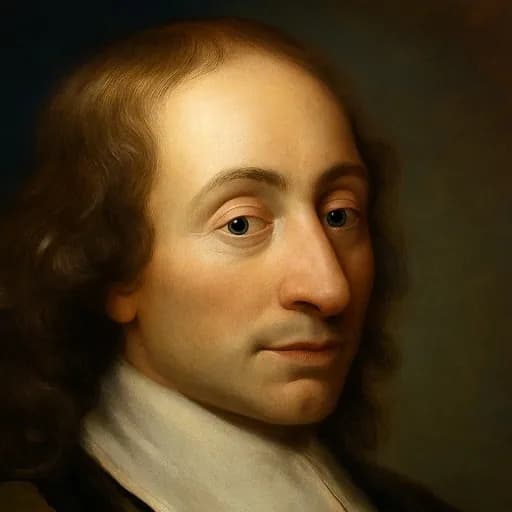
Blaise Pascal
Quotes
What is it to be superintendent, chancellor, first president, but to be in a condition wherein from early morning a large number of people come from all quarters to see them, so as not to leave them an hour in the day in which they can think of themselves? And when they are in disgrace and sent back to their country houses, where they lack neither wealth nor servants to help them on occasion, they do not fail to be wretched and desolate, because no one prevents them from thinking of themselves.
The struggle alone pleases us, not the victory. ...It is the same in play, and the same in the search for truth. In disputes we like to see the clash of opinions, but not at all to contemplate truth when found. ...So in the passions, there is pleasure in seeing the collision of two contraries; but when one acquires the mastery, it becomes only brutality. We never seek things for themselves, but for the search.
The wisest reason takes as her own principles those which the imagination of man has everywhere rashly introduced.
Justice and truth are two such subtle points, that our tools are too blunt to touch them accurately. If they reach the point, they either crush it, or lean all round, more on the false than on the true.
Notre raison est toujours déçue par l'inconstance des apparences.
...there are some people who lie for the mere sake of lying.
How much greater confidence has an advocate, retained with a large fee, in the justice of his cause! How much better does his bold manner make his case appear to the judges, deceived as they are by appearances! How ludicrous is reason, blown with a breath in every direction!
The will is one of the chief factors in belief, not that it creates belief, but because things are true or false according to the aspect in which we look at them. The will, which prefers one aspect to another, turns away the mind from considering the qualities of all that it does not like to see; and thus the mind, moving in accord with the will, stops to consider the aspect which it likes, and so judges by what it sees.
Custom is our nature. He who is accustomed to the faith believes in it, can no longer fear hell, and believes in nothing else. He who is accustomed to believe that the king is terrible … etc. Who doubts then that our soul, being accustomed to see number, space, motion, believes that and nothing else?
The justest man in the world is not allowed to be judge in his own cause.
Nature gives us... passions and desires suitable to our present state. We are only troubled by the fears which we, and not nature, give ourselves...
Self-love.—The nature of self-love and of this human Ego is to love self only and consider self only. But what will man do? He cannot prevent this object that he loves from being full of faults and wants. He wants to be great, and he sees himself small. He wants to be happy, and he sees himself miserable. He wants to be perfect, and he sees himself full of imperfections. He wants to be the object of love and esteem among men, and he sees that his faults merit only their hatred and contempt. This embarrassment in which he finds himself produces in him the most unrighteous and criminal passion that can be imagined; for he conceives a mortal enmity against that truth which reproves him, and which convinces him of his faults. He would annihilate it, but, unable to destroy it in its essence, he destroys it as far as possible in his own knowledge and in that of others; that is to say, he devotes all his attention to hiding his faults both from others and from himself, and he cannot endure either that others should point them out to him, or that they should see them.

