
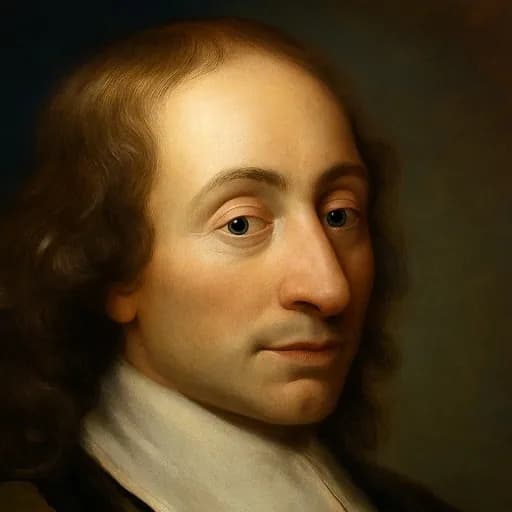
Blaise Pascal
Quotes
The most important affair in life is the choice of a calling; chance decides it. Custom makes men masons, soldiers, slaters. ...We choose our callings according as we hear this or that praised or despised in our childhood, for we naturally love truth and hate folly. ...It is custom then which... constrains nature. But sometimes nature gains the ascendancy, and preserves man's instinct, in spite of all custom, good or bad.
There are different degrees in this aversion to truth; but all may perhaps be said to have it in some degree, because it is inseparable from self-love. It is this false delicacy which makes those who are under the necessity of reproving others choose so many windings and middle courses to avoid offense. They must lessen our faults, appear to excuse them, intersperse praises and evidence of love and esteem. Despite all this, the medicine does not cease to be bitter to self-love. It takes as little as it can, always with disgust, and often with a secret spite against those who administer it. Hence it happens that if any have some interest in being loved by us, they are averse to render us a service which they know to be disagreeable. They treat us as we wish to be treated. We hate the truth, and they hide it from us. We desire flattery, and they flatter us. We like to be deceived, and they deceive us.
A mere trifle consoles us, for a mere trifle distresses us.
Human life is thus only a perpetual illusion; men deceive and flatter each other. No one speaks of us in our presence as he does of us in our absence. Human society is founded on mutual deceit; few friendships would endure if each knew what his friend said of him in his absence, although he then spoke in sincerity and without passion. Man is then only disguise, falsehood, and hypocrisy, both in himself and in regard to others. He does not wish any one to tell him the truth; he avoids telling it to others, and all these dispositions, so removed from justice and reason, have a natural root in his heart.
The Catholic religion does not bind us to confess our sins indiscriminately to everybody; it allows them to remain hidden from all other men save one, to whom she bids us reveal the innermost recesses of our heart, and show ourselves as we are. There is only this one man in the world whom she orders us to undeceive, and she binds him to an inviolable secrecy, which makes this knowledge to him as if it were not. Can we imagine anything more charitable and pleasant? And yet the corruption of man is such that he finds even this law harsh; and it is one of the main reasons which has caused a great part of Europe to rebel against the Church. How unjust and unreasonable is the heart of man, which feels it disagreeable to be obliged to do in regard to one man what in some measure it were right to do to all men! For is it right that we should deceive men?
Without amusement there is no joy; with amusement there is no sadness.
The imagination enlarges little objects so as to fill our souls with a fantastic estimate; and, with rash insolence, it belittles the great to its own measure, as when talking of God.
Nothing is so insufferable to man as to be completely at rest, without passions, without business, without diversion, without study. He then feels his nothingness, his forlornness, his insufficiency, his dependence, his weakness, his emptiness. There will immediately arise from the depth of his heart weariness, gloom, sadness, fretfulness, vexation, despair.
Diversion.—When I have occasionally set myself to consider the different distractions of men, the pains and perils to which they expose themselves at court or in war, whence arise so many quarrels, passions, bold and often bad ventures, etc., I have discovered that all the unhappiness of men arises from one single fact, that they cannot stay quietly in their own chamber. A man who has enough to live on, if he knew how to stay with pleasure at home, would not leave it to go to sea or to besiege a town. A commission in the army would not be bought so dearly, but that it is found insufferable not to budge from the town; and men only seek conversation and entering games, because they cannot remain with pleasure at home.
But on further consideration, when, after finding the cause of all our ills, I have sought to discover the reason of it, I have found that there is one very real reason, namely, the natural poverty of our feeble and mortal condition, so miserable that nothing can comfort us when we think of it closely.
Truly it is an evil to be full of faults; but it is a still greater evil... to be unwilling to recognise them, since that is to add the further fault of a voluntary illusion. We do not like others to deceive us; we do not think it fair that they should be held in higher esteem by us than they deserve; it is not then fair that we should deceive them, and should wish them to esteem us more highly than we deserve.
Men spend their time chasing a ball or a hare; it is the very sport of kings.
Things which have most hold on us, as the concealment of our few possessions, are often a mere nothing. It is a nothing which our imagination magnifies into a mountain.

