
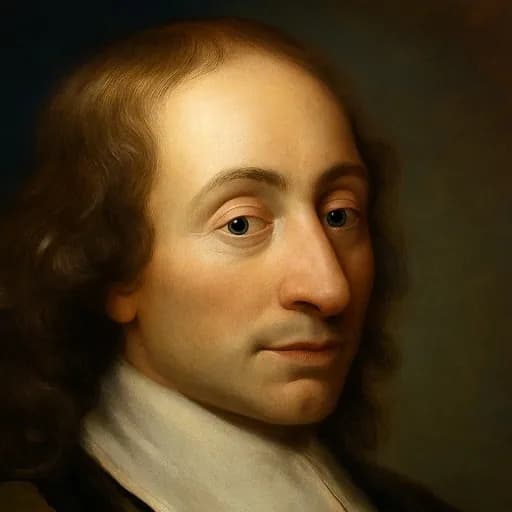
Blaise Pascal
Quotes
That passion may not harm us, let us act as if we had only eight hours to live.
Anyone who found the secret of rejoicing when things go well without being annoyed when they go badly would have found the point.
If our condition were truly happy we should not need to divert ourselves from thinking about it.
How wonderful it is that a thing so evident as the vanity of the world is so little known, that it is a strange and surprising thing to say that it is foolish to seek greatness!
If, at the bottom of their heart, they are troubled at not having more light, let them not disguise the fact; this avowal will not be shameful. The only shame is to have none. Nothing reveals more an extreme weakness of mind than not to know the misery of a godless man. Nothing is more indicative of a bad disposition of heart than not to desire the truth of eternal promises. Nothing is more dastardly than to act with bravado before God. Let them then leave these impieties to those who are sufficiently ill-bred to be really capable of them. Let them at least be honest men, if they cannot be Christians.
We know that there is an infinite, and are ignorant of its nature. As we know it to be false that numbers are finite, it is therefore true that there is an infinity in number. But we do not know what it is. It is false that it is even, it is false that it is odd; for the addition of a unit can make no change in its nature. Yet it is a number, and every number is odd or even (this is certainly true of every finite number). So we may well know that there is a God without knowing what He is. Is there not one substantial truth, seeing there are so many things which are not the truth itself?
Atheists.—What reason have they for saying that we cannot rise from the dead? What is more difficult, to be born or to rise again; that what has never been should be, or that what has been should be again? Is it more difficult to come into existence than to return to it? Habit makes the one appear easy to us; want of habit makes the other impossible. A popular way of thinking! Why cannot a virgin bear a child? Does a hen not lay eggs without a cock? What distinguishes these outwardly from others? And who has told us that the hen may not form the germ as well as the cock?
The charm of fame is so great, that we like every object to which it is attached, even death.
...there are two kinds of people one can call reasonable; those who serve God with all their heart because they know Him, and those who seek Him with all their heart because they do not know Him.
Nothing is so important to man as his own state, nothing is so formidable to him as eternity; and thus it is not natural that there should be men indifferent to the loss of their existence, and to the perils of everlasting suffering. They are quite different with regard to all other things. They are afraid of mere trifles; they foresee them; they feel them. And this same man who spends so many days and nights in rage and despair for the loss of office, or for some imaginary insult to his honor, is the very one who knows without anxiety and without emotion that he will lose all by death. It is a monstrous thing to see in the same heart and at the same time this sensibility to trifles and this strange insensibility to the greatest objects. It is an incomprehensible enchantment, and a supernatural slumber, which indicates as its cause an all-powerful force.
We know ourselves so little, that many think they are about to die when they are well, and many think they are well when they are near death...
When our passion leads us to do something, we forget our duty; for example, we like a book and read it, when we ought to be doing something else. Now, to remind ourselves of our duty, we must set ourselves a task we dislike; we then plead that we have something else to do, and by this means remember our duty.

