
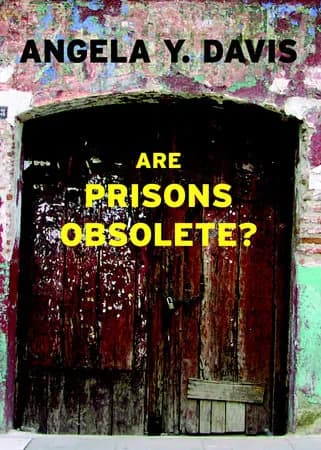
Quotes
The prison has become a black hole inti which the detritus of contemporary capitalism is deposited. Mass imprisonment generates profits as it devours social wealth, and thus it tends to reproduce the very conditions that lead people to prison
Many people are familiar with the campaign to abolish the death penalty. In fact, it has already been abolished in most countries. Even the staunchest advocates of capital punishment acknowledge the fact that the death penalty faces serious challenges. Few people find life without the death penalty difficult to imagine.
The massive prison-building project that began in the 1980s created the means of concentrating and managing what the capitalist system had implicitly declared to be a human surplus. In the meantime, elected officials and the dominant media justified the new draconian sentencing practices, sending more and more people to prison in the frenzied drive to build more and more prisons by arguing that this was the only way to make our communities safe from murderers, rapists, and robbers
Although men constitute the vast majority of prisoners in the world, important aspects of the operation of state punishment are missed if it is assumed that women are marginal and thus undeserving of attention.
The prison industrial complex is much more than the sum of all the jails and prisons in this country. It is a set of symbiotic relationships among correctional communities, transnational corporations, media conglomerates, guards' unions, and legislative and court agendas.
The call to abolish the prison as the dominant form of punishment cannot ignore the extent to which the institution of the prison has stockpiled ideas and practices that are hopefully approaching obsolescence in the larger society, but that retain their ghastly vitality behind prison walls.
Positing decarceration as our overarching strategy, we would try to envision a continuum of alternatives to imprisonment - demilitarization of schools, revitalization of education at all levels, a health system that provides free physical and mental care to all, and a justice system based on reparatuon and reconciliation rather than retribution and vengeance.
The prison has become a black hole into which the detritus of contemporary capitalism is deposited. Mass imprisonment generates profits as it devours social wealth, and thus it tends to reproduce the very conditions that lead people to prison. There are thus real and often quite complicated connections between the deindustrialization of the economy—a process that reached its peak during the 1980s—and the rise of mass imprisonment, which also began to spiral during the Reagan-Bush era. However, the demand for more prisons was represented to the public in simplistic terms. More prisons were needed because there was more crime. Yet many scholars have demonstrated that by the time the prison construction boom began, official crime statistics were already falling.
The most immediate question today is how to prevent as many imprisoned women and men as possible back into what prisoners call "the free world." How can we move to decriminalize drug use and the trade in sexual services? How can we take seriously strategies of restorative rather than elusively punitive justice? Effective alternatives involve both transformation of the techniques for addressing "crime" and of the social and economic conditions that track so many children from poor communities, and especially communities of color, into the juvenile system and then on to prison. The most difficult and urgent challenge today is that of creatively exploring the new terrain of justice, where the prison no longer serves as our major anchor.
Although guard-on-prisoner sexual abuse is not sanctioned as such, the widespread leniency with which offending officers are treated suggests that for women, prison is a space in which the threat of sexualized violence that looms in the larger society is effectively sanctioned as a routine aspect of the landscape of punishment behind prison walls.
Both [the military industrial complex and the prison industrial complex] generate huge profits from processes of social destruction. Precisely that which is advantageous to those corporations, elected officials, and government agents who have obvious stakes in the expansion of these systems begets grief and devastation for poor and racially dominated communities in the United States and throughout the world.
Private prisons are direct sources of profit for the companies that run them, but public prisons have become so thoroughly saturated with the profit-producing products and services of private corporations that the distinction is not as meaningful as one might suspect.
If, however, we shift our attention from the prison, perceived as an isolated institution, to the set of relationships that comprise the prison industrial complex, it may be easier to think about alternatives. In other words, a more complicated framework may yield more options than if we simply attempt to discover a single substitute for the prison system.
It should be remembered that the ancestors of many of today's most ardent liberals could not have imagined life without slavery, life without lynching, life without segregation.
The criminalization of black and Latina women includes persisting images of hypersexuality that serve to justify sexual assaults against them both in and outside of prison.
The prison therefore functions ideologically as an abstract site into which undesirables are deposited, relieving us of the responsibility of thinking about the real issues afflicting those communities from which prisoners are drawn in such disproportionate numbers. This is the ideological work that the prison performs—it relieves us of the responsibility of seriously engaging with the problems of our society, especially those produced by racism and, increasingly, global capitalism.
Because we are so accustomed to talking about race in terms of black and white, we often fail to recognize and contest expressions of racism that target people of color who are not black.
Critiques of the prison industrial complex undertaken by abolitionist activists and scholars are very much linked to critiques of the global persistence of racism. Antiracist and other social justice movements are incomplete with attention to the politics of imprisonment.
Despite the important gains of antiracist social movements over the last half century, racism hides from view within institutional structures, and its most reliable refuge is the prison system.
On the whole, people tend to take prisons for granted. It is difficult to imagine life without them At the same time, there is reluctance to face the realities hidden within them, a fear of thinking about what happens inside them. Thus, the prison is present in our lives and, at the same time, it is absent from our lives. To think about this simultaneous presence and absence is to begin to acknowledge the part played by ideology in shaping the way we interact with our social surroundings. We take prisons for granted but are often afraid to face the realities they produce.
Paradoxically, demands for parity with men's prisons, instead of creating greater educational, vocational, and health opportunities for women prisoners, often have led to more repressive conditions for women. This is not only a consequence of deploying liberal - that is, formalistic - notions of equality, but of, more dangerous, allowing male prisons to function as the punishment norm.
I am not suggesting that the abolition of slavery and the lease system has produced an era of equality and justice. On the contrary, racism surreptitiously defines social and economic structures in ways that are difficult to identify and thus are much more damaging.
The notion of a prison industrial complex insists on understandings of the punishment process that take into account economic and political structures and ideologies, rather than focusing myopically on the individual criminal conduct and efforts to "curb crime."
Particularly in the United States, race has always played a central role in constructing presumptions of criminality.
There are now thirty-three prisons, thirty eight camps, sixteen community correctional facilities, and five tiny prisoner mother facilities in California. In 2002, there were 157,979 people incarcerated in these institutions, including approximately twenty thousand people whom the state holds for immigration violations.
While jails and prisons have been dominant institutions for the control of men, mental institutions have served a similar purpose for women. That is, deviant men have been constructed as criminal, while deviant women have been constructed as insane.
To reiterate, rather than try to imagine one single alternative to the existing system of incarceration, we might envision an array of alternatives that will require radical transformations of many aspects of our society. Alternatives that fail to address racism, male dominance, homophobia, class bias, and other structures of domination will not, in the final analysis, lead to decarceration and will not advance the goal of abolition.
The transformation of imprisoned bodies - and they are in their majority bodies of color - into sources of profit who consume and also often produce all kinds of commodities, devours public funds, which might otherwise be available for social programs such as education, housing, childcare, recreation, and drug programs.
An attempt to create a new conceptual terrain for imagining alternatives to imprisonment involves the ideological work of questioning why "criminals" have been constituted as a class and, indeed, a class of human beings undeserving of the civil and human rights accorded to others. Radical criminologists have long pointed out that the category "lawbreakers" is far greater than the category of individuals who are deemed criminals since, many point out, almost all of us have broken the law at one time or another.

That’s all the quotes.
29 quotes in the collection · come back when we add more