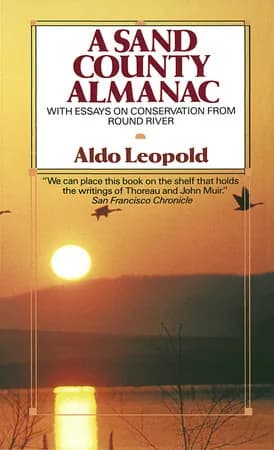
Aldo Leopold
Quotes
All ethics so far evolved rest upon a single premise: that the individual is a member of a community of interdependent parts. … The land ethic simply enlarges the boundaries of the community to include soils, waters, plants, and animals, or collectively: the land. … A land ethic changes the role of Homo sapiens from conqueror of the land-community to plain member and citizen of it. It implies respect for his fellow-members, and also respect for the community as such.
p. 203
The drama of the sky dance is enacted nightly on hundreds of farms, the owners of which sigh for entertainment, but harbor the illusion that it is to be sought in theaters. They live on the land, but not by the land.
p. 34
One swallow does not make a summer, but one skein of geese, cleaving the murk of a March thaw, is the spring.
p. 18
I have read many definitions of what is a conservationist, and written not a few myself, but I suspect that the best one is written not with a pen, but with an axe. It is a matter of what a man thinks about while chopping, or while deciding what to chop. A conservationist is one who is humbly aware that with each stroke he is writing his signature on the face of his land.
p. 68
The modern dogma is comfort at any cost.
p. 71
Hunts differ in flavor, but the reasons are subtle. The sweetest hunts are stolen. To steal a hunt, either go far into the wilderness where no one has been, or else find some undiscovered place under everybody’s nose.
p. 55
How like fish we are: ready, nay eager, to seize upon whatever new thing some wind of circumstance shakes down upon the river of time! … Even so, I think there is some virtue in eagerness, whether its object prove true or false.
p. 39
In farm country, the plover has only two real enemies: the gully and the drainage ditch. Perhaps we shall one day find that these are our enemies, too.
p. 35
During every week from April to September there are, on the average, ten wild plants coming into first bloom. … No man can heed all of these anniversaries; no man can ignore all of them. … Tell me of what plant-birthday a man takes notice, and I shall tell you a good deal about his vocation, his hobbies, his hay fever, and the general level of his ecological education.
p. 44
There are some who can live without wild things, and some who cannot. These essays are the delights and dilemmas of one who cannot.
Conservation is getting nowhere because it is incompatible with our Abrahamic concept of land. We abuse land because we regard it as a commodity belonging to us. When we see land as a community to which we belong, we may begin to use it with love and respect. There is no other way for land to survive the impact of mechanized man, nor for us to reap from it the aesthetic harvest it is capable, under science, of contributing to culture.
What a dull world if we knew all about geese!
p. 20