Quotes about ecology
222 quotes · 87 authors
Quotes
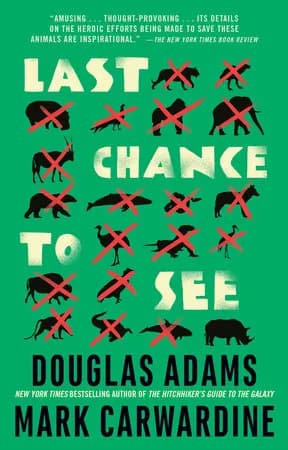
It’s easy to think that as a result of the extinction of the dodo, we are now sadder and wiser, but there’s a lot of evidence to suggest that we are merely sadder and better informed.
p. 205
Wildlife conservation is always a race against time. As zoologists and botanists explore new areas, scrabbling to record the mere existence of species before they become extinct, it is like someone hurrying through a burning library desperately trying to jot down some of the titles of books that will now never be read.
p. 211
But while nature has considerable resilience, there is a limit to how far that resilience can be stretched. No one knows how close to the limit we are getting. The darker it gets, the faster we’re driving.
p. 213
Up until that point [the extinction of the dodo] it hadn’t really clicked with man that an animal could just cease to exist. It was as if we hadn’t realised that if we kill something, it simply won’t be there any more. Ever. As a result of the extinction of the dodo we are sadder and wiser.
p. 204
A planet could take pretty good care of itself, he thought, if people would only leave it alone.
p. 209
The symbol for the Environment Ministry is the eye of a tortoise, for the long view—the understanding that nothing comes cheap or quickly without a hidden cost.
p. 121
Food should come from the place of its origin, and stay there. It shouldn’t spend its time crisscrossing the globe for the sake of profit. We went down that path once, and it brought us to ruin.
p. 93
You wanna know who lost World War Z? Whales. I guess they never really had a chance, not with several million hungry boat people and half the world's navies converted to fishing fleets. [...] So the next time someone tries to tell you about how the true losses of this war are "our innocence" or "part of our humanity"... Whatever, bro. Tell it to the whales.
An idea, a relationship, can go extinct, just like an animal or a plant. The idea in this case is 'nature,' the separate and wild province, the world apart from man to which he adapted, under whose rules he was born and died. In the past, we spoiled and polluted parts of that nature, inflicted environmental 'damage.' But that was like stabbing a man with toothpicks: though it hurt, annoyed, degraded, it did not touch vital organs, block the path of lymph or blood. We never thought that we had wrecked nature. Deep down, we never really thought we could: it was too big and too old; its forces—the wind, the rain, the sun—were too strong, too elemental. But, quite by accident, it turned out that the carbon dioxide and other gases we were producing in our pursuit of a better life... could alter the power of the sun, could increase its heat. And that increase could change the patterns of moisture and dryness, breed storms in new places, breed deserts...We have produced the carbon dioxide—we are ending nature.
p. 41
The greenhouse effect is a more apt name than those who coined it imagined. The carbon dioxide and trace gases act like the panes of glass on a greenhouse—the analogy is accurate. But it's more than that. We have built a greenhouse, 'a human creation' where once there bloomed a sweet and wild garden.
p. 78
Are we not natural creatures? Are we not evolved, too? Surely all the lessons we’ve learned in the past century come to a single point: we have to stop thinking of ourselves as somehow apart from nature, and recognise that we’re inseparable from it.
p. 132
Like living creatures, automobiles expired when their environment became saturated with their own excreta. We ourselves are living creatures. We don't want the same to happen to us.
p. 12