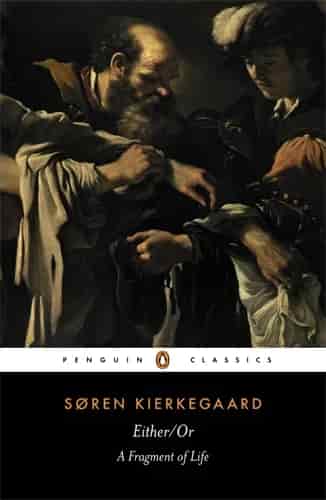
When I was young, I forgot how to laugh in the cave of Trophonius; when I was older, I opened my eyes and… — Søren Kierkegaard
When I was young, I forgot how to laugh in the cave of Trophonius; when I was older, I opened my eyes and beheld reality, at which I began to laugh, and since then, I have not stopped laughing. I saw that the meaning of life was to secure a livelihood, and that its goal was to attain a high position; that love’s rich dream was marriage with an heiress; that friendship’s blessing was help in financial difficulties; that wisdom was what the majority assumed it to be; that enthusiasm consisted in making a speech; that it was courage to risk the loss of ten dollars; that kindness consisted in saying, “You are welcome,” at the dinner table; that piety consisted in going to communion once a year. This I saw, and I laughed.
p. 33Source: Wikiquote · CC BY-SA 4.0

More from this book
As the Pastor puts it, "Therefore, wishing to be in the wrong is an expression of an infinite relationship, and wanting to be in the right, or finding it painful to be in the wrong, is an expression of a finite relationship! Hence, it is upbuilding always to be in the wrong-because only the infinite builds up; the finite does not!"
p. 243
Father in heaven! Teach us to pray rightly so that our hearts may open up to you in prayer and supplication and hide no furtive desire that we know is not acceptable to you, nor any secret fear that you will deny us anything that will truly be for our good, so that the labouring thoughts, the restless mind, the fearful heart may find rest in and through that alone in which and through which it can be found-by always joyfully thanking you as we gladly confess that in relation to you we are always in the wrong. Amen.
p. 341
Anyone who refuses to struggle with actualities acquires phantoms to struggle against.
p. 223