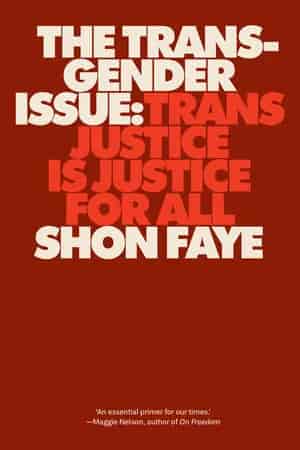
Shon Faye
Quotes
By the end of the 2010s, trans people weren’t the occasional freak show in the pages of a red-top tabloid. Rather, we were in the headlines of almost every major newspaper every single day. We were no longer portrayed as the ridiculous but unthreatening provincial mechanic who was having a ‘sex swap’; now, we were depicted as the proponents of a powerful new ‘ideology’ that was capturing institutions and dominating public life. No longer something to be jeered at, we were instead something to be feared. Soon after the Lucy Meadows inquest, that fleeting opportunity to shed light on the bullying of trans people evaporated. In the intervening years, the press flipped the narrative: it was trans people who were the bullies.
Dysphoria, it should be said, is not a precondition of being trans. According to some research, as many as 10 per cent of those who positively identify as trans men, trans women, non-binary people and various other terms do so without any feelings of dysphoria. It is sometimes incorrectly assumed that trans men and women experience dysphoria and non-binary people do not, when in fact some non-binary people feel themselves to be in great need of medical assistance, and some trans men and women seek none at all. Nevertheless, most trans people experience dysphoria to some degree.
The media agenda with respect to ‘the transgender issue’ is often cynical and unhelpful to the cause of trans justice and liberation. Media coverage of the trans community rarely seems to be driven by a desire to inform and educate the public about the actual issues and challenges facing a group who – as all evidence indicates – are likely to experience severe discrimination throughout their lives. Today, the typical news item on trans people features a debate between a trans advocate on one side and a person with ‘concerns’ on the other – as if both parties were equally affected by the discussion. As trans people face a broken – which in turn leaves them with a desperate lack of support both with their gender and the mental health impacts of the all-too-commonly associated problems of family rejection, bullying, homelessness and unemployment – trans people with any kind of platform or access have tried to focus media reporting on these issues, to no avail. Instead, we are invited on television to debate whether trans people should be allowed to use public toilets. Trans people have been dehumanized, reduced to a talking point or conceptual problem: an ‘issue’ to be discussed and debated endlessly. It turns out that when the media want to talk about trans issues, it means they want to talk about their issues with us, not the challenges facing us.
Historical accounts of gender-variant people who lived in a social role different from the one assigned to them at birth occur in almost every recorded human culture. Sometimes, they lived their lives with the encouragement and licence of their community, which recognized the existence of a third gender – or even several other genders – beyond man and woman; sometimes, their perceived ‘transgression’ of gender norms was understood to merit punishment.
Both trans and cis patients alike have good reason to fear the increasing NHS reliance on the private sector, which drives up costs and introduces a profit motive to healthcare, including gender identity services and surgeries. There is an irony here: it is generally conservatives who make specious claims about money-making schemes preying on trans people, but, in fact, it is conservatives’ own policies of cuts and privatization that actually allow the private sector to behave vampirically.
For those who need them, medical transition and contraception or abortion are – or should be – about the bodily autonomy of the individual, their right to mental well-being and the freedom to carve out their own destiny in defiance of prevailing gender roles. (These roles, should we need reminding, frame women as vessels for reproduction and trans people as threats to the strict separation of male and female sex roles on which patriarchy depends.) Access to abortion and access to trans healthcare are often attacked in similar ways: principally by overstating the incidence and likelihood of regretting either process, and an intense, disproportionate focus in the media on the stories of individuals who do regret their personal choices, as a way to undermine the principle of choice generally. Only about 5 per cent of women experience any degree of regret over their abortion. Multiple studies show the regret rate for gender reassignment surgery is even lower: about 0–2 per cent. Despite this, the fear of regret has become a powerful tool used to justify the delay or withholding of treatment. Little wonder, then, that it is conservative politicians who attack trans healthcare and women’s in the same breath.
Ending homelessness is an important political goal for society as a whole; it is especially important for trans people.
In general, trans people are more likely to have lower incomes and to experience poverty than the wider population. [...] Prejudice persists. It is not just a personal affront, but an economic reality that shapes and limits trans lives.
Given the British media’s recent pained wrangling with the very idea of gender affirmation as a potential ‘slippery slope’, the fact that more straightforward access to medical transition and legal gender recognition was available during the Second World War than is often the case today is astonishing. The mainstream media’s presumption that strict ‘controls’ on transition are and have always been necessary relies on the suppression, and ignorance, of trans medical and legal history.
‘Trans’ [...] is an umbrella term that describes people whose (their personal sense of their own gender) varies from, does not sit comfortably with, or is different from, the biological sex recorded on their birth certificate based on the appearance of their external . The standard view of how sex and gender manifest in the world is as follows. Babies born with observable penises are recorded as male, referred to and raised as boys, and as adults are men; babies born with observable vulvas are recorded as female, referred to and raised as girls, and as adults are women. To be trans is, on some level, to feel that this standardized relationship between one’s genitalia at birth and the assignment of one of two fixed gender identities that are supposed to accurately reflect your feelings about your own body has been interrupted. How the person who experiences this interruption reacts to it can vary hugely – which is why ‘trans’ is a catch-all word for a diverse range of identities and experiences.
The same hormone therapies that today are associated with helping trans people – the use of feminizing oestrogen for trans women and masculinizing testosterone for trans men – were used by endocrinologists in the middle decades of the twentieth century in attempts to ‘cure’ sexual inverts and intersex individuals, by administering hormones to ‘remedy’ the imbalance which caused their ‘disorder’. Homosexual females, for instance, would be treated with oestrogen. Homosexual males were sometimes treated with testosterone and, in some cases, with oestrogen in order to chemically castrate them and prevent them acting on their desires. In the 1950s such hormonal ‘cures’ for sexual and gender variance diminished (largely because they didn’t work), only to be replaced by psychiatric and aversion therapies – the underlying belief in sexual inversion and disorder remained. It must be stressed that the non-consensual, coercive and violent use of hormones to interfere with the bodily integrity of LGBTQ+ people and those born with intersex conditions destroyed countless lives and should be considered a stain on the history of Western medicine. This shared historical experience is also a point of unity for trans people and cisgender lesbians, gays and bisexuals, demonstrating our shared struggle against our pathologizing and mistreatment over the past century and more.
The reality of trans life today is often hidden from public view.