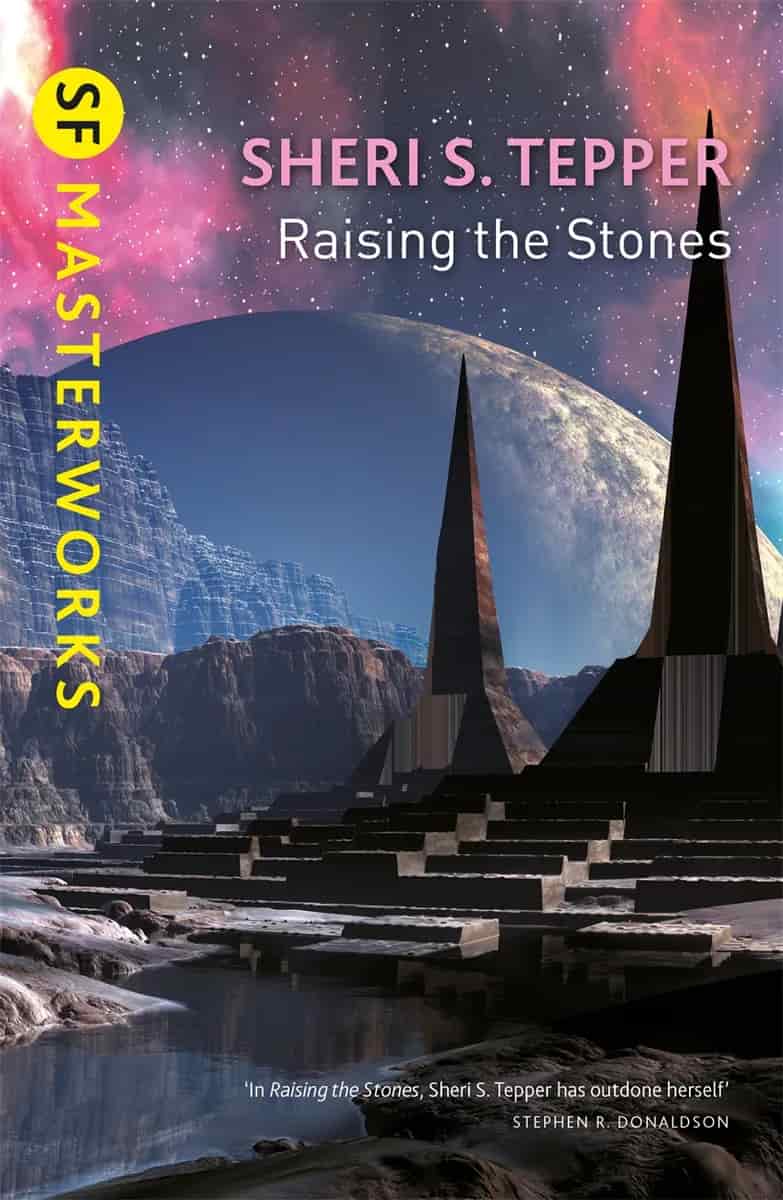
Sheri S. Tepper
Quotes
Sam grew up to be both dutiful and willful, a boy who would say yes to avoid trouble but then do as he pleased.
p. 16
 Raising The Stones
Our lives are made up of many things, not just one. Many answers, not just one. It’s men that want one answer for everything. They’re always making laws, as though they could make one law that would be just in all cases. They can’t. They never have. I think men get derailed, sometime during their growing up. Instead of settling for what’s honest and real and sort of thoughtful, they go off on these quests. They go strutting and crowing, waving their weapons and shouting their battle cries. They say they’re seeking something higher, but it always seems to end in pain, doesn’t it?
p. 468
Raising The StonesThat’s why they become prophets. Why would you want to be one, otherwise? Why would you want to scream your head off and threaten people with death and torture and Hell and make women cover themselves up unless you were hardwired for being crazy? The point is, if somebody’s hardwired and you’re not, the only thing he’ll let you be is a follower. If an ordinary person tries to talk to a hardwired person and be nice to him, it doesn’t do any good. It’s like being nice to a fruit-plucking machine. It’ll pluck out your eyes if you get in the way, no matter how fast you talk or how nice you are. Punishment doesn’t work, and talking to them won’t work, and arguing with them won’t work, any more than arguing with a plucking machine would work.
p. 398
Raising The Stones“Coup markers?” Jep had asked Pirva. “The cause?”
Pirva had not looked up from what she was doing. “The Cause is their society, their religion, their brotherhood,” she had said, the words dripping like acid from her mouth. “It’s a killers’ club. A man gets a coup counter for each Abolitionist or Gharm man, woman, or child he has killed out there in Ahabar or the Three Counties. There are special counters for bombs set off in the three counties, no matter who is killed or mutilated.”
p. 294
Raising The StonesThe prophets trusted no one. Trust had no part in the Cause.
p. 291
Raising The Stones“Why pretend now that you cared?”
“Why not pretend whatever I like if it makes my life easier? We learned that, you see, we Faithful. We learn to say to ourselves whatever we need to say to make the task easy. We learn to say, ‘for God and Voorstod,’ when we blow up some old lady in the toilet or some schoolyard full of children. We wouldn’t necessarily do it for ourselves, you see, but we can do it for God and Voorstod.”
p. 390
Raising The Stones“I think he is a wicked man.”
Sam said doggedly, “Are you so sure he is wicked, Lilla? Perhaps, away from here, he might change.”
“We Gharm have a saying. Perhaps, away from the pond, the frog would grow feathers.”
p. 408
Raising The StonesFor several days they cut, trimmed, and stacked the slender trunks, trying to pick ones that were straight and uniform in size, being careful not to clear-cut any area of the forest, a deed which Jep’s mom would have regarded as only slightly less dishonorable than genocide.
p. 96
Raising The StonesThese men are the kind who would kill their slaves and families rather than let us free them.
p. 327
Raising The Stones“Also, the people who’ve left tended to be those who thought man was more important than other parts of creation, and themselves more important than other men,” Africa mused. “Me-and-my-image devotees. Human fertility worshippers. The kind of people who will happily kill other species to make room for more humans, advocates of the old ‘fill up the world and ruin it’ philosophy.”
p. 466
Raising The Stones“Early on, of course, it was assumed that there were lots of gods who caused various things, and one needed access to them to propitiate them or ask them to undo what some other god had done or, in rarer cases, to say thank you. Since there were lots of them, one always had a god to go to if some other one was acting up. Not a bad state of affairs, really, very much the system Phansure has today. Of course, it carried the seeds of its own destruction, because some of the priests that rose up around the man-gods got carried away with their own greed or need for power.
“So, some of them became prophets, each of them claiming his particular god—or some new one he’d thought up – what is the biggest or the best or the only. Sometimes they said God was all-good or all-powerful or all-something-or-other or even, God knows, all-everything, which inevitably created dualism, because if God was all-everything, why did these contrary things keep happening? This required that man postulate some other force responsible for contrariness, either a sub-god or a bad angel or man himself, just being sinful, and that placed man squarely in the middle of this cosmic battlefield, always been told it was his fault when things went wrong.
“And as long as man was in the middle, nothing could happen but a kind of tug-of-war. Man constantly prayed to God for peace, but peace never happened, so he decided that his god must really want war because the other side was sinful. Man invented and extolled virtues which could only be exemplified under conditions of war, like heroism and gallantry and honor, and he gave himself laurel wreaths or booty or medals for such things, thus rewarding himself for behaving well while sinning. He did it when he was a primitive, and he went on with it after he thought he was civilized.”
p. 106
Raising The StonesIt was her way to start each conversation with an apology, so she could be offended when the apology was accepted.
p. 101
Raising The Stones