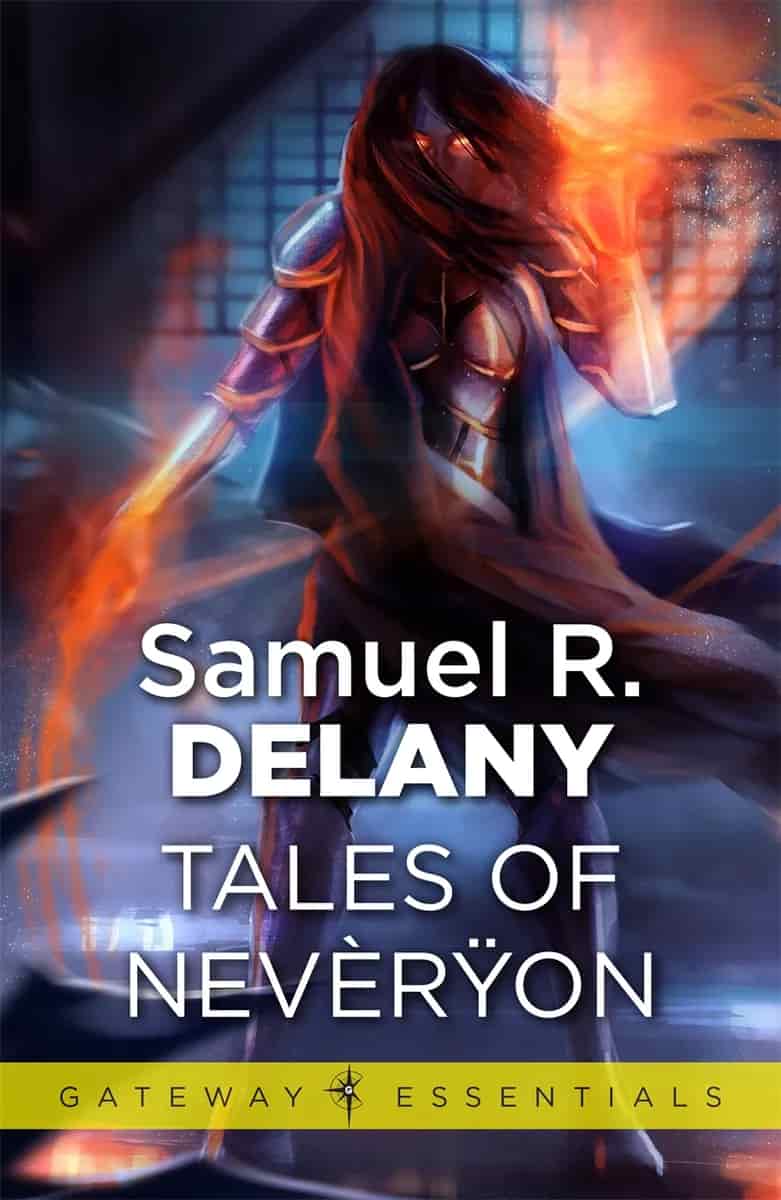
Samuel R. Delany
Quotes
“Ah ha!” the Spike said. “I think we have just gotten down to a gritty—or at least a nitty.”
p. 123
 Triton
You should always tell the truth, she thought, not because one lie leads to another, but rather because one lie could so easily lead you to that terrifying position from which, with just the help of a random dream, you can see, both back and ahead, the morass where truth and falsity are simply, for you, indistinguishable.
p. 329
TritonNevertheless, I still wonder. Each of us, with money, gets further and further away from those moments where the hand pulls the beet root from the soil, shakes the fish from the net into the basket—not to mention the way it separates us from one another, so that when enough money comes between people, they lie apart like parts of a chicken hacked up for stewing.
p. 161
 Tales of Neveryon
“So,” said Raven, “once again tonight we are presented with a mysterious sign and no way to know whether it completes a pattern or destroys one.”
p. 245
Tales of NeveryonTopologically, men and women are identical. Some things are just larger and more developed in one than the other and positioned differently.
p. 266
TritonBut almost as if presenting the image of some ironic answer, the wings flapped against a sudden, high, unfelt breeze, and the beast, here shorn of all fables, rose and rose—for a while—under the night.
p. 245
Tales of NeveryonAnd who’s to say where life ceases and theater begins—
p. 113
TritonAnd of course that is the problem with all truly powerful ideas. And what we have been talking of is certainly that. What it produces is illuminated by it. But applied where it does not pertain, it produces distortions as terrifying as the idea was powerful.
p. 87
Tales of NeveryonChildhood is that time in which we never question the fact that every adult act is not only an autonomous occurrence in the universe, but that it is also filled, packed, overflowing with meaning, whether that meaning works for ill or good, whether the ill or good is or is not comprehended.
Adulthood is that time in which we see that all human actions follow forms, whether well or badly, and it is the perseverance of the forms that is, whether for better or worse, their meaning.
Various cultures make the transition at various ages, which transition period lasts for varying lengths of time, one accomplishing it in a week with careful dances, ancient prayers, and isolate and specified rituals; another, letting it take its own course, offering no help for it, and allowing it to run on frequently for years. But at the center of the changeover there is a period—whether it be a moment’s vision or a year-long suspicion—where the maturing youth sees all adult behavior as merely formal and totally meaningless.
p. 114
Tales of NeveryonYou were beautiful and heartless...in some ways rather a bore. But you have grown up into another over-refined soul of the sort our aristocracy is so good at producing and which produces so little itself save ways to spend unconscionable amounts on castles, clothes, and complex towers to keep comfortable impossible beasts.
p. 214
Tales of NeveryonEveryone in a position of authority is hysterical, and everyone else is pretending to be asleep.
p. 54
TritonThe whole problem, I suppose, is that any time some piece of communication strikes poor Fred, or any of the remaining Beasts, for that matter, as possibly meaningful—or is it meaningless? It’s been explained to me a dozen times and I still can’t get it right—anyway, his religious convictions say he has to either stop it or—barring that—refuse to be a party to it.
p. 113
Triton