


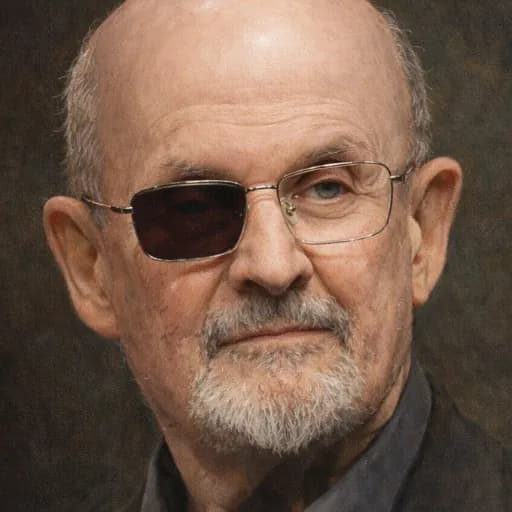
Salman Rushdie
Quotes
"I barely knew them -- they were aliens, after all, visitors from a familiar-sounding elsewhere, slipping into our awareness by an unimaginable route -- and yet I'm profoundly stirred by their loss. I'm trying to work out why that is. In the end I decide it's because although I, we, didn't really know them, they knew us, and whenever someone who knows you disappears, you lose one version of yourself. Yourself as you were seen, as you were judged to be. Lover or enemy, mother or friend, those who know us construct us, and their several knowings slant the different facets of our characters like diamond-cutter's tools. Each such loss is a step leading to the grave, where all versions blend and end."
"The concert was over, the crowd was drifting away, but I stood rooted to the spot, taking photographs. The world was cracking. Ormus and Vina were deep in conversation with the musicians, who were packing up their instruments and shouting at the local stagehands to watch what they were doing. My heart was breaking. While Ormus and Vina chatted to the jazzmen, their hands and bodies were talking to each other. Click, click. I can see you, you two. Click. Peekaboo! Do you know I'm doing this? Are you letting me watch, is that it, even though I'm getting the goods on you, in here, in my little German box of wonders? You don't care any more, is that it? You want it all out in the open. Click. And what about me, Vina? I'll grow up too. He waited for you. Why wouldn't you wait for me? I want to be in that number!"
Children are vessels where adults pour their poison.
It has often been said that Mrs. Gandhi's younger son Sanjay accused his mother of being responsible, through her neglect, for his father's death; and that this gave him an unbreakable hold over her, so that she became incapable of denying him anything.
There was one more serious problem... they failed to notice the immobility of my eyelids... they observed my icy blueness, but there was not the slightest tremor; until Amina took matters into her own hands and reached into the cradle to stroke my eyelids downwards. They closed: my breathing altered, instantly, to the contented rhythms of sleep. After that, for several months, mother and ayah took it in turns to open and close my lids. "He'll learn, Madam," Mary comforted Amina, "He is a good obedient child and he will get the hang of it for sure." I learned: the first lesson of my life: nobody can face the world with his eyes open all the time.
The world, somebody wrote, is the place we prove real by dying in it.
Names, once they are in common use, quickly become mere sounds, their etymology being buried, like so many of the earth's marvels, beneath the dust of habit.
No people whose word for "yesterday" is the same as their word for "tomorrow" can be said to have a firm grip on the time.
"You be respectable, sister," she said, "Me, I'll be alive."
Who what am I? My answer: I am the sum total of everything that went before me, of all I have been seen done, of everything done-to-me. I am everyone everything whose being-in-the-world affected was affected by mine. I am anything that happens after I've gone which would not have happened if I had not come. Nor am I particularly exceptional in this matter; each "I", everyone of the now-six-hundred-million-plus of us, contains a similar multitude. I repeat for the last time: to understand me, you'll have to swallow a world.
There is no magic on earth strong enough to wipe out the legacies of one's parents.
Hell is other people's fantasies: every saga requires at least one descent into Jahannum, and I followed Picture Singh into the inky negritude of the Club, holding an infant son in my arms.


