Robert A. Heinlein
Quotes
To permit irresponsible authority is to sow disaster; to hold a man responsible for anything he does not control is to behave with blind idiocy. The unlimited democracies were unstable because their citizens were not responsible for the fashion in which they exerted their sovereign authority . . . other than through the tragic logic of history. The unique 'poll tax' that we must pay was unheard of. No attempt was made to determine whether a voter was socially responsible to the extent of his literally unlimited authority. If he voted the impossible, the disastrous possible happened instead—and responsibility was then forced on him willy-nilly and destroyed both him and his foundationless temple.
"One last thing. I had a letter from Captain Jelal just before we left. He says that his new legs work fine. But he also told me to tell you that he's got you in mind... And that he expects your names to shine!"
p. 262
There is no worse tyranny than to force a man to pay for what he does not want merely because you think it would be good for him.
I will accept the rules that you feel necessary to your freedom. I am free, no matter what rules surround me. If I find them tolerable, I tolerate them; if I find them too obnoxious, I break them. I am free because I know that I alone am morally responsible for everything I do.
"I told you that 'juvenile delinquent' is a contradiction in terms. 'Delinquent' means 'failing in duty.' But duty is an adult virtue—indeed a juvenile becomes an adult when, and only when, he acquires a knowledge of duty and embraces it as dearer than the self-love he was born with. There never was, there cannot be a 'juvenile delinquent.' But for every juvenile criminal there are always one or more adult delinquents—people of mature years who either do not know their duty, or who, knowing it, fail."
p. 120
Man is what he is, a wild animal with the will to survive, and (so far) the ability, against all competition. Unless one accepts that, anything one says about morals, war, politics—you name it—is nonsense. Correct morals arise from knowing what man is—not what do-gooders and well-meaning old Aunt Nellies would like him to be. The universe will let us know—later—whether or not Man has any "right" to expand through it. In the meantime the M.I. will be in there, on the bounce and swinging, on the side of our own race.
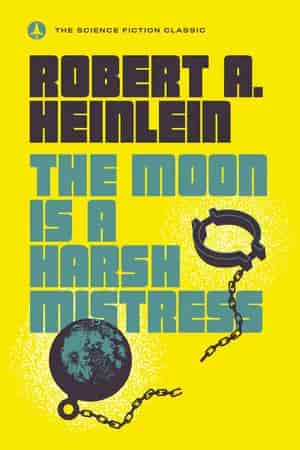
When Mike was installed in Luna, he was pure thinkum, a flexible logic — "High-Optional, Logical, Multi-Evaluating Supervisor, Mark IV, Mod. L" — a HOLMES FOUR. He computed ballistics for pilotless freighters and controlled their catapult. This kept him busy less than one percent of time and Luna Authority never believed in idle hands. They kept hooking hardware into him — decision-action boxes to let him boss other computers, bank on bank of additional memories, more banks of associational neural nets, another tubful of twelve-digit random numbers, a greatly augmented temporary memory. Human brain has around ten-to-the-tenth neurons. By third year Mike had better than one and a half times that number of neuristors.
And woke up.
With national governments in collapse at the end of the XXth century, something had to fill the vacuum, and in many cases it was the returned veterans. They had lost a war, most of them had no jobs, many were sore as could be over the terms of the Treaty of New Delhi, especially the P.O.W. foul-up — and they knew how to fight. But it wasn't revolution; it was more like what happened in Russia in 1917 — the system collapsed; somebody else moved in. The first known case, in Aberdeen, Scotland, was typical. Some veterans got together as vigilantes to stop rioting and looting, hanged a few people (including two veterans) and decided not to let anyone but veterans on their committee. Just arbitrary at first — they trusted each other a bit, they didn't trust anyone else. What started as an emergency measure became constitutional practice in a generation or two. (Pg. 179)
A rational anarchist believes that concepts such as "state" and "society" and "government" have no existence save as physically exemplified in the acts of self-responsible individuals. He believes that it is impossible to shift blame, share blame, distribute blame. . . as blame, guilt, responsibility are matters taking place inside human beings singly and nowhere else. But being rational, he knows that not all individuals hold his evaluations, so he tries to live perfectly in an imperfect world. . . aware that his effort will be less than perfect yet undismayed by self-knowledge of self-failure.
“Er, will your grandmother tell that fib for you?”
“I guess so. Yes, I'm sure she will. She says people have to tell little white fibs or else people couldn’t stand each other. But she says fibs were meant to be used, not abused.”
“She sounds like a sensible person.”
I always get the shakes before a drop. I've had the injections, of course, and hypnotic preparation, and it stands to reason that I can't really be afraid. The ship's psychiatrist has checked my brain waves and asked me silly questions while I was asleep and he tells me that it isn't fear, it isn't anything important — it's just like the trembling of an eager race horse in the starting gate. I couldn't say about that; I've never been a race horse. But the fact is: I'm scared silly, every time.
p. 1
I made a very important discovery at Camp Currie. Happiness consists in getting enough sleep. Just that, nothing more. All the wealthy, unhappy people you've ever met take sleeping pills; Mobile Infantrymen don't need them. Give a cap trooper a bunk and time to sack out in it, and he's as happy as a worm in an apple—asleep.
p. 52