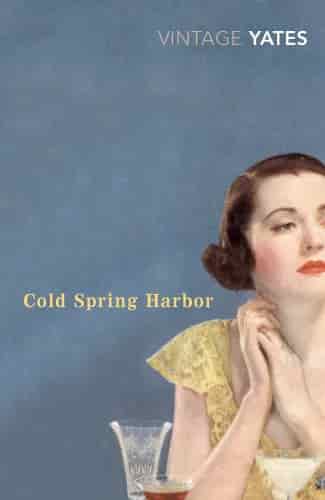
Richard Yates
Quotes
"But this isn't a lecture course. The only way any of us can learn this craft is by saturating ourselves in examples of it, in and out of print, and then trying to put the best of what we've found into our own work."
p. 187
One advantage of the very low lighting in this room, he'd decided, was that it could make almost any girl look like a million dollars.
p. 123
There would probably always be kids like Grove in prep schools: you would find only irritation in trying to help them, or to like them, and you could probably never bring yourself to call them by their first names until ten years later, when they came back to visit the school with their wives.
p. 164
"Well, she's - sweet," he told her. "She's very sweet, and I guess that's part of the trouble. She's like a little girl - is a little girl.
p. 122
"Of course. And isn't that the worst kind of loss? When you don't even realise the value of something until you've thrown it away?"
p. 42
"It's often occurred to me," she said, "that 'friend' is about the most treacherous word in the language."
p. 180
exchanging agreeable remarks for no other purpose than to keep silence from closing in.
p. 286
And he didn't mind at all. Downstairs and outdoors and alone again, back in the trampled dust in front of the place, he pitied the drab supervisor and all her quick, harried, frowning children because none of them looked as though they had anything worth waiting for, tonight or ever.
p. 120
He couldn't help pondering how he would feel if his own father were to die. It was unthinkable: Jock MacKenzie was in the very prime of life, a laughing, sailing, golf- and tennis-playing man who could still defeat his son at arm-wrestling any time he felt like it, and often did. Still, there were heart attacks; there were strokes; there was cancer. Nobody lived forever.
Jock MacKenzie's anger could be terrible, but in his gentle moods there was no finer companion in the world. Every worthwhile thing Steve knew, it seemed, was something he had learned from his father. As a condition of receiving a car on his sixteenth birthday, Steve had been made to memorise the whole of Kipling's "If", which later helped him earn the only "A" he'd ever had in Pop Driscoll's course; and certain lines of that poem, remembered now as they sounded in his father's voice , were enough to fill his eyes with tears.
This Sunday, he promised himself, he would call home and have a good long talk with the old man.
"When you're talking, Steve", Jock MacKenzie had told him once, "and I don't care who it's to or what it's about, the important thing is knowing when to stop. Never say anything that doesn't improve on silence."
p. 85
Rachel became slowly aware now, even while talking and listening to her own voice, that there might well be something universal about the pleasure a grown girl could take in disparaging her mother. Maybe it happened with sons and their fathers, too, or with all grown children and the ever-diminishing presence of parents in their lives; in any case, the knowledge didn't prevent her from pressing on, as if to see how far she would dare to go.
p. 64
And from this distance they all did look like kids - boys and girls from far and wide with their cheap hand luggage and their Army duffel bags, brave entertainers who might travel for years before it occurred to them, or to most of them, that they weren't going anywhere.
p. 176
"It's funny, you know? Distance doesn't matter anymore. It's almost as if geography didn't exist. All you do is doze and float in a pressurised cabin for a while - and it doesn't even matter how long, because time isn't important, either - and before you know it you're in Los Angeles, or London, or Tokyo. Then if you don't happen to like wherever it is you find yourself, you can doze and float again until you find yourself somewhere else."
p. 398