Leafy Quotes
Recently added
The newest book quotes in the Leafy Quotes collection — passages readers have just added, each with its author, book and the page it came from.
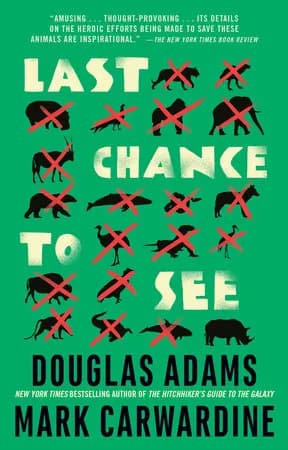
Assumptions are the things you don’t know you’re making, which is why it is so disorienting the first time you take the plug out of a washbasin in Australia and see the water spiraling down the hole the other way around. The very laws of physics are telling you how far you are from home.
p. 143
We talked about how easy it was to make the mistake of anthropomorphising animals, and projecting our own feelings and perceptions on to them, where they were inappropriate and didn’t fit. We simply had no idea what it was like being an extremely large lizard, and neither, for that matter, did the lizard, because it was not self-conscious about being an extremely large lizard, it just got on with the business of being one. To react with revulsion to its behaviour was to make the mistake of applying criteria that are only appropriate to the business of being human. We each make our own accommodation with the world and learn to survive in it in different ways. What works as successful behaviour for us does not work for lizards, and vice versa.
p. 35
I’ve never understood all this fuss people make about the dawn. I’ve seen a few and they’re never as good as the photographs, which have the additional advantage of being things you can look at when you’re in the right frame of mind, which is usually around lunchtime.
p. 135
In conclusion, may I repeat that stigma involves not so much a set of concrete individuals who can be separated into two piles, the stigmatized and the normal, as a pervasive two-role social process in which every individual participates in both roles, at least in some connexions and in some phases of life. The normal and the stigmatized are not persons but rather perspectives. These are generated in social situations during mixed contacts by virtue of the unrealized norms that are likely to play upon the encounter. […] And since interaction roles are involved, not concrete individuals, it should come as no surprise that in many cases he who is stigmatized in one regard nicely exhibits all the normal prejudices held toward those who are stigmatized in another regard.
p. 163
While the stranger is present before us, evidence can arise of his possessing an attribute that makes him different from others... and of a less desirable kind – in the extreme, a person who is quite thoroughly bad, or dangerous, or weak. He is thus reduced in our minds from a whole and usual person to a tainted, discounted one. Such an attribute is a stigma, especially when its discrediting effect is very extensive; sometimes it is also called a failing, a shortcoming, a handicap. It constitutes a special discrepancy between virtual and actual social identity.
The term stigma, then, will be used to refer to an attribute that is deeply discrediting, but it should be seen that a language of relationships, not attributes, is really needed.
p. 12
When we told our guide that we didn’t want to go to all the tourist places, he took us instead to the places where they take tourists who say that they don’t want to go to tourist places. These places are, of course, full of tourists. Which is not to say that we weren’t tourists every bit as much as the others, but it does highlight the irony that everything you go to see is changed by the very action of going to see it, which is the sort of problem which physicists have been wrestling with for most of this century.
p. 22
Society is organized on the principle that any individual who possesses certain social characteristics has a moral right to expect that others will value and treat him in an appropriate way.
p. 13
Sometimes, everyone is right. Not always and not even usually, but once in a while, everyone is right.
p. 41
The degree that the individual maintains a show before others that he himself does not believe, he can come to experience a special kind of alienation from self and a special kind of wariness of others.
p. 229
Knowing that his audiences are capable of forming bad impressions of him, the individual may come to feel ashamed of a well-intentioned honest act merely because the context of its performance provides false impressions that are bad. Feeling this unwarranted shame, he may feel that his feelings can be seen; feeling that he is thus seen, he may feel that his appearance confirms these false conclusions concerning him. He may then add to the precariousness of his position by engaging in just those defensive maneuvers that he would employ were he really guilty. In this way it is possible for all of us to become fleetingly for ourselves the worst person we can imagine that others might imagine us to be.
p. 236
“You're an idiot,” Lucy said. “Just ’cause you don’t understand them don’t mean they’re out to get you.”
p. 265
The self... is not an organic thing that has a specific location, whose fundamental fate is to be born, to mature, to die; it is a dramatic effect arising diffusely from a scene that is presented.
p. 252