Philip K. Dick
Quotes
To save one life, Mr. Tagomi had to take two. The logical, balanced mind cannot make sense of that. A kindly man like Mr. Tagomi could be driven insane by the implications of such reality.
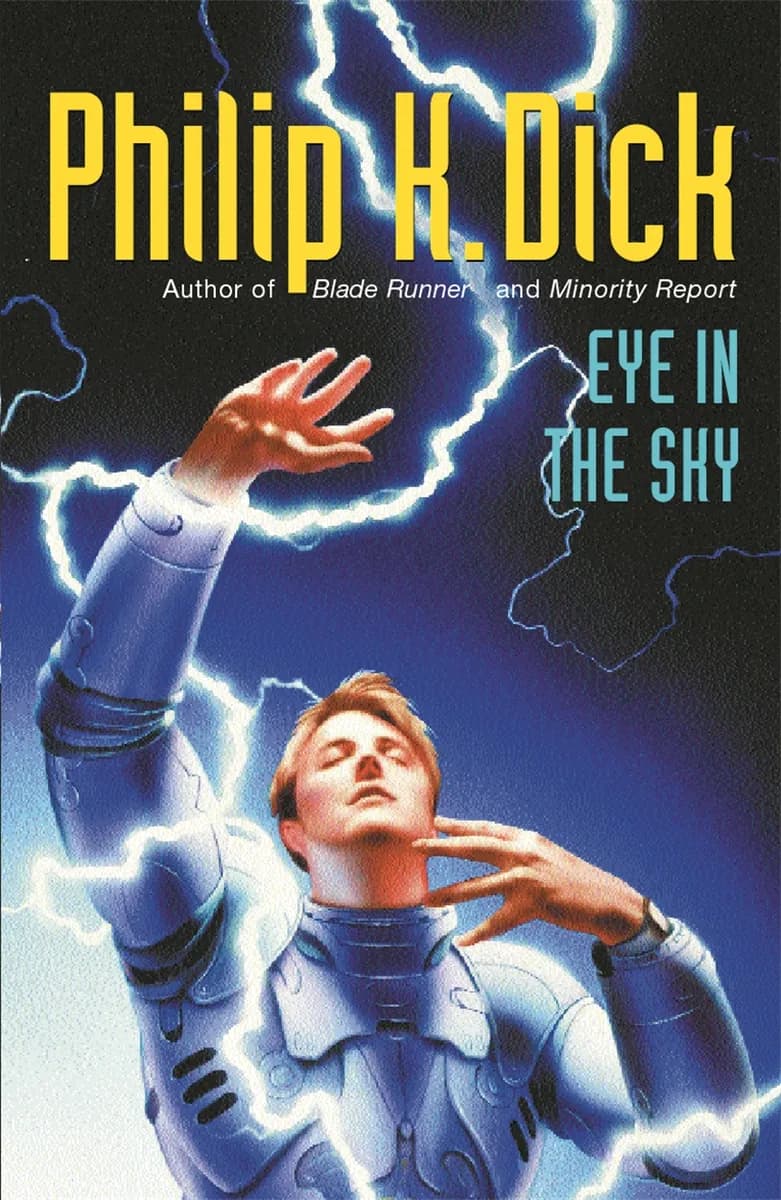
This time, there was no punishment from above. Sighing, Hamilton almost wished there had been; the capricious personality element infuriated him. There was just too little relationship between deed and punishment; the lightning was probably cutting down some totally innocent Cheyennite, on the far side of town.
p. 92
“Time to get up,” he informed her. “Don’t you hear the Almighty bellowing in the living room?”
“What’s he saying?” Marsha murmured crossly.
“Nothing in particular. Repent or suffer eternal damnation. The usual tribal tub-thumping.”
p. 103
In the early twentieth century the problem of production had been solved; after that it was the problem of consumption that plagued society. In the 1950s and '60s, consumer commodities and farm products began to pile up in vast towering mountains all over the Western World. As much as possible was given away — but that threatened to subvert the open market. By 1980, the pro tem solution was to heap up the products and burn them: billions of dollars of worth, week after week.
p. 16
“Why?” Hamilton lashed out suddenly and loudly. “Why the hell did God answer that prayer? Why not some of the others? Why not Bill Laws’s?”
“God approved of your prayer,” Silky said. “After all, it’s up to Him; He has to decide how He feels about it.”
“That’s terrible.”
Silky shrugged. “Maybe so.”
“How can you live with that? You never know what’s going to happen—there’s no order, no logic.” It infuriated him that she did not object, that it seemed natural to her. “We’re helpless; we have to depend on whim. It keeps us from being people—we’re like animals waiting to be fed. Rewarded or punished.”
p. 77
“You know what you can buy at the supermarket?” Laws inquired acidly. “I’ll tell you. Canned burnt offerings.”
“You know what you can buy at the hardware store?” Hamilton answered. “Scales to weigh your soul on.”
“That’s silly,” the blond said petulantly. “A soul doesn’t have any weight.”
“Then,” Hamilton reflected, “you could put one through the U. S. mail for nothing.”
“How many souls,” Laws conjectured ironically, “can be fitted into one stamped envelope? New religious question. Split mankind in half. Warring factions. Blood running in the gutters.”
“Ten,” Hamilton guessed.
“Fourteen,” Laws contradicted.
“Heretic. Baby-murdering monster.”
“Bestial drinker of unpurified blood.”
“Accursed spawn of filth-devouring evil.”
p. 75
“Explain it,” Hamilton muttered. “This place—this bar. Why doesn’t God erase it? If this world operates by moral laws—”
“This bar is necessary to the moral order. This is a sinkpit of corruption and vice, a fleshpot of iniquity. You think salvation can function without damnation? You think virtue can exist without sin? That’s the trouble with you atheists; you don’t grasp the mechanics of evil. Get on the inside and enjoy life, man. If you’re one of the Faithful, you’ve got nothing to worry about.”
“Opportunist.”
“Bet your sweet soul.”
p. 66
“Cats have no souls,” Hamilton said morbidly, watching his tomcat avidly feed. “The most majestic cat in the universe would balance a carrot on his head for a bite of pork liver.”
p. 30
“But what are you supposed to do in a society that’s corrupt? Are you supposed to obey corrupt laws? Is it a crime to break a law that’s a rotten law, or an oath that’s rotten?
“It’s a crime,” Cartwright admitted slowly. “But it may be the right thing to do.”
“In a society of criminals,” Shaeffer offered, “the innocent man goes to jail.”
“Who decides when the society is made up of criminals? Benteley demanded. “How do you know when your society has gone wrong? How do you know when it’s right to stop obeying the laws?”
“You just know,” Rita O'Neill said fiercely.
p. 156
Skill is a function of chance. It's an intuitive best-use of chance situations.
p. 60
I'm a strange person. Sometimes I hardly know what I'm going to do or say next. Sometimes I seem a stranger to myself. Sometimes what I do surprises me and I can't understand why I do it.
“We should celebrate,” Rita said.
“Yes. I'm where I wanted to be.” Benteley sipped the remains of his drink. “Working for the Directorate. Sworn in to the Quizmaster. That’s what I set out for, that day. It seems like a long time ago. Well, I've finally arrived.” He gazed down at his glass and was silent.
“How do you feel?”
“Not much different.”
p. 176