Noam Chomsky
Quotes
There is a new and highly regarded literary genre inquiring into the cultural defects that keep us from responding properly to the crimes of others. An interesting question no doubt, though by any reasonably standard it ranks well below a different one: Why do we persist in or crimes, either directly or through crucial support for murderous clients? It is constructive to ask how often, or how accurately, one finds reference to Turkey, Colombia, East Timor, and many contemporary literature on the flaws in our character. There is much self-congratulation about the new "ruling ideology" in the moral universe of the enlightened states, grounded in the principal that "all states have a responsibility, to protect their citizens' if their leaders are unable or unwilling to do so, they render their countries liable to military intervention = authorized by the Security Council or, failing that (as in the case of Kosovo), by individual countries in 'conscience-shocking situations'" Atrocities comparable to or much worse than anything charged to Milosevic in Kosovo before the NATO bombing were not "conscience-shocking" when responsibility traced back home, as it often did - and even when the crimes took place within, not just near, the borders of NATO.
Let us turn now to the most elementary principle of just war theory, universality. Those who cannot accept this principle should have the decency to keep silent about matters of right and wrong, or just war. If we can rise to this level, some obvious questions arise: for example, have Cuba and Nicaragua been entitled to set off bombs in Washington, New York, and Miami in self-defense against ongoing terrorist attack? Particularly so when the perpetrators are well known and act with complete impunity, sometimes in brazen defiance of the highest international authorities, so that the cases are far clearer than Afghanistan? If not, why not?
The final years of the millennium witnessed a display of exuberant self-adulation that may even have surpassed its no-too-glorious predecessors, with awed acclaim for an "idealistic new world bent on ending inhumanity," dedicated to "principles and values" for the first time in history. An era of enlightenment and benevolence was upon us, in which the civilized nations, led by the United States, then "at the height of its glory, " acted out of "altruism" and "moral fervor" in pursuit of exalted ideals.
Two hundred years ago Rousseau denounced the sophistic politicians and intellectuals “who search for ways to obscure the fact,” so he maintained, “that the essential and the defining property of man is his freedom. They attribute to man a natural inclination to servitude, without thinking that it is the same for freedom as for innocence and virtue. Their value is felt only as long as one enjoys them oneself, and the taste for them is lost as soon as one has lost them.” As proof of this doctrine he refers to the marvels done by all free peoples to guard themselves from oppression. “True” he says “those who have abandoned the life of a free man do nothing but boast incessantly of the peace, the repose they enjoy in their chains. But when I see the others sacrifice pleasures, repose, wealth, power and life itself for the preservation of this sole good which is so disdained by those who have lost it, when I see multitudes of entirely naked savages scorn European voluptuousness and endure hunger, fire, the sword and death to preserve only their independence, I feel it does not behoove slaves to reason about freedom.” A comment to which we can perhaps give a contemporary interpretation.
p. 136
And it taught a lesson: State propaganda, when supported by the educated classes and when no deviation is permitted from it, can have a big effect. It was a lesson learned by Hitler and many others, and it has been pursued to this day.
Let's begin with the first modern (U.S.) government propaganda operation. That was under the Woodrow Wilson Administration. Woodrow Wilson was elected President in 1916 on the platform "Peace Without Victory." That was right in the middle of the World War I. The population was extremely pacifistic and saw no reason to become involved in a European war. The Wilson administration was actually committed to war and had to do something about it. They established a government propaganda commission, called the Creel Commission which succeeded, within six months, in turning a pacifist population into a hysterical, warmongering population which wanted to destroy everything German, tear the Germans limb from limb, go to war and save the world.
Unfortunately, you can't vote the rascals out, because you never voted them in, in the first place. The corporate executives and the corporation lawyers and so on who overwhelmingly staff the executive, assisted increasingly by a university based mandarin class, remain in power no matter whom you elect.
p. 140
Roughly speaking, I think it's accurate to say that a corporate elite of managers and owners governs the economy and the political system as well, at least in very large measure. The people, so-called, do exercise an occasional choice among those who Marx once called "the rival factions and adventurers of the ruling class."
p. 146
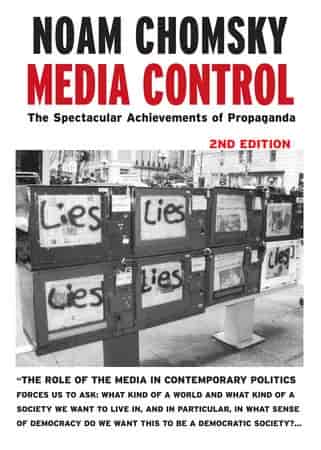
The role of the media in contemporary politics forces us to ask what kind of a world and what kind of a society we want to live in, and in particular in what sense of democracy do we want this to be a democratic society? Let me begin by counter-posing two different conceptions of democracy.
The picture of the world that's presented to the public has only the remotest relation to reality. The truth of the matter is buried under edifice after edifice of lies upon lies.
The issue is whether we want to live in a free society or whether we want to live under what amounts to a form of self-imposed totalitarianism... admiring with awe the leader who saved them from destruction, while the educated masses goose-step on command and repeat the slogans they're supposed to repeat and the society deteriorates at home. We end up serving as a mercenary enforcer state, hoping that others are going to pay us to smash up the world.
The progressive intellectuals, people of the John Dewey circle ... took great pride, as you can see from their own writings at the time, in having shown that what they called the "more intelligent members of the community," namely, themselves, were able to drive a reluctant population into a war by terrifying them and eliciting jingoist fanaticism.